






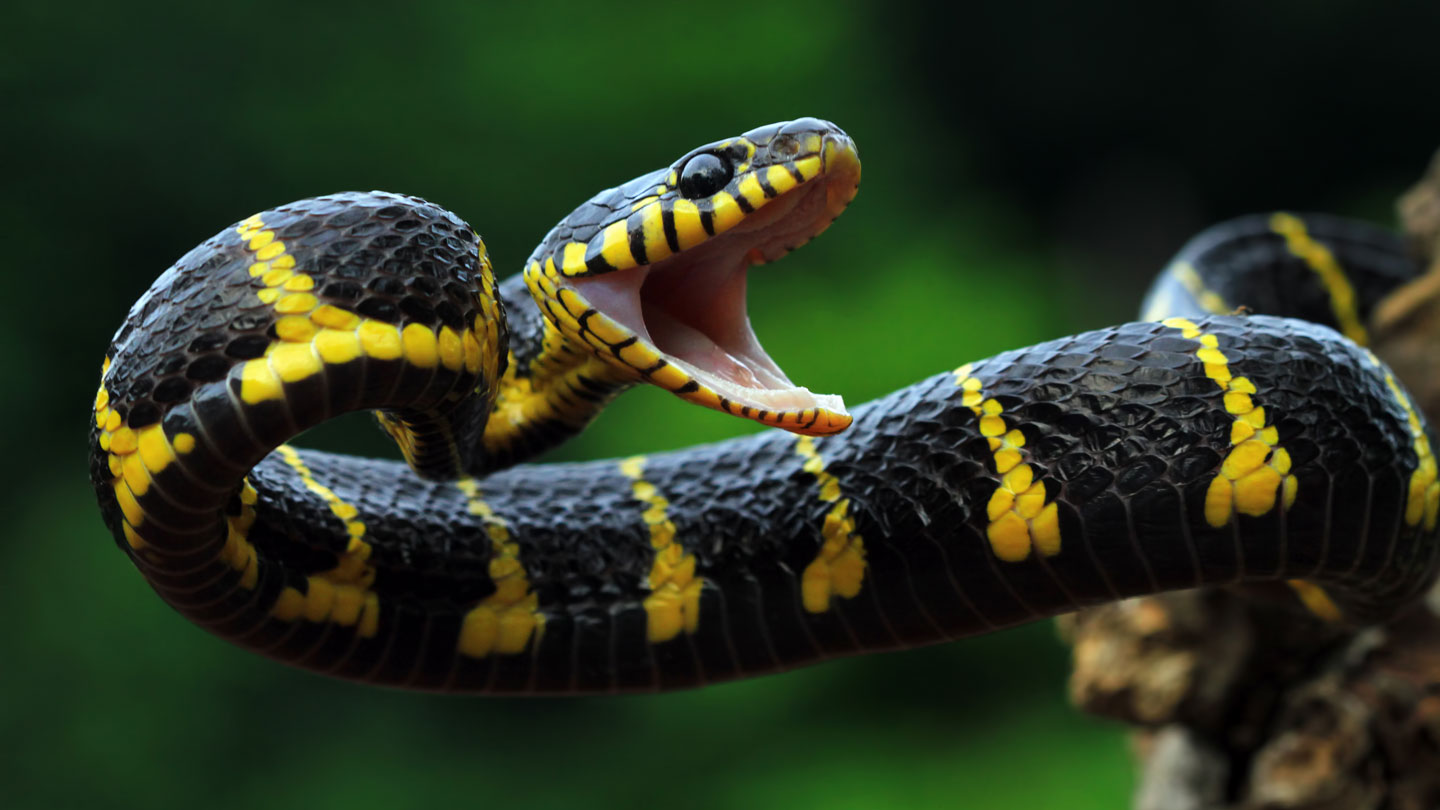
Snakes would do great on Survivor. These animals can last weeks — even months — without food. A couple of recently discovered genetic changes may help.
Certain snakes and some other reptiles lack the gene encoding ghrelin, commonly known as the hunger hormone, researchers report in the Feb. 1 Open Biology. The gene encoding an essential enzyme that activates ghrelin is missing too. But ghrelin’s complicated relationship with hunger and its presence in other reptiles that can also withstand long fasts make the trend hard to interpret.
The researchers’ findings are “striking,” says Todd Castoe, an evolutionary geneticist at the University of Texas at Arlington who was not involved in the work. Many scientists, including himself, had missed the “really cool pattern.”
Evolutionary geneticist Rui Pinto and colleagues stumbled on the discovery when comparing the genomes of 112 reptile species, including snakes, crocodiles and chameleons, which they obtained from a public database. Genes for ghrelin and its activating enzyme were absent in 32 snake species. Surprisingly, the researchers also observed this pattern in some species of chameleons and lizards called toadhead agamas, which eat quite regularly. On the other hand, crocodiles, which can go more than a year without food — even outlasting snakes — still have both genes.
Snakes’ lack of ghrelin may have nothing to do with hunger, says Pinto, of the Interdisciplinary Centre of Marine and Environmental Research in Porto, Portugal. Other studies show that mice lacking ghrelin experience no change in appetite or food intake. And in mice and humans, levels of the key activating enzyme and ghrelin’s active form rise after a meal. If ghrelin’s main function is to stimulate hunger, why would its activity surge after the sensation has been sated?
To Pinto, this suggests that the absence of ghrelin in snakes probably has more to do with metabolism than hunger. Researchers have also linked ghrelin to the regulation of fat storage and response to insulin. Maybe snakes’ metabolism is just so different from mammals’ that they have no need for ghrelin, Pinto says.
Other experts caution against overemphasizing ghrelin’s importance for metabolism. Like all hormones involved in appetite and satiety, ghrelin has metabolic effects, but there’s no evidence those effects are profound, says Tobias Wang, a zoophysiologist at Aarhus University in Denmark.
Study author Rute Fonseca, an evolutionary geneticist at the University of Copenhagen, acknowledges that the analyses that she and her colleagues performed are not meant to tell a complete story about ghrelin’s functions.
Understanding ghrelin’s many roles and how its absence impacts different animals will require more experiments. For example, Wang is curious about what will happen when researchers delete the ghrelin gene in crocodiles or give the hormone to snakes.
Castoe says that such studies might reveal a thing or two about human metabolic disorders such as diabetes and obesity along the way. “I think there’s a lot more cool stories that we will see come out of this.”
Read the full article here