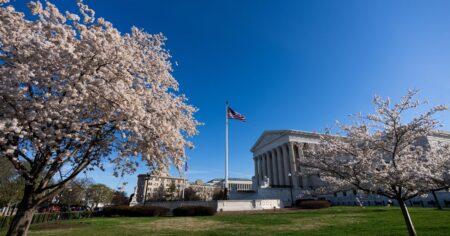
Washington — The Supreme Court heard arguments Wednesday over the legality of President Trump’s executive order that seeks to end birthright citizenship, a case that will test one of the cornerstones of his immigration agenda.
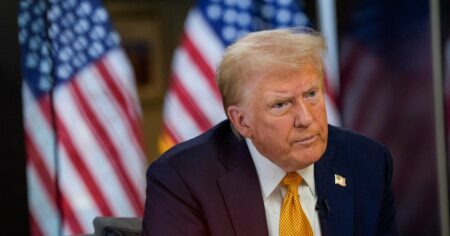
Mr. Trump attended the first part of the arguments in person, becoming the first sitting president to do so.
The question in the case, known as Trump v. Barbara, is whether Mr. Trump’s birthright citizenship order complies with the 14th Amendment’s Citizenship Clause and federal immigration law enacted in 1952. Mr. Trump issued the executive order on the first day of his second term as part of his plans for a sweeping immigration crackdown, but lower courts have blocked it from taking effect.
The 14th Amendment’s Citizenship Clause was adopted after the Civil War and aimed to disavow the Supreme Court’s infamous Dred Scott decision. It states that “all persons born or naturalized in the United States and subject to the jurisdiction thereof, are citizens of the United States and of the state wherein they reside.” Congress codified that language in the Nationality Act in 1940 and again in the Immigration and Nationality Act in 1952.
The Citizenship Clause has been understood for more than 100 years to broadly confer citizenship to nearly all babies born on U.S. soil, with few exceptions. But Mr. Trump’s executive order embraces a narrower view and seeks to deny citizenship to children born to parents who are in the country illegally or temporarily, such as those on student or work visas, or who have been granted certain deportation protections.
The legal case
The legal fight before the Supreme Court arose last July, when three plaintiffs with children who would be impacted by the president’s executive order filed a class-action lawsuit challenging its legality and seeking to block it.
U.S. District Judge Joseph Laplante ruled in their favor, and the Supreme Court in December agreed to bypass the appeals court and move straight to reviewing the legality of Mr. Trump’s measure. The high court had considered last year a different case involving the president’s birthright citizenship policy, but the issue there centered on judges’ ability to issue nationwide injunctions and not the legal merits of the measure itself.
In defending Mr. Trump’s executive order, Solicitor General D. John Sauer has argued in court filings that the 14th Amendment was adopted to grant citizenship to freed slaves and their children, not to babies whose parents are undocumented or in the U.S. temporarily.
He said that since the mid-1900s, parts of the executive branch have “misread” the 14th Amendment as granting citizenship to nearly all babies born in the U.S. As a result, American citizenship has been conferred on hundreds of thousands of people who do not qualify for it, the solicitor general claimed.
“That misinterpretation has, in turn, powerfully incentivized illegal entry into the United States and encouraged ‘birth tourists’ to travel to the United States solely to acquire citizenship for their children,” Sauer wrote.
The president, he said, is now seeking to correct that “misreading.”
“Birthright citizenship for children of illegal and transient aliens degrades the meaning and value of American citizenship,” Sauer said.
But lawyers for the American Civil Liberties Union, which is representing the plaintiffs, said the 14th Amendment guarantees citizenship based on birth in the U.S., not their parents’ nationality, immigration status or domicile.
“For generations, all three branches of the U.S. government and the American people have understood, applied, and relied on that constitutional bedrock — embodying our American values of equality and opportunity and contributing to the thriving of our Nation,” they wrote in court filings.
A key question for the Supreme Court will be how it interprets the phrase “subject to the jurisdiction thereof.”
The Trump administration argued that only those who are “completely subject” to the country’s political jurisdiction — meaning those who owe “direct and immediate allegiance” to the U.S. and may claim its protection — are guaranteed citizenship. Children born to undocumented immigrants or temporary residents cannot meet that standard, Sauer said in court filings.
But lawyers for the plaintiffs said that “subject to the jurisdiction” means subject to U.S. laws. The 14th Amendment, they wrote in filings, recognizes only a narrow set of exceptions for the children of diplomats and invading enemies, as well as babies born into Native American tribes.
“The government is asking for nothing less than a remaking of our Nation’s constitutional foundations,” lawyers who oppose the executive order wrote. “The Order may be formally prospective, applying to tens of thousands of children born every month, and devastating families around the country. But worse yet, the government’s baseless arguments — if accepted — would cast a shadow over the citizenship of millions upon millions of Americans, going back generations.”
The Supreme Court considered the meaning of the Citizenship Clause in 1898, in a case involving a man named Wong Kim Ark who was born in San Francisco to parents who were Chinese citizens but resided in the U.S.
After returning from a visit to China in 1895, Wong Kim Ark was denied entry back into the U.S. on the grounds that he was not a citizen and therefore barred from coming into the country under the Chinese Exclusion Acts. But in a 6-2 decision, the Supreme Court ruled that because Wong Kim Ark was born in the U.S., the 14th Amendment guaranteed him citizenship.
Pointing to that decision, Mr. Trump’s administration has argued that the clause was originally understood to extend citizenship to the children of U.S. citizens and foreign nationals with a “permanent domicil and residence” in the country. Sauer noted that in that ruling more than 125 years ago, the high court referenced Wong Kim Ark’s parents as permanent residents of the U.S. several times in its opinion.
But the ACLU and opponents of Mr. Trump’s executive order claimed the president is attempting to rewrite settled law. The framers of the 14th Amendment enshrined the English common-law rule of citizenship by birth in the Constitution, and that understanding was cemented by the Supreme Court in the Wong Kim Ark case, they said.
The plaintiffs also rejected the administration’s assertion that the Citizenship Clause requires parents to be permanent residents. Instead, if the framers of the 14th Amendment wanted to impose a so-called domicile requirement, they would’ve said so, ACLU lawyers said.
“Birthright citizenship is foundational to who we are as a Nation,” they wrote. “Wong Kim Ark is one of the most important decisions in our history, and its vindication of the Clause stands as a cornerstone of modern American society. Our entire Nation has relied on the decision in determining citizenship and thus eligibility for countless rights, obligations, and benefits.”
More than 250,000 babies born each year would be impacted by Mr. Trump’s executive order, according to the Migration Policy Institute and Penn State’s Population Research Institute. The Trump administration has said that the directive is prospective, and federal agencies are directed not to issue citizenship documents for babies born more than 30 days after the policy takes effect.
A decision from the Supreme Court is expected by late June or early July.
Read the full article here