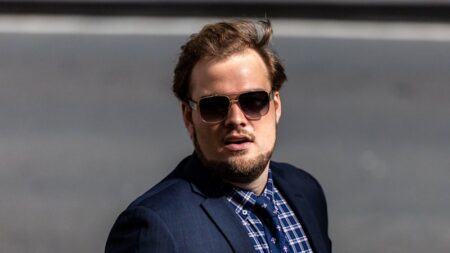






Millionaire Sydney property mogul and suspended cosmetic surgeon Jerry Schwartz has been found guilty of professional misconduct in a major blow to his years-long campaign to return to treating patients.
Schwartz is suspended from practising in Australia and has had multiple restrictions placed on his medical and surgical practice since 2013, including conditions enforced in 2017 preventing him from giving conscious sedation to patients.
In a decision published last week, the NSW Civil and Administrative Tribunal (NCAT) found Schwartz breached these conditions by giving fentanyl to eight patients receiving cosmetic procedures between 2019 and 2021.
Schwartz was also found to have failed to meet professional standards in several other cases, including one where he mistakenly advised a patient their skin cancer “won’t spread”, and another where he advised his staff to write his signature on a patient’s medical form.
Schwartz was found to have inappropriately treated family members, an employee, and himself, including by self-prescribing sleeping pills on 15 occasions and by twice injecting the muscle relaxant Dysport into his forehead. NSW Medical Council’s guidelines prevent doctors from treating themselves and those close to them “whenever possible”.
The tribunal found these breaches, taken together, were serious enough to justify suspension or cancellation of Schwartz’s registration.
Schwartz argued in a September hearing that giving patients fentanyl could not be considered “conscious sedation” and that authorities had failed to impose conditions that were clear and unambiguous.
The tribunal found these arguments had no merit and his repeated use of fentanyl despite the restrictions was “particularly serious”.
“When a practitioner is given the opportunity to continue to practise with conditions imposed upon his registration, it is on the basis that the imposition of those conditions will be sufficient to protect public safety,” the tribunal said. “We find that the practitioner (Schwartz) is disingenuous in making those assertions and that he knew, by using fentanyl, he was involving himself in the conscious sedation of patients.”
The tribunal found “considerable difficulty in generally accepting” Schwartz’s evidence due to his poor record-keeping and conflicting evidence.
“We do not accept any uncorroborated assertions or opinions by [Schwartz] unless they are uncontroversial, inherently likely or accompanied by corroborative evidence,” the decision said.
In a statement to this masthead, Schwartz said he would be appealing the decision “because it is arguable in fact and has tones of victimisation”.
“The medical administrators have been looking for reasons to single me out for over 15 years and despite the intense scrutiny, they do not have serious grounds for their findings,” he said. “There are so many urgent issues in the medical sector that you do have to wonder whether all the time they take to try and get rid of good doctors, rather than concentrating on enhancing services for patients, is justified.”
Schwartz is one of Sydney’s wealthiest men, estimated by The Australian to be worth $667 million after inheriting the hotel empire built by his parents, Hungarian World War II migrants Bela and Eve Schwartz.
In 2013, a NSW coroner found Schwartz had acted inappropriately in filling out his own mother’s death certificate, and was not justified in listing complications relating to lung cancer as the cause of death.
Coroner Mary Jerram said Schwartz’s ex-partner had claimed to police that, after initially claiming his mother had died by suicide, Schwartz had confessed to killing her and her best friend, Magda Wales.
Schwartz denied the allegations and Jerram did not find sufficient evidence to determine the cause of death or pursue criminal charges. Jerram did not fully accept the stories of either Schwartz or his ex-partner.
The family company has grown to 14 hotels including the Sofitel in Darling Harbour, the Mercure Hotel Sydney, two Ibis and two Rydges hotels in Sydney’s CBD.
Separately from the NCAT case, Schwartz’s company was forced to recall and destroy its Dr Schwartz Hand Sanitiser, a complimentary gift to hotel guests, after a person at Paradise Resort on the Gold Coast ingested two 60 millilitre bottles of the product and suffered acute methanol poisoning. The person was treated in hospital and has since been discharged.
The Australian Competition and Consumer Commission (ACCC) issued a recall after Queensland Health’s laboratory tested samples of the hand sanitiser and found that it contained a high concentration of methanol, a Queensland Health spokesperson said.
High concentrations of methanol can cause serious and irreversible injuries or death if ingested, and are banned in alcohol-based hand sanitiser and other consumer products.
Schwartz said the company had imported the product to help protect guests from COVID-19 but, by 2025, it was only being given to guests at the Gold Coast hotel.
“There were no issues with the sanitiser until a guest consumed two small bottles of it, contrary to the label instructions,” he said. “The remaining hand sanitisers have been destroyed.”
Start the day with a summary of the day’s most important and interesting stories, analysis and insights. Sign up for our Morning Edition newsletter.


From our partners
Read the full article here