





The Bank of Canada says it’s staying “cautious” heading into 2026 as uncertainty remains high with the global trade war, tariffs and a trade deal with the U.S. set for review next month.
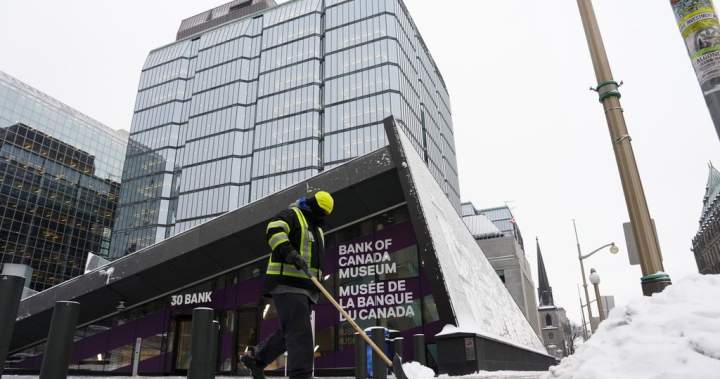
On Tuesday, the Bank of Canada released its written summary of deliberations from the last rate announcement.
This comes after the Bank opted to leave borrowing rates alone earlier in December, and after cutting its benchmark rate by a total of one per cent over the course of four meetings in 2025.
Although there were several areas of caution, the Bank said Canada’s economy was doing somewhat better than expected overall.
“Members agreed the Canadian economy was showing signs of resilience after a year of trade upheaval, but uncertainty remained high,” said the Bank of Canada.
“They would remain cautious in interpreting incoming data given recent volatility and would be prepared to react if their outlook changed materially.”
The trade war began in March, when U.S. President Donald Trump imposed tariffs on goods and services from virtually all countries, including Canada.
Although the terms outlined in the Canada United-States Mexico Agreement, or CUSMA, meant the majority of Canada’s exports would be free of tariffs, the duties imposed on critical sectors like steel, aluminum, lumber, automotive and others meant GDP was being impacted.
Trade policy remains a critical piece of Canada’s economy heading into 2026, as the current CUSMA is set for review.
If a renewed trade deal continues to see most, if not all goods remain free of tariffs, then the Bank sees the economy growing, albeit slowly.
However, if CUSMA expires with no new deal in place or more tariffs are imposed on Canadian goods, then the economy could tilt in the opposite direction.


Get breaking National news
For news impacting Canada and around the world, sign up for breaking news alerts delivered directly to you when they happen.
“Members agreed that the upcoming review of the Canada-United States-Mexico Agreement (CUSMA) was a significant risk. The uncertainty leading up to and during negotiations would likely weigh on business investment,” said the Bank of Canada.
“A worst-case scenario involving the dissolution of CUSMA and higher tariffs would be very damaging to the Canadian economy.”
Gross domestic product, or GDP, measures the total value of all goods and services produced in an economy like Canada’s in a given period.
In the three months spanning from March through May, Canada’s GDP fell by a total of 1.8 per cent. Two back-to-back quarters, or a six-month period of negative GDP meets the technical definition of a recession, but the third quarter saw a rebound.
“After declining by 1.8 per cent in the second quarter, GDP grew by 2.6 per cent in the third quarter, which was stronger than expected,” said the Bank of Canada.
The Bank also signalled that the current fourth quarter, October through December, will likely see another period of weaker economic activity, leading into a slightly positive first quarter of 2026.
“They (governing members) expected fourth-quarter GDP to be soft, with increases in consumption, housing activity and government spending offsetting weakness in business investment and net exports,” said the Bank of Canada.
“GDP would expand at a moderate pace in 2026 and inflation would remain close to the two per cent target.”
The labour market was an area where the Bank showed some optimism, although with some caveats.
The November Labour Force Survey from Statistics Canada marked the third straight month of employment growth, and the unemployment rate fell from 7.1 to 6.5 per cent. However, most of the new jobs were part-time and job vacancies remain low, as businesses weren’t as eager to hire new workers.
“Members were encouraged by the job gains reported in the Labour Force Survey for November. While this was a sign the labour market was improving, a broader set of indicators showed a mixed picture,” said the Bank of Canada.
“Governing Council members noted that much of the hiring over the past three months was in part-time jobs. They also noted that vacancies were low and that surveys of businesses indicated that hiring intentions were subdued.”
Inflation is also a key area of focus for the Bank of Canada, and although the high cost of living in Canada continues to be a major issue for so many Canadians, the Bank says prices have remained somewhat stable in 2025.
The summary released Tuesday outlines how governing members at the Bank expect the Consumer Price Index, or CPI, to “rise slightly” over the next few months, but will still stay close to the two per cent target.
This means that even though prices now may be higher than many Canadians can afford, especially for essentials like food, the Bank of Canada doesn’t expect prices to rise much more than what has been seen in recent months.
Gov. Tiff Macklem at the Bank of Canada acknowledged at the last rate announcement in December that although inflation has come down, “prices have not.”
A separate report from the Bank of Canada suggests the best way to solve the affordability crisis is not to find ways to lower prices, but instead to raise the income of Canadians so they can afford the current cost of living. To do this, the Bank adds that Canada needs to increase its economic productivity.
The Bank also said with the upcoming changes to the CUSMA that fiscal and industrial policy, like with the federal budget, “were appropriate tools to address this structural transition,” but that any positive results from these policies likely won’t happen overnight.
“The federal budget included measures aimed at increasing public and private investment, but members agreed it will take some time for the impact of these measures to be fully realized,” said the Bank of Canada.
For borrowers, or those who expect to borrow money for things like a mortgage or car loan in 2026, the Bank of Canada said because of “the high level of uncertainty,” it wasn’t sure if the next interest rate move would be a cut or a hike.
“Members agreed that while the current policy rate was at about the right level in the current situation, it was difficult to predict when and in which direction the next change in the policy rate would be,” said the Bank of Canada, adding that if needed, it is “prepared to respond.”
Read the full article here