



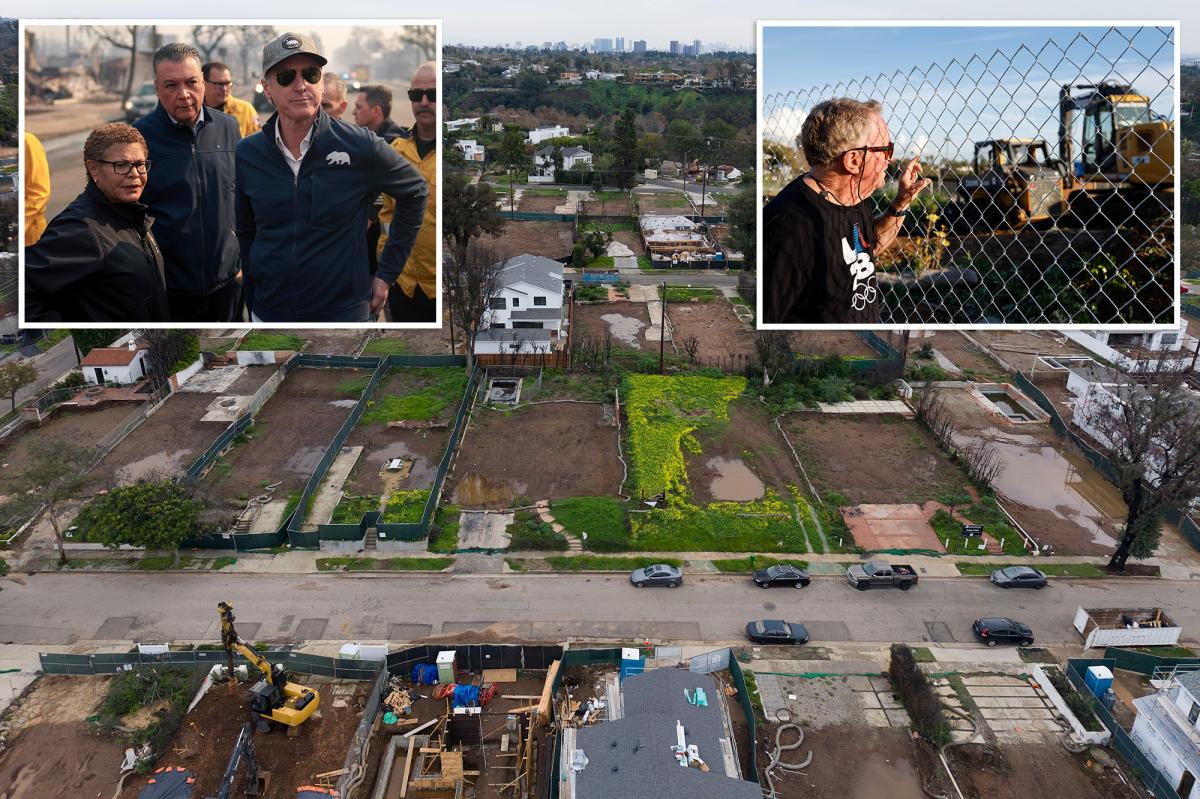
LOS ANGELES — Pacific Palisades — once one of the most sought-after neighborhoods in Los Angeles, home to celebs like Tom Hanks and Ben Affleck — still looks like a war-zone a year after wildfires leveled much of it.
Only a handful of the nearly 7,000 destroyed homes have been rebuilt, and outraged residents say Mayor Karen Bass and city bureaucracy have failed them every step of the way.
Building permits have been issued for just 686 of the roughly 6,800 homes and businesses destroyed after the Palisades Fire sparked on Jan. 7 and raged for nearly three weeks, LA city data shows.
That’s just about 10% of the destroyed properties that have been green-lit for rebuilding 12 months on.
Only about 400 of those properties are actually under construction — about 5%, according to the Wall Street Journal — while a mere handful are finished.
Things in Altadena are just as grim, with over 9,000 structures destroyed and more than $3 billion in estimated property value lost. Many in the area lost everything, and construction to help rebuild has been equally as slow.
Angelinos who have been left in various stages of homelessness since the fires told The Post that city and state leadership bear the most blame for this situation.
“We have a mayor that will look directly into the camera and say, this is the fastest rebuild ever. That is not true,” said 52-year-old Jeremy Padawer, who lost his home in the fires and still hasn’t seen a new foundation poured.
Padawer is an organizer of “They Let Us Burn,” a protest of residents scheduled for Wednesday in Pacific Palisades, where displaced homeowners will demand tax and fee breaks for rebuilding — all of which they say Mayor Bass and Gov. Gavin Newsom already promised, but failed to deliver.
“Literally the day after the fire you have people like our mayor and governor saying things like ‘natural disaster,’ ‘climate change.’ But it’s been an ‘unnatural disaster’ perpetuated by a lot of misdirection and gaslighting,” Padawer told The Post.
Neighbors across the Palisades community echoed this fury — with many detailing how they’ve received little but endless red tape from city agencies, hefty permit fees that can total into the six figures, and 9.5% sales taxes on building materials, which goes directly into state, city and county coffers.
“The fact that we have to pay the city of LA permit fees to rebuild our homes that burned down by no fault of our own is ludicrous,” said Kimberley Bloom, 66, whose home is finally ready to be rebuilt after months of labor.
But Bloom and her husband may end up spending a staggering $100,000 on city building permits — the kind of permits Bass promised to waive to help spurn reconstruction.
“We just don’t know what they’re going to do. This whole last year has just been this abyss of unknown,” Bloom added.
Those fees and taxes are especially frustrating, because many feel city negligence allowed the fires to become as destructive as they did.
Many neighbors cited the failure to fully extinguish the Lachman Fire, a brushfire set in the Palisades hills days before the larger, Palisades Fire exploded. Firefighters doused it, but federal prosecutors earlier this year revealed that it smoldered for days before rekindling and whipping into a deadly inferno by extreme winds.
Others pointed to a major water reservoir that was empty, and fire hydrants that ran dry during the battle against the blaze — leaving firefighters unarmed.
“[Officials] are sloppy and lazy, and they didn’t anticipate the worst-case scenario,” said Bud Kling, 78, a former Palisades High School tennis coach who lost his home of 43 years. “When the worst-case scenario happened, they didn’t even do the minimum.”
And numerous city agencies have bogged down the permitting process, with some residents saying they feel like they’ve have to earn a college degree’s worth of knowledge to navigate endless zoning and building laws — often just to rebuild homes on the same footprint that was fully permitted for decades before the fire.
“Every day it seems like there’s something new. Right now there’s a big issue with drainage. You can’t have runoff from your yard into somebody else’s yard,” said Liesel Reinhart, 57, who lost her home in Altadena north of LA. “I don’t even have a straight shot to do a drain in our lot that doesn’t go into someone else’s lot.”
The issuance of building permits is currently taking about five to six weeks — but that’s only after residents have spent months fighting insurance companies and hacking through municipal red tape to get their plans approved.
“All of these things they promised a year ago, that they would defer the fees, that they would lessen our taxes, they haven’t done any of it,” said Sara Trepanier, who is currently awaiting the delivery of a modular house to replace her destroyed Palisades home.
“The city hasn’t shown that we’re a priority at all,” the 57-year-old added.
And the difficulties began for many before they even begin the permitting process, with insurance companies fighting them tooth and nail to withhold as much cash as possible.
Trepanier experienced that firsthand when she was finally handed a $720,000 check for her home, which was worth $3.6 million.
“My house before was a Spanish-style home with curved windows and curved walls. It was so beautiful. This house is literally a square box. Because that’s all my insurance would pay for,” she said.
When the modular home does arrive, it will be the only house on her barren block.
It remains unclear exactly how many homes have been actually rebuilt in the Palisades, but in greater Los Angeles County — where another 7,400 properties were damaged or destroyed in Altadena, Malibu and other neighborhoods — construction on just seven homes has been completed, according to the most current county data.
Many people are paying mortgages on empty lots they increasingly can’t pay for and can’t afford to rebuild, prompting some to sell or consider selling their land to make ends meet — and leaving longtime residents anguished over the loss of their homes.
“Our community has continued to be burned long after the flames went out by delays, silence, and lack of accountability from institutions meant top protect us,” said “They Let Us Burn” co-organizer Miriam Engel, 47, one of the few Palisades residents whose house was miraculously spared.
“Our neighbors are scattered, our friends are displaced, and our children can’t just run down the street to each other’s homes anymore,” she added.
“We were robbed of our homes, our safety, and our sense of community.”
Read the full article here