




International students are paying upwards of $850,000 for a degree, with more than 583 courses costing more than $250,000, a situation the peak body has slammed as an existential threat to higher education.
The fees paid by international students are as much as eight times that of domestic students, government data obtained by this masthead shows.
Commonwealth government data for 2025 analysed by the Herald and The Age shows that combined postgraduate medical degrees from the prestigious Group of Eight universities are the most expensive, with the University of NSW’s combined bachelor of medical studies/doctor of medicine/bachelor of arts taking eight years and costing an eye-watering $854,000.
The University of Sydney’s bachelor of science and doctor of dental medicine, bachelor of science and doctor of medicine, and bachelor of arts and doctor of medicine are the next most expensive, each costing around $633,000.
Medicine and dental degrees dominated the rankings and represented all 14 courses priced above $500,000. Engineering, law and other prestigious degrees closely follow.
The most expensive non-medical degree is Monash University’s combined bachelor of laws (honours) and bachelor of engineering (honours), costing $433,535. UNSW’s bachelor of engineering (honours)/bachelor of laws is close behind at $417,500.
Of 583 courses that cost more than $250,000 for international students, 445 were at Group of Eight universities. UNSW was represented most in these rankings, with 164 courses, followed by 95 from the University of Sydney.
This represents almost half of all courses priced over $250,000.
Group of Eight chief executive Vicki Thomson said international student fees reflect the “true cost” of degrees.
“These costs have risen substantially in recent years due to global inflation, increased operational expenses, and the need to maintain cutting-edge facilities and research capability,” she said.
“Funding constraints … and policy changes limiting international student numbers has meant universities must recover cost through fewer students while maintaining quality.”
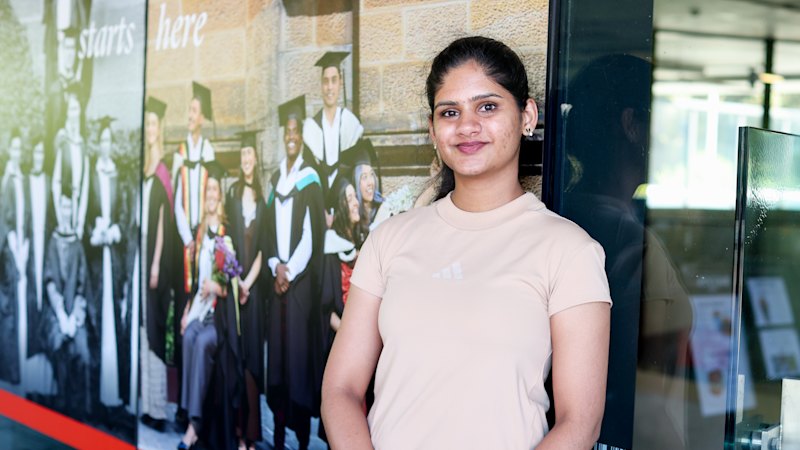
Ariye Sunilkumar Monee, an international student from India, is completing a masters of professional engineering in electrical engineering at the University of Sydney after completing an undergraduate degree in her home country. The three-year postgraduate course cost $180,035.87 for international students in 2025.
Sunilkumar Monee said the cost is “too much, but still, it’s worth it”.
She said that it was impossible for international students to work enough to cover their fees. “I usually have … four days, three days in a week of uni,” she said. “You do have your rent to pay, you do have your own living expenses, food and everything.”
Sunilkumar Monee has taken out an education loan to pay her fees at the “premier” institution. “I am not … making my parents struggle to pay my fees,” she said.
The University of Sydney said it was “incredibly proud” of its international students and that universities across the sector “have become increasingly reliant on income from other sources, ranging from international student fees to the commercialisation of our research and the generosity of our donors.”
Monash said its fees were determined by “various factors, including market trends, demand, market pricing, and the costs of delivering a world-class, global education from a top 50 university”.
The federal government failed to pass legislation capping the number of international students in its first term. Student numbers are now controlled via slow processing of visas after a university reaches 80 per cent of its allocated student intake.
Fees for international students have been increasing “much faster than inflation” in recent years, said immigration expert Dr Abul Rizvi.
“That’s particularly the case for the higher-tier universities and the more extensive courses such as medicine.”
The most expensive course in 2025 has increased in price by 9.8 per cent since 2024, and 55.7 per cent since 2021. It increased again in 2026 to more than $889,000, according to UNSW’s website.
Noise around limiting places for international students, creating the perception of a smaller supply, may have emboldened universities to increase pricing, Rizvi said.
Despite the huge fees, Australia is attractive globally because of what he labelled “among the most generous work rights of comparative nations” that allow international students to work up to 24 hours a week.
“The more generous the work rights, the more you [can] offset the higher cost.”
Ongoing social upheaval in the United States, recent measures in Canada that have “very dramatically” reduced the number of international students and reductions in students taken by the United Kingdom have also increased the appeal of Australian universities.
But the peak body for international students has slammed the universities’ increasing reliance on international student fees, saying it represents a threat to the sector’s legitimacy and integrity.
“There has been a quiet drift from reinvesting surplus for mission towards using international tuition as a quasi-tax base,” according to a submission to the NSW parliamentary inquiry into universities from Weihong Liang of the International Students Representative Council of Australia.
“Over time, this disconnect fosters disillusionment and a sense of inequity, weakening confidence in the fairness and transparency of the system. Erosion of trust poses a lasting reputational risk … to the integrity and legitimacy of the entire NSW higher education sector.”
Start the day with a summary of the day’s most important and interesting stories, analysis and insights. Sign up for our Morning Edition newsletter.
From our partners
Read the full article here