





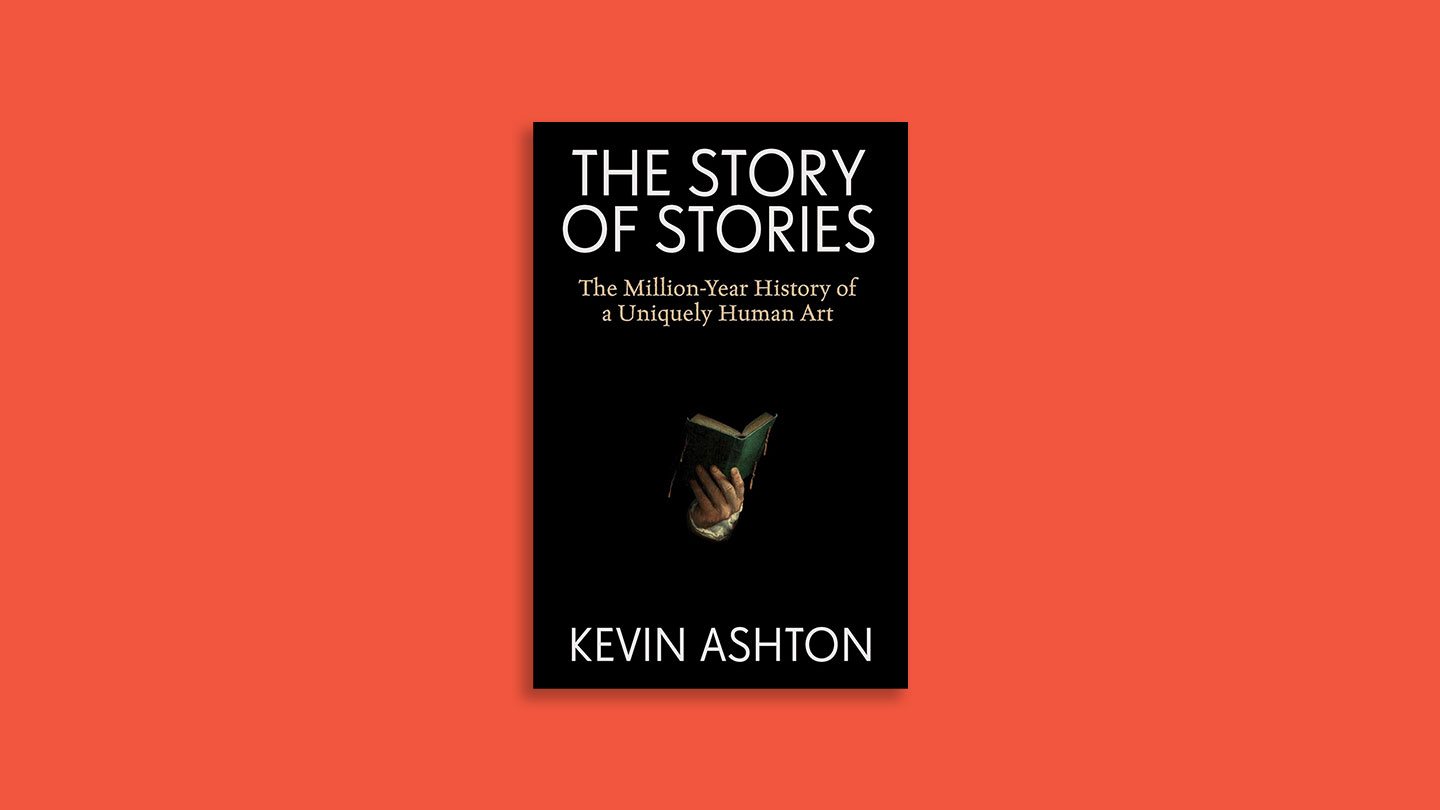
The Story of Stories
Kevin Ashton
Harper, $32
Back in 1944, two psychologists performed a somewhat mundane experiment. The researchers asked people to simply watch a short film and describe it. Most of the viewers spun elaborate tales involving lovers, violence and abandonment. That’s pretty amazing, considering the film featured only shapes: two triangles and a circle that moved in and out of a rectangle.
Our brains, as it turns out, can find a story in anything.
That’s the central truth at the heart of The Story of Stories. In this wide-ranging book, technologist Kevin Ashton dips into the often strange history of storytelling itself, as he describes the technologies that have evolved alongside these tales and makes the case for why stories matter. It’s a compelling effort, particularly today when everyone with a smartphone can be a storyteller.
Ashton sets himself an audacious goal of tracing an overarching story of all stories from the earliest tales. Chapter 1 begins with fire, around which our ancestors sat at night. Around these fires, the imperatives of the day’s work fell away. “In the warmth and security of their flames, they communicated about events remembered and imagined, from places and times near and far. Or, they started telling stories,” Ashton writes.
The chapters that follow offer scattershot history lessons, curious anecdotes of the ways stories have been passed from person to person, and lively descriptions of revolutionary technologies — from the printing press to electricity to Facebook.
Ashton has a knack for pulling out memorable bits from historical records, scientific studies and other sources for readers. For instance, in the mid-1800s in the United States, before paper was regularly made from wood pulp, paper was made from cloth rags. Some of those rags were pulled off Egyptian mummies and stank to high heaven. “Paper mills did not always admit that their ‘Egyptian rags’ had once wrapped mummies, perhaps for fear of upsetting a delicate public,” he writes.
The narrative arc of The Story of Stories can at times be hard to follow; readers are occasionally left without a strong anchor line as the book flits from anecdote to anecdote. But stick with it and eventually the soft orange glow of Chapter 1’s ancient fires turn blue — the harsh light of smartphone screens.
In the digital age, especially with the ubiquity of social media, “we have gone from a world where a few people could tell stories to a few people, to a world where everyone can tell stories to everyone,” Ashton writes. Storytelling (and listening) has reached a fever pitch.
The implications of this expansion are many, and they’re certainly not all positive.
Misinformation and disinformation about COVID-19 and vaccines spread far and wide during the pandemic. Ashton details how digital lies contributed to some people refusing to get vaccinated, more cases of severe disease and more preventable deaths.
Manipulative stories that convincingly represent fiction as fact — due to generative AI’s ability to create realistic fake images, video and audio — continue to spread.
Playing with people’s perceptions will become even easier as generative AI gets better at mimicking reality. Will powerful people “rewind time to say things they did not say, and to unsay things they did?” Likely yes, Ashton says. Popular digital platforms “are not shaping the online reality of billions, but reality itself,” he writes.
The only way out of this jam is to recognize that our minds are often gullible. That means that vigilance, doubt and humility are the ways ahead, Ashton says.
If that sounds bleak, consider the greater arc of history: While this current age of hatred, as Ashton describes modern online vitriol, is a step back, it is also “a reaction, a backlash, a squeal of dismay, a counterrevolution encouraged and exploited by powerful people.” That reaction is up against a multitude of other narratives. Today’s proliferation of stories, Ashton writes, hold power to show “the heterogeneous beauty and glory of all humanity.”
Buy The Story of Stories: The Million-Year History of a Uniquely Human Art from Bookshop.org. Science News is a Bookshop.org affiliate and will earn a commission on purchases made from links in this article.
Read the full article here