


Between the latest news of inconvenient network outages and rising smartphone costs due to a RAM shortage caused by the AI boom, mobile carriers are vying for your money and business. So which one do your fellow readers recommend?
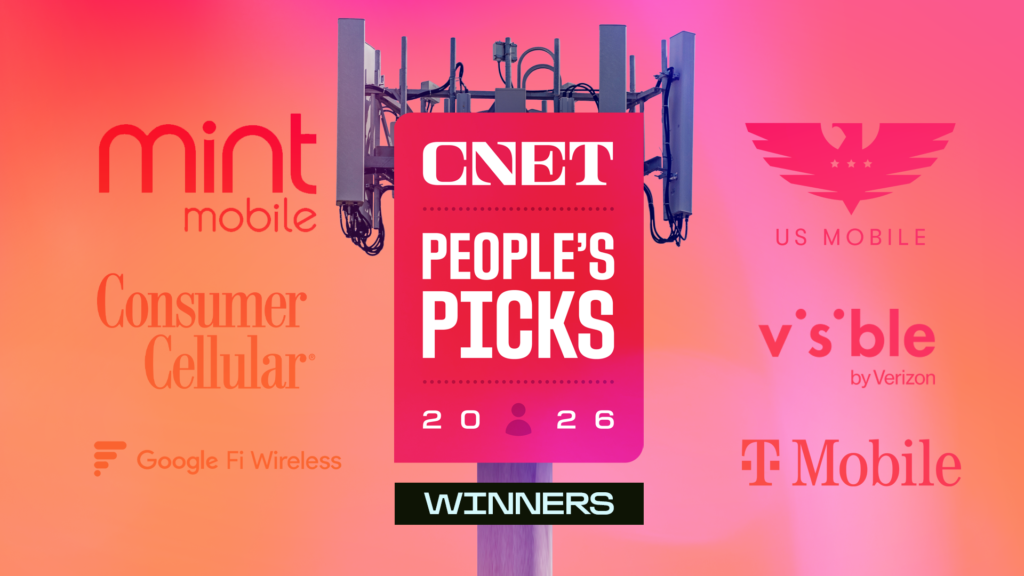
CNET’s People’s Picks is a community awards program that surveys our readers to get their opinions on the tech gadgets and services they use and love the most, like internet service providers, headphones and TVs. The latest People’s Picks awards zoom in on what readers think about their mobile carriers — that includes everything from price to signal reliability and even data.
The results are surprising. We hear a lot about major network carriers with lots of perks, data and infrastructure. However, our readers’ opinions indicate that mobile virtual network operators have more to offer than cellphone plans from the big three carriers, AT&T, T-Mobile and Verizon.
CNET’s People’s Picks: Mobile carriers’ overall satisfaction rating
Overall winner: Mint Mobile
CNET readers chose Mint Mobile as CNET’s People’s Picks overall mobile carrier winner. It has a strong overall satisfaction average rating of 4.68 out of 5.
“Customer satisfaction in general is a fuzzy metric, and Mint Mobile has done an excellent job of reinforcing to its customers that they’ve made the right choice,” said Jeff Carlson, CNET senior editor. “I chalk a lot of that up to its marketing, led by actor and former part-owner Ryan Reynolds, which elevates Mint in a crowded market. But Mint remains affordable and reliable, which solidifies its customers’ choice.”
Value for money
Mint Mobile beats out other MVNOs and major network carriers, giving you the best bang for your buck. It offers flexibility without costing a fortune.
Mint Mobile offers several phone plans depending on your term and data needs. It offers three, six and 12-month plans starting at $15 per month for some plans, but an upfront payment is required. Mint Mobile also offers family plans that let you choose the data amount for each included line at one set price. You’ll also have the option to use your existing phone or buy one through Mint Mobile.
“The position of Mint Mobile and the other MVNOs on this list really shows how much people value simplicity in pricing and features,” said Carlson. “Yes, Mint requires up-front payment to get the best value, but customers can see what that is. They can budget a set amount for the next six months, pay it, and then not worry about fluctuations during that time.”
Carlson also noted that Mint Mobile isn’t trying to load up its plans with features to justify higher costs. It has core features such as 5G coverage and high-speed data, which is what most people are looking for.
Comparatively, major networks struggle in this category. For comparison, Verizon and AT&T are 2.98 and 3.05, respectively. It’s also worth noting that readers are happy with Mint Mobile’s pricing — 90% say their bill has remained consistent over the past year, and 5% say it has decreased.
Cellular data connection
Usually, if your carrier’s cellular data connection isn’t reliable enough, you’ll go looking for a Wi-Fi network. Most CNET readers with Mint Mobile service (70%) give the mobile carrier high ratings for how well they’re able to rely on Mint Mobile’s cellular data without connecting to a Wi-Fi network.
Over half (59%) of CNET readers with Mint Mobile service rarely have that problem, and for some, not at all. Eleven percent of CNET readers with Mint Mobile service say they leave Wi-Fi off entirely because their cellular data is faster.
Carlson said it is surprising that MVNOs, including Mint Mobile, win against major network categories for cellular data connection, but there are many reasons people connect to Wi-Fi instead of relying on their mobile carrier — like downloading files quickly or watching YouTube videos.
Runner-up: Consumer Cellular
J. Hazelwood/CNETConsumer Cellular wins a few categories in CNET’s People’s Picks, including signal reliability, customer service and the mobile carrier that’s least likely to drop calls. It also comes close to winning in two categories: cellular data connection and unlimited data.
Signal reliability
Consumer Cellular wins in signal reliability, with the highest average rating of 4.60 out of 5. US Mobile and Mint Mobile trail closely behind, with averages of 4.56 and 4.53, respectively.
But that’s not the whole story, because all the MVNOs use the big carriers’ infrastructure – they don’t have their own cell towers. Most are tied to a single carrier, like Mint Mobile, which uses T-Mobile’s network. On its website, Consumer Cellular says, “When you sign up for our service, your network is assigned based on the strongest signal available in your geographic area.” Consumer Cellular’s customers likely give it a high score because they can use the network that works best in their area.
If you’re curious about coverage, Consumer Cellular has an interactive map that shows which areas are covered based on your zip code or address. Most areas have 5G or 4G LTE, and Wi-Fi calling is also available.
Least likely to drop calls
If you’re constantly dealing with dropped calls, CNET readers with Consumer Cellular give it high marks compared to other mobile carriers. Most (70%) of Consumer Cellular readers say they rarely or never lose service. Close to 23% experience call drops in rural areas and on road trips — the lowest among mobile carriers. Even fewer experience call drops inside their home. Carlson said that could be because CNET readers with the service are getting the best coverage in their area, which is also why readers have high signal reliability ratings.
Customer service
Consumer Cellular also wins in customer service, with an average rating of 4.72 out of 5, compared to US Mobile’s 4.34. There are two ways to reach Consumer Cellular for assistance: call (888) 345-5509 or use its online chat feature. Consumer Cellular also receives high rankings from CNET readers for its service and fast resolution times. Most say they were able to resolve issues with Consumer Cellular over the phone in fewer than 30 minutes.
T-Mobile
J. Hazelwood/CNETMost popular
T-Mobile is the most popular mobile carrier among CNET readers (29%), followed by Verizon (18%). T-Mobile has several phone plans to choose from, but CNET editors recommend the T-Mobile Essentials Saver 2.0, which starts at $55 per month if you need only one line; the T-Mobile Experience More 2.0 may be ideal if you’re looking to save money from other perks. We like that T-Mobile’s autopay discount qualifies you for a lower price when you use an eligible payment method.
T-Mobile has a few features that make it worth considering if you’re looking for a new mobile carrier. CNET editors say it has a robust 5G network and some money-saving perks, like plan savings with a new line and T-Mobile Tuesdays — the carrier’s weekly appreciation program. And T-Mobile recently unveiled a three-year phone installment plan to make new phones more affordable.
“One advantage T-Mobile has right now is its visibility – customers respond to T-Mobile Tuesdays, its sponsorship of things like a large section of the Formula One Las Vegas Grand Prix and its broad marketing,” said Carlson. “It feels like a place to be, and its mobile plans are well-received. They aren’t the cheapest, but their position here makes me think people are responding to T-Mobile giving them plenty of features for what they’re paying for.”
US Mobile
J. Hazelwood/CNETData speeds
US Mobile earns a nearly perfect average of 4.65 out of 5 from CNET readers who use it, making it the highest among popular mobile carriers. MVNO competitors Mint Mobile and Consumer Cellular come close to winning this category, with average ratings of 4.63 and 4.48, respectively.
Several factors go into determining data speeds. If you own a phone that’s capable of the highest 5G speeds and you’re in an area that can deliver them, you’ll see the best performance. That could be a device such as an iPhone 17 connected within a pocket of T-Mobile’s 5G Ultra Capacity (its name for 5G millimeter-wave spectrum) signal, which can download files much faster or deliver movies at 4K resolution smoothly.
Like Consumer Cellular, US Mobile isn’t tied to a specific carrier for its infrastructure. It’s able to use the best network available in your area – but US Mobile lets you choose which one to use. For example, if you travel to a location with a stronger network (like an extended vacation or for work), you can switch to that network for a fee. It uses its own names for the networks: Dark Star is AT&T, Light Speed is T-Mobile, and Warp is Verizon.
US Mobile’s ability to leverage the best network in your area likely gives it the edge in this category. US Mobile’s Broadband Facts break down each plan’s data speeds. All three Unlimited plans (Flex, Starter and Premium) have unlimited data, but your download and upload speed will depend on which cellular network you’re connected to. US Mobile’s Dark Star has download speeds up to 389 Mbps, while the Light Speed and Warp networks have download speeds up to 357 Mbps and 702 Mbps, respectively. Upload speeds are much different. Dark Star, Light Speed and Warp have upload speeds up to 33, 32 and 702 Mbps.
Fair pricing
Fair pricing eliminates month-to-month surprises — giving you predictability and peace of mind when paying your bill. That’s why US Mobile also wins for CNET’s Fair Pricing category of People’s Picks, with 98% of US Mobile users saying their bill “remained perfectly consistent” or “actually went down” in the last 12 months. While other mobile carriers reported base monthly prices increasing, US Mobile didn’t report any new fees, perks going away or changes.
US Mobile’s plans start at $25 per month for the Unlimited Starter plan, including taxes and fees, whereas the Unlimited Flex is an annual plan that starts at $17.50 per month, including taxes and fees.
Visible by Verizon
J. Hazelwood/CNETFor unlimited data
Visible by Verizon gets the highest marks from readers who use the mobile service for its no-data-throttling policy. CNET found that 73.3% of Visible by Verizon users say their data is truly unlimited and has never been throttled, whereas 72.9% of readers with Consumer Cellular service say the same. Comparatively, 61% of Verizon postpaid users say the same. You may notice slower internet speeds if you reach your monthly high-speed data limit.
Visible by Verizon offers unlimited data across all three plans, with premium (high-speed) data included on Visible Plus and Visible Plus Pro. Customers don’t need to worry about hitting a cap and seeing their speed dropped (though Visible and all carriers reserve the right to slow data if needed). While the Visible plan is listed as the most popular, the Visible Plus and Visible Plus Pro plans also offer unlimited data when roaming in Mexico and Canada, but speeds drop after 2GB per day of use.
Google Fi Wireless
J. Hazelwood/CNETRoaming features
Most (63%) of readers who have Google Fi Wireless are satisfied with its roaming features, the highest among mobile carriers. There are no reports of dissatisfaction or frustration from CNET readers.
CNET’s director of content, Patrick Holland, says Google Fi is one of Google’s best-kept secrets. “Its competitive pricing, international roaming (at no extra charge) and flexible data plans are some of the main reasons that it’s been my carrier of choice for most of the past decade,” said Holland.
Google Fi Wireless has a few standout roaming features among other competitors. International service is available with Google Fi Wireless’ Unlimited Premium and Unlimited Standard plans. The Unlimited Premium plan includes free texts and calls at 20 cents per minute. Some calls to other countries (over 50) are free. Google Fi Wireless also offers 50GB of high-speed data to over 200 destinations, with 256kbps thereafter. Many other providers offer minimal international features.
Did you agree with these findings? CNET’s People’s Picks is community-driven and helps us spread the word about the tech and services you love. Take our ongoing phones survey to tell us what you love about yours.
Methodology
CNET commissioned Alchemer to conduct the People’s Picks survey to compile data. The survey was carried out online, and all figures are from Alchemer. The total sample comprised 1,198 adults. The figures have been weighted and are representative of all US adults (aged 18 plus). Fieldwork was undertaken July 1 to July 26, 2026.
Read the full article here