




For the rockhead poacher, the noises are all in its head.
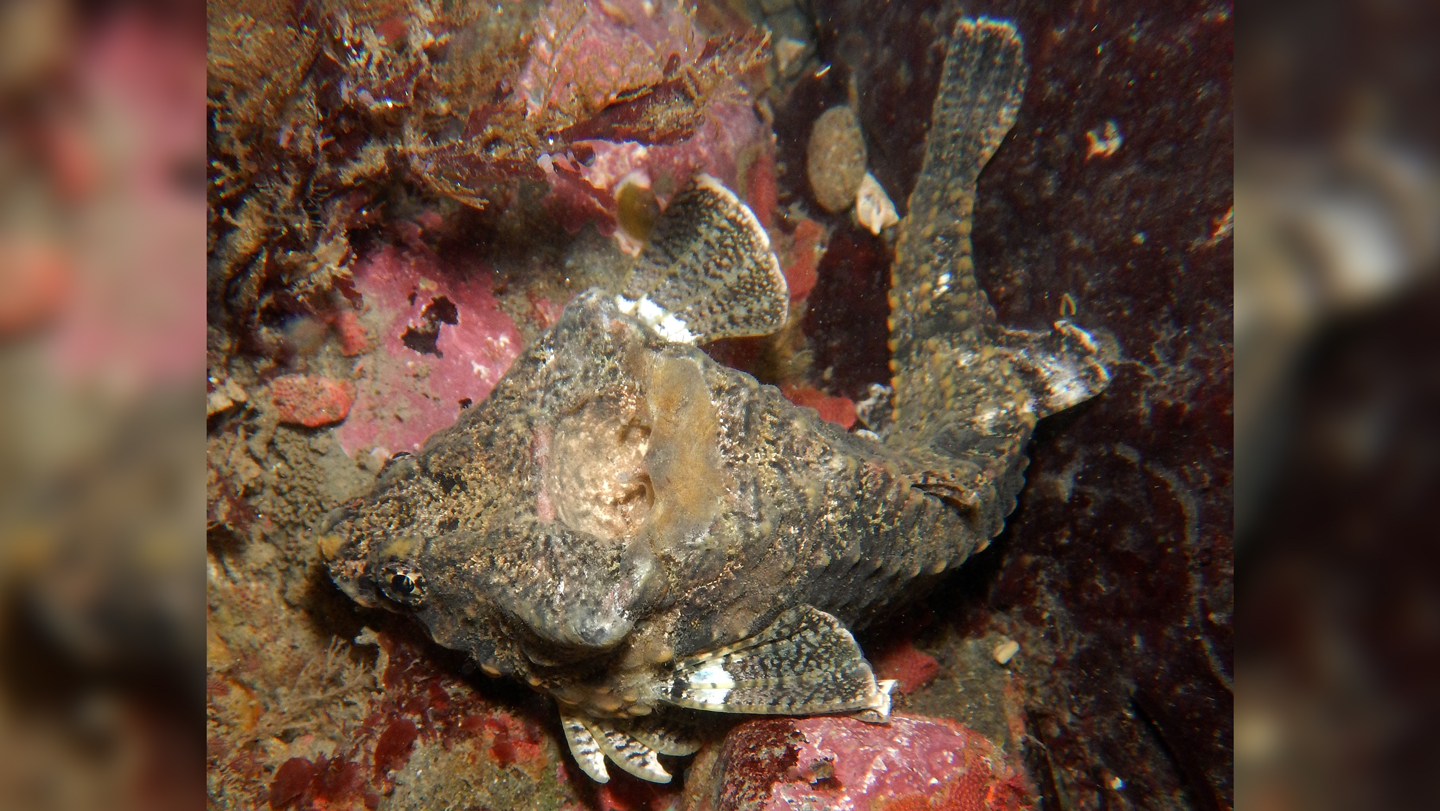
The fish is a pint-size, unassuming inhabitant of nearshore shallows, but it has a conspicuous divot in the top of its skull that appears to work like a drum. New research suggests that flattened, mobile ribs may rap against the pit’s underside like drumsticks, possibly so the fish can communicate with other members of its species.
“No fish has anything like this,” says functional morphologist Daniel Geldof, who defended the work in December for his master’s thesis at Louisiana State University in Baton Rouge.
Rockhead poachers (Bothragonus swanii) are armored, teardrop-shaped fish found from Alaska to California, where they spend much of their time in shallow waters perched on sea bottoms and camouflaged to resemble rocks or sponges. Scientists had long noted the deep pit — about as large as the fish’s brain — scooped out of the top of its head. But its function remained mysterious. Did it create sound or collect it like a satellite dish? Or was it used in other senses?
To find out, Geldof and colleagues scanned a preserved specimen with X-rays. Compiling thousands of individual images gave the team a detailed, 3-D model of the poacher’s strange head and everything within.
The rib bones underlying the bottom of the head hole are unusually dense, large and flattened, Geldof says. They’re also quite mobile and attached to powerful muscles. Geldof thinks these ribs are adapted for striking the bottom of the pit, creating noise.
“This fish basically has a tiny drum kit or maraca in its head,” he says. “I’ve handled lots of other annoyed poacher [species], and you can feel them vocalizing. It feels very similar to if you have a cell phone in your hand that’s on vibrate mode.”
The phenomenon of striking or scraping elements together to make noise is called stridulation. While other fish are known to stridulate, the rockhead poacher “seems to be a rather extreme example of it,” Geldof says.
It’s possible all this drumming and buzzing is an adaptation for startling predators. But Geldof thinks it’s more likely for calling and courting other poachers in a challenging acoustic environment. The wave-pounded intertidal shallows the poachers call home are turbulent and noisy. Rockhead poachers may be sending their buzzing vibrations into the rocks they rest upon.
“They have to work around all these crazy challenges if they want to hear and be heard in this din,” Geldof says.
Audrey Looby, a fish ecologist at the University of Victoria in British Columbia who was not involved with the research, notes that there’s increasing evidence that fish might be using sounds transmitted through surfaces they touch. For instance, mottled sculpins (Cottus bairdi) slap their heads against rocks and gravel to send vibrations through the substrate. “Just like we would want to study bird sounds to understand more about their communication,” she says, we can do the same to understand fish communication.
Ecomorphologist Eric Parmentier of the University of Liège in Belgium isn’t convinced the fish are stridulating. The pit may amplify sound, he says, but the ribs might not be hitting the pit’s underside to create that sound. The sounds from bones hitting bones would mostly be at a far higher frequency than the roughly 20 Hertz Geldof and his colleagues predict — above 1,000 Hertz, he says.
“This would not match the types of sounds suggested in the report,” he says.
So far, the proposed drum mechanism hasn’t been seen in action, and the fish hasn’t been recorded underwater making its sounds. Experiments and observations in the lab would help confirm just how this percussion pit may work, Geldof says, and why such a weird quirk evolved in the first place.
Read the full article here