




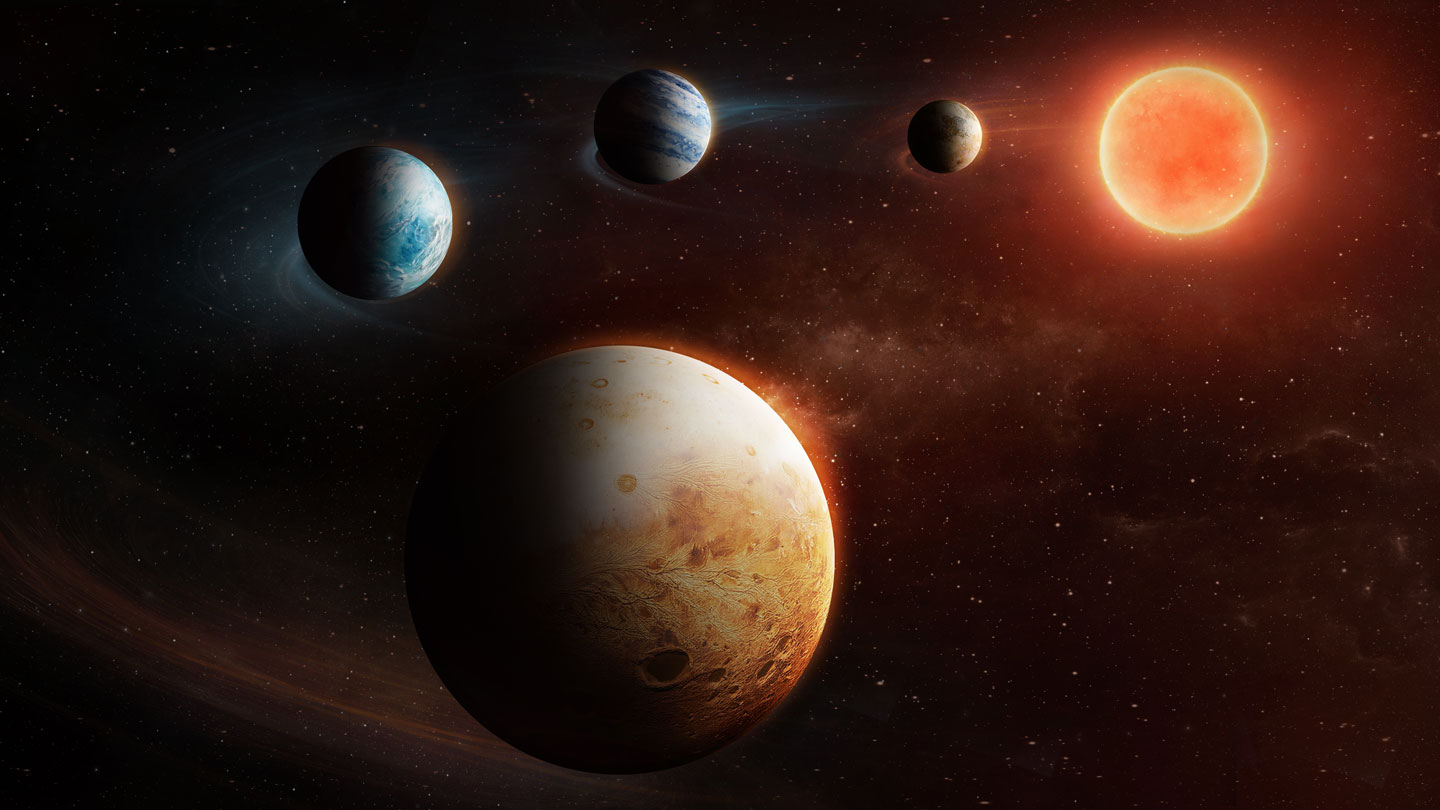
Like a double-stuffed Oreo of planetary proportions, the star LHS 1903 boasts two rocky exoplanets sandwiching two gaseous ones.
From the star outward, the lineup — rocky-gaseous-gaseous-rocky — defies models that predict rocky planets appearing close in and gaseous ones further out. The configuration hints at a history of violence in the system, potentially refining our understanding of planetary formation, researchers report February 12 in Science.
“Bad stuff does happen in young planetary systems,” says Andrew Cameron, an astronomer at the University of St. Andrews in Scotland. “This one has the look of something that’s been turned inside out.”
LHS 1903 is a red dwarf star located roughly 116 light-years away and is about half as massive as the sun. Its four companions all orbit in less than 30 days, making for a compact system whose worlds range from around 1.4 to 2.5 times our planet’s radius, straddling the boundary between super-Earths and mini-Neptunes.
NASA’s Transiting Exoplanet Survey Satellite discovered the system in 2019, and subsequent observations were made by a host of ground- and space-based instruments. This lets scientists precisely pin down the planets’ masses and densities, giving some clues to their compositions.
Planets are thought to form from the dusty disks surrounding young stars. Rocky planets typically grow closer in, where intense starlight can strip away their atmospheres. Gas is more prevalent in the outer disk, spawning giants like Jupiter that often retain thick envelopes.
“[LHS 1903] follows that pattern beautifully for the first three planets,” Cameron says. “Then, something weird happened to the fourth planet.”
Based on its density, LHS 1903’s fourth planet appears to be rocky, whereas the two planets starward from it seem to be wrapped in gaseous envelopes. It would be like finding a world resembling Venus out past the orbit of Neptune.
The headscratcher supports the idea that, sometime early in their history, LHS 1903’s outer planets migrated inward. Such a process is believed to have occurred in our own solar system’s first few hundred million years, when a gravitational spasm caused Jupiter and Saturn to lurch toward the sun, knocking asteroids helter-skelter and perhaps even switching Uranus and Neptune’s orbits.
Something similar may have happened to LHS 1903’s planets, either sending a large body crashing into the fourth planet that blasted away its atmosphere or scattering world-building material from the outer system. The fourth planet may have grown up late, “just as the system ran out of gas,” Cameron says.
Read the full article here