




The Utah man accused of gunning down Turning Point USA founder Charlie Kirk appeared in court Tuesday as his defense team is asking to have the Utah County Attorney’s Office disqualified from the case after it was revealed a member of the prosecution team had an adult child who was present for the murder.
Attorneys for Tyler Robinson continued arguing their motion to dismiss the Utah County Attorney’s Office from the case, telling the court last month that they were “very concerned we are getting off on the wrong foot.”
Tuesday’s hearing was a continuation of a Jan. 16 court appearance, which was adjourned after more than two hours of testimony.
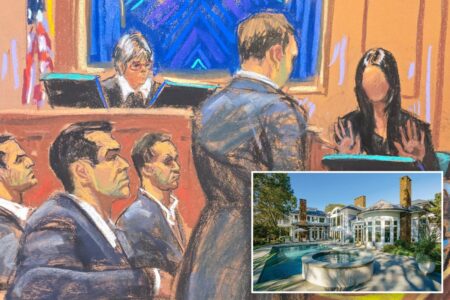
The 22-year-old was seated in the courtroom as press and members of the gallery streamed in.
His parents, Matthew and Amber, were present in court. He was shackled at the waist.
The hearing opened with what has become a hotly-debated subject in pre-trial proceedings thus far — what, if any, media should be allowed in the courtroom.
One of Robinson’s defense attorneys, Richard Novak, argued that even still images of his client could interfere with his right to a fair trial. Attorney Michael Judd, arguing on behalf of the media, countered by saying photography should be allowed.
Ultimately, Judge Tony Graf ordered still photographers to the back of the courtroom, and ordered them not to zoom in on the faces of any parties.
The video camera was also moved to the back of the courtroom, and honed in on the backs of the parties’ attorneys as they argued before Graf.
Robinson spent the beginning of the hearing looking down at a document shared with him by another defense lawyer, Kathryn Nester.
After the arguments over media coverage concluded, the court took up the issue at hand.
The defense insists that a conflict of interest is at play, given that an adult child of a member of the prosecution team was present at Utah Valley University during Kirk’s Sept. 10 assassination.
Graf said at the outset that while a potential conflict could be conceivable, the defense had not yet met the statutory threshold required to remove county prosecutors or refer the case to the Utah Attorney General’s Office.
Novak picked up where he left off last month, questioning Utah County Attorney Jeff Gray, and trying to pinpoint the exact time when Gray decided he would seek the death penalty against Robinson.
The court then heard testimony from an unnamed senior prosecutor, identified only as “Prosecutor A,” who described the office’s internal handling of the case and the decision to disclose the child’s presence to the defense.
The prosecutor testified there was no recollection of a specific conversation with Gray about how to proceed because of the child’s presence, but acknowledged it was routine for Gray to consult senior prosecutors in death penalty cases.
The prosecutor testified Gray expressed early on that he intended to seek the death penalty and wanted that decision announced at the same time charges were filed — earlier than is typical, when such notices often come after a preliminary hearing.
The prosecutor said disclosure of the child’s presence was made out of professionalism and transparency and was not a concession that a conflict existed. The prosecutor also testified the child’s presence did not influence charging decisions or the decision to seek the death penalty.
Testifying about the day of the shooting, the prosecutor said they were attending an out-of-county conference when family group text messages began coming in. One message read, “CHARLIE GOT SHOT.”
The prosecutor testified that they later went to campus, described the scene as chaotic, and informed officers that a backpack left behind belonged to the child but did not remove it.
The prosecutor said they later walked the scene from what was described as the “shooter’s perch” and concluded the child was not within the zone of danger, estimating the distance at about 85 feet.
The state then called Utah State Bureau of Investigation Agent Dave Hall, one of the lead investigators in the case.
Hall testified the investigation focused on identifying the shooter and said eyewitness accounts did not identify the suspect. He told the court investigators collected more than 40 witness statements, along with extensive video, digital and forensic evidence.
Videos shown included footage of Kirk arriving behind the stage, entering the amphitheater and interacting with the crowd, as well as graphic cellphone video capturing the moment he was shot. Other footage showed crowd reactions and a rooftop area where bystanders could be heard discussing someone running.
Hall testified investigators determined the bullet came from straight in front of Kirk. He said he did not learn that a prosecutor’s adult child had been present at the event until the defense filed its conflict-of-interest motion and that the information had no impact on the investigation.
Hall also testified investigators recovered a firearm from a wooded area near campus and a screwdriver from a rooftop, and said DNA found on the firearm was consistent with Robinson’s DNA. He said investigators reviewed social media messages tied to Robinson that included admissions indicating involvement in the shooting.
As prosecutors played videos and images of Kirk before and during the event, Robinson accepted a tissue from Nester and wiped his face, looking down during portions of the presentation. When the hearing concluded, Robinson was led out, still shackled and gave his family a small grin as he exited the courtroom.
After Hall was excused, the defense said it would call no additional witnesses.
Graf reiterated that he is accepting the defense’s alleged facts as true for purposes of the motion but emphasized he has not yet made up his mind.
He scheduled a Feb. 24 hearing at 10 a.m. via WebEx, where he will issue an oral ruling followed by a written decision on whether county prosecutors should be disqualified — a ruling that will determine how the case proceeds.
Robinson faces seven charges, including aggravated murder, which carries the potential death penalty. He has not entered a plea.
Motions to block video evidence and further restrict courtroom cameras remain pending.
Legal experts say removing an entire prosecutor’s office is rare and difficult, but the issue raised by the defense carries broader implications.
“I think to remove an entire office can be very difficult,” Skye Lazaro, a Salt Lake City–based criminal defense attorney not involved in the case, told Fox News Digital. “What this is ultimately going to turn on is whether or not that played any role in their decision to charge this case, and I don’t think that it really did. They were going to prosecute this case regardless, so I think this is an uphill battle.”
At the same time, Lazaro said the argument is not frivolous.
“I also think it probably is an argument that has merit and is worth bringing by the defense,” she said.
Lazaro said the issue could become a true conflict if the prosecutor’s family connection becomes part of the evidence presented to jurors.
“If this person’s child were to be put on a witness list, or the text messages they’d want to use as evidence were introduced, then yes — at that point, that becomes a real conflict,” Lazaro said.
She also emphasized public perception.
“When you look at conflicts, it’s also about holding public trust in prosecutorial agencies and them being unbiased when they investigate and prosecute cases,” Lazaro said. “There’s no personal ties, no personal feelings — they’re able to do what’s best for the state.”
Finally, Lazaro noted the motion could affect who controls the death-penalty decision.
“This isn’t going to keep Tyler Robinson from being prosecuted,” she said. “It just means either a different county attorney’s office would handle it or a special prosecutor would be appointed. And whoever prosecutes the case is the one who decides whether to seek the death penalty — a decision that can change.”
Read the full article here