





The United States population experienced its slowest growth since the start of the COVID-19 pandemic amid President Trump’s deportation and border crackdown, new data from the Census Bureau show.
The nation’s population grew by 1.8 million people, or about 0.5%, from July 2024 to July 2025, driven largely by a decline in net immigration. The immigrant population grew by 1.3 million over that timeframe, compared with a 2.7 million increase over the 12 months prior. While net immigration still remains above pre-pandemic levels, the Census Bureau projects that it could drop to 321,000 by July 2026, if current trends continue.
The U.S. immigration population had previously been growing for more than 50 years. Net immigration ballooned during the Biden administration, when border crossings hit record highs, until policies enacted in 2024, such as restrictions on asylum applications, slowed that growth.
Those changes, which preceded record-low encounters between law enforcement and those who entered the U.S illegally at the southern border, in conjunction with widespread deportations under Mr. Trump, made a decline in immigration unsurprising, demographics experts told CBS News.
“The big takeaway is, wow, the Trump administration and even the end of the Biden administration made a big difference,” said Steven Camarota, the director of research at the Center for Immigration Studies. “It sure looks like we’re seeing a fundamental change that reflects policy.”
Mark Hugo Lopez, director of race and ethnicity research at the Pew Research Center, agreed that the immigration decline was a response to policy shifts, but added that global factors play a role in U.S. immigration as well. Some of the surge in the years following the COVID-19 outbreak reflected “pent-up demand” from when countries closed their borders during the pandemic, he said, while policy changes in other countries could make them more attractive to migrants than the U.S.
U.S. population growth has been slowing for decades, in large part because birth rates have declined. The new figures show that trend continuing, but without migrants compensating for the fertility declines as much as they had been in previous years.
Births outpaced deaths by 519,000 between July 2024 and 2025, which is relatively stable compared to the year before, but a significant decline compared to earlier this decade. In 2017, nearly 1.1 million more people were born than died.
Camarota said that while slowed population growth could benefit the environment and ease housing costs, some businesses may struggle as the pool of workers and consumers shrinks. Lopez also noted immigrants’ impact on the workforce.
“Immigration has been important for driving U.S. population growth, but also U.S. labor force growth and the building of particular skillsets in the country,” Lopez said, highlighting farm work, manufacturing and tech jobs.
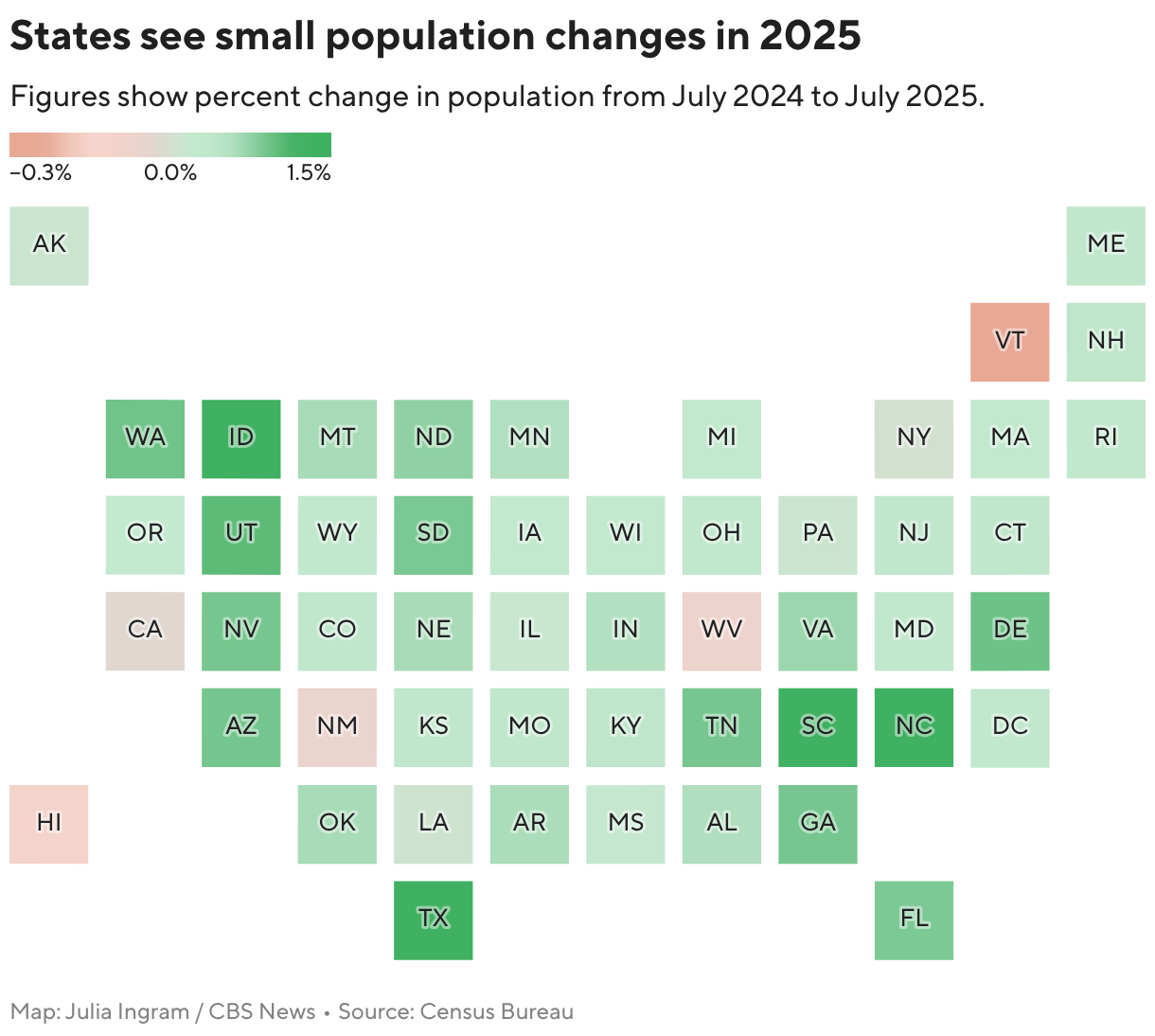
Population growth slowed in nearly every state and declined in five, with Vermont experiencing the largest decline at 0.3%. Hawaii, West Virginia, New Mexico and California also saw small population declines.
Meanwhile, South Carolina’s population is growing the fastest, according to the Census Bureau. Its population rose 1.5% last year, which the Census Bureau said was fueled by people migrating from other states. Idaho, North Carolina and Texas also saw gains, after ranking in the top 10 fastest-growing states between 2023 and 2024 as well.

Read the full article here