






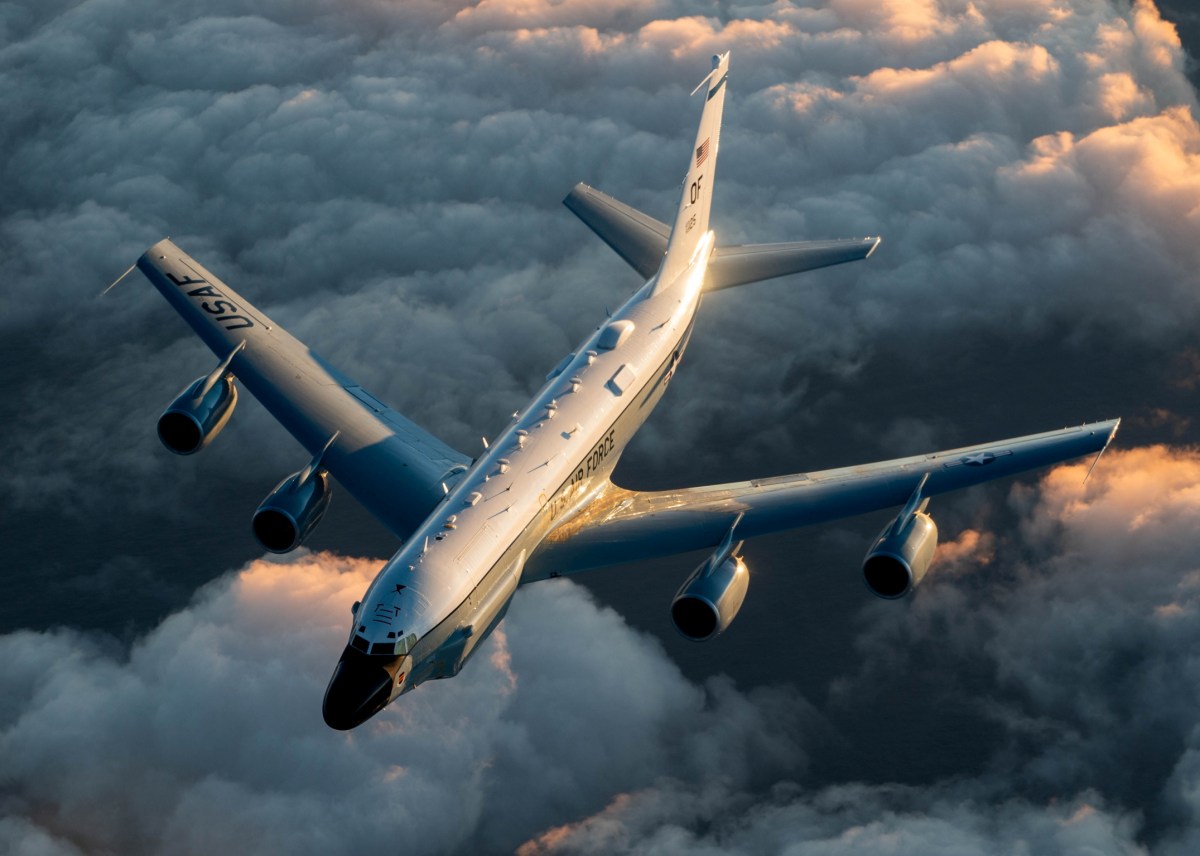
The United States recently deployed two specialized military aircraft, one capable of detecting radioactive “clouds,” from Kadena Air Base on Japan’s Okinawa Island for missions near North Korea and Russia, according to flight-tracking data reproduced in a Newsweek map.
Newsweek has emailed the North Korean Embassy in Beijing for comment by email. The Russian Defense Ministry did not immediately respond to a request for comment.
Why It Matters
Officially described as the Keystone of the Pacific, Kadena Air Base hosts a range of U.S. military aircraft, including fighter jets and spy planes, as part of the approximately 60,000 U.S. forces stationed in Japan to defend the ally and U.S. interests in the region.
Strategically located, Okinawa Island is part of the First Island Chain, along with other Japanese islands, Taiwan and the Philippines, under a U.S. containment strategy aimed at deterring aggression in the region by projecting American and allied military power.
What To Know
Flight-tracking data from Flightradar24 shows that a pair of U.S. Air Force aircraft, an RC-135W Rivet Joint and a WC-135R Constant Phoenix, departed from Kadena Air Base on Monday, heading toward South Korea and Japan’s main islands, respectively.
The Constant Phoenix aircraft, which can be used to detect radioactive “clouds,” was tracked until it transited over the Pacific off Japan’s Hokkaido Island. It reappeared on tracking eight hours later, flying from the northeast near Japan’s northernmost main island.
Hokkaido is the Japanese main island closest to Russian territory, lying about 27 miles south of Sakhalin Island.
It was not clear if the aircraft was tasked with another routine “mobile nuclear airborne sampling” mission near Russia’s Far East in support of the Limited Nuclear Test Ban Treaty. The same aircraft was tracked on a similar flight on December 4.
The deployment came after President Vladimir Putin’s order in early November to assess Russia’s preparations for full-scale nuclear tests in response to U.S. President Donald Trump’s directive to restart atomic testing.
The Rivet Joint aircraft, designed to detect, identify and geolocate signals across the electromagnetic spectrum, circled south of the North Korea-South Korea boundary, as well as over the Yellow Sea and the Sea of Japan, which is also known as the East Sea.
Flightradar24 data suggest that the flight missions of the Rivet Joint and the Constant Phoenix aircraft lasted more than 11 hours and nearly 15 hours, respectively.
In a press release, the U.S. Air Force’s 18th Wing, the host unit at Kadena Air Base, explained how the base supports intelligence, surveillance and reconnaissance missions that help preserve stability, reassure partners and ensure the readiness of U.S. forces.
A mix of U.S. and allied aircraft, including manned planes such as the Rivet Joint, as well as Reaper and Triton drones, work together to maintain what it called “a constant, shared operational picture” in the Indo-Pacific region, the 18th Wing said on Monday.
According to U.S. Air Force Lieutenant Colonel Michael Ellsworth, commander of the 82nd Expeditionary Reconnaissance Squadron, the unit—stationed at Kadena Air Base since 1968—provides critical situational awareness to support operational decisions.
“Rivet Joint cryptologic and special signals crews provide unmatched adversary insight to Kadena and national leadership,” said Lieutenant Colonel Sean Batson, commander of the 390th Intelligence Squadron.
What People Are Saying
The U.S. Air Force’s 18th Wing said: “Together, these joint and allied [intelligence, surveillance and reconnaissance] teams form one of the most robust intelligence networks in the Pacific: a coalition that sees first, understands first and acts first. Their unified vigilance ensures any challenge is met with speed, precision and strength.”
What Happens Next
The U.S. is expected to maintain and bolster its air power at Kadena Air Base amid ongoing tensions across the western Pacific, particularly between China and Japan.
Read the full article here