




By Giuseppe Distefano, Giada Zampano Giuseppe Distefano and Giada Zampano with AP
Published on
Tour guides who lead hikers up Sicily’s Mount Etna have gone on strike for the first time in decades.
They are protesting tougher restrictions imposed by local authorities after a round of eruptions at the giant volcano in recent weeks.
Authorities in the city of Catania have suspended or restricted excursions to see the volcano’s lava flows over safety concerns.
Mount Etna tourist guides strike over new restrictions
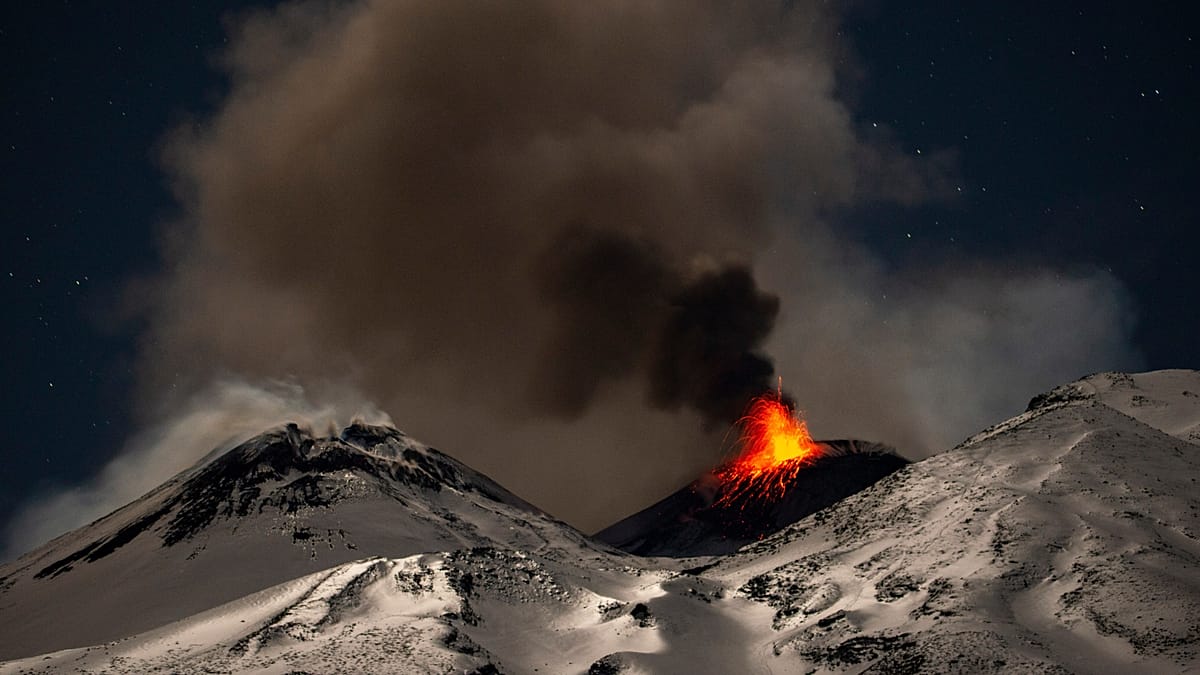
Mount Etna frequently puts on sensational volcanic displays, and tourists flock to climb the slopes and see the spectacle up close.
Above certain altitudes, it is a legal requirement to go up with a qualified guide.
On Wednesday, dozens of these official guides demonstrated in front of Mount Etna’s lava flow gate, calling the new restrictions excessive and saying the lava flows are slow-moving enough to be viewed safely, as has been done in the past.
On Tuesday night, forestry police were stationed on the slopes, enforcing restrictions. According to local media, 21 people were reported to local authorities for non-compliance.
“These measures effectively nullify the role of guides, stripping them of their skills, function, and professional responsibility,” a statement by the guides’ regional board said.
The guides, who are expected to continue their strike in the coming days, hope to come to a compromise with authorities that can protect their profession while also ensuring the safety of visitors.
Claudia Mancini, a 32-year-old tourist, said she came from Palermo for an excursion with a guide at Mount Etna.
“Unfortunately, we got the bad news of the cancelling of all activity,” Mancini said, adding that she sympathised with the guides over a situation that ”is not making anyone happy.”
What are Mount Etna’s new excursion restrictions?
The lava flows are especially spectacular after sunset, but under the new rules, excursions are allowed only until dusk.
Visitors can go no closer than 200 metres to the lava flow. A previously existing limit of 10 people per group is also being vigorously enforced, including with drones.
The latest restrictions were adopted after Mount Etna started a round of eruptions on Christmas Eve.
The most advanced lava front reached 1,360 metres above sea level, before stopping and entering a cooling phase after a journey of approximately two miles, local authorities said.
The lava flow poses no danger to nearby residential areas, volcanologists say, nor to hikers with guides.
“Among all the eruptions of Etna in recent years, there hasn’t been one as harmless, pleasant, or as little dangerous,” Catania volcanologist Boris Behncke, who is based at the National Institute of Geophysics and Volcanology (INGV), wrote on Facebook.
“I don’t know what on earth went on whoever deemed it useful to issue these ordinances, in an area that needs much more intervention to provide a service to the community and to this environment that hosts and nourishes us.”
Italy’s National Institute of Geophysics and Volcanology confirmed this week that Mount Etna’s eruption is ongoing, but said the lava fronts are cooling and not advancing further.
“This is a lava flow that is descending very slowly on an area that is now also flat or semi-flat,” said Dario Teri, a member of Sicily’s association of alpine and volcano guides who participated in Wednesday’s protest.
Is it safe to visit Mount Etna during an eruption?
Mount Etna is Europe’s most active volcano and the continent’s largest. It attracts hikers and backpackers to its slopes, while less adventurous tourists can take it in from a distance, most stunningly from the Ionian Sea.
At 3,350 metres tall and 21.7 miles wide, the Sicilian giant frequently offers a front-row seat to nature’s power.
Last June, a massive eruption forced tourists to flee the volcano after a plume of high-temperature gases, ash and rock several kilometres high billowed into the air above them.
But the behemoth is closely monitored so warnings are usually issued in advance meaning even when it’s active, many trails and paths are still safe. There are also plenty of hiking routes that steer well clear of the summit and craters where explosions take place.
That said, visitors are always recommended to go accompanied by a local guide or agency – and if you want to hike past the 2,900-metre mark it is compulsory to hire a guide.
Read the full article here