





Whale hunting began far earlier — and much farther south — than scientists previously suspected.
Five-thousand-year-old whalebone harpoons and other artifacts along Brazil’s southern coast suggest that Indigenous communities actively hunted whales at least 1,500 years before the earliest evidence to date, researchers report January 9 in Nature Communications. The findings not only rewrite the origins of whaling, but also suggest that humpback whales once lived outside their modern range — meaning animals now moving into the region may be reclaiming ancient habitat.
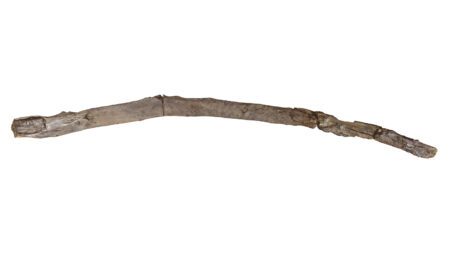
Until now, scientists believed that organized whaling originated between 3,500 and 2,500 years ago in the Arctic and North Pacific, driven by food scarcity in extreme northern environments. While whale bones have been found in South American archaeological sites, they were usually attributed to opportunistic scavenging of stranded animals. The new evidence points to active hunting: specialized bone harpoons, crafted whalebone objects and bones with cut marks from systematic butchery.
The artifacts came from vast shell mounds known as sambaquis, which are abundant along Brazil’s southern coast. To save them from urban development in the mid-20th century, an amateur archaeologist collected more than 10,000 objects from sambaquis in the Babitonga Bay area. The collection is now held at the Sambaqui Archaeological Museum in Joinville. These mounds could reach 30 meters in height and served as not only landfills but also burial sites, with the deceased often accompanied by crafted whalebone objects.
When archaeologist Andre Colonese and colleagues recently reexamined the collection, the scale of the whale remains stood out. “There’s an absurd amount of whale bones in these mounds,” says Colonese, of Universitat Autònoma de Barcelona. A series of identical long sticks with pointy ends stood out: “These are harpoon heads,” he realized.
Laboratory analyses confirmed the harpoons’ 5,000-year-old age. Protein analysis of hundreds of whalebone objects showed that most came from southern right whales (Eubalaena australis), but some were from humpback whales (Megaptera novaeangliae) and several dolphin species. The humpbacks came as a surprise, as they had long been absent from Brazil’s southern coast, says Krista McGrath, a biomolecular archaeologist also at Universitat Autònoma de Barcelona.
The finding provides a unique insight into the region’s ecology before European colonization. Humpbacks were probably wiped out from these waters by intensive whaling during the 17th and 18th centuries, Colonese says. Their recent, tentative return to the area may therefore represent a recolonization of historic habitat rather than a shift driven by modern population growth.
This distinction matters. It can help conservation efforts by showing that the natural range of humpbacks included areas as far south as Babitonga Bay, even though their current breeding grounds are hundreds of kilometers to the north, the researchers say.
Similar protein studies have been common in Europe and the American Northwest in the last decade, but “very few studies have actually undertaken this in the Southern Hemisphere,” says Youri van der Hurk, a zooarchaeologist at the University of Bergen in Norway who was not part of the study. “It doesn’t surprise me at all that humans were exploiting whales all over the world when they were close to their settlements.”
Some whale species would have been especially vulnerable. Southern right whales frequently linger near the coast with their calves and stay afloat when they die, making it easier for hunters to recover the animals, the authors say.
Researchers have often resisted the idea of early whaling in resource-rich places like Brazil, McGrath says: “Why would you risk doing that?” But a single whale could yield such a bounty of food and other valuable materials such as fat, oil and bones, which were turned into tools, she says, that the question answers itself: “You catch a whale and you’re good for months.”
The team plans to survey other areas along Brazil’s coast and suspects that similar evidence for whaling across the Americas will appear now that scientists know what to look for. They are also building a catalog of whale species present before European arrival, hoping to inform conservation efforts. “Then we will be able to tell conservationists, biologists and politicians, ‘Look, these are the species that were here,’” Colonese says.
Read the full article here