



The Council of the European Union sanctioned four individuals on 16 March, accusing them of conducting hybrid manipulation and foreign interference activities on behalf of Russia.
In practice, this means their assets will be frozen, while EU citizens and companies will be forbidden from providing them with funds or financial assets.
Who are these four people, and how have they spread disinformation about Russia’s full-scale invasion of Ukraine?
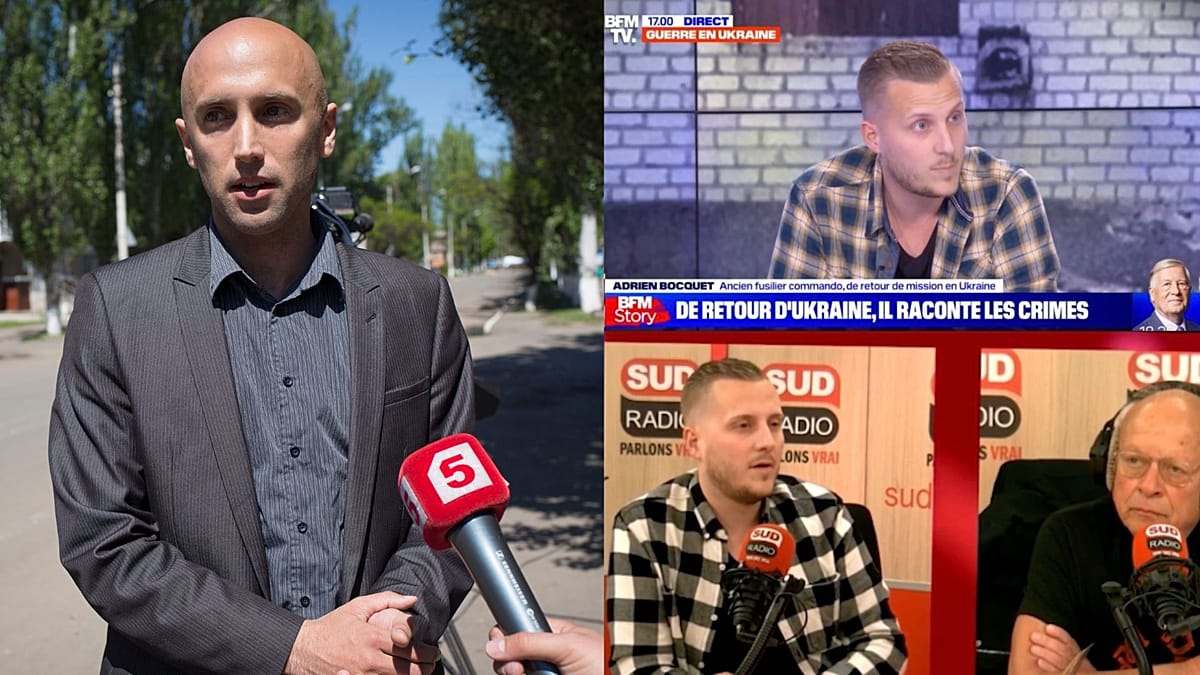
Adrien Bocquet
Adrien Bocquet, a former member of the French military, intensified his activities amplifying Kremlin propaganda in Europe and Russia following Moscow’s full-scale invasion of Ukraine.
France’s Minister for Europe and Foreign Affairs, Jean-Noël Barrot, told reporters that Bocquet was a “recruiter of foreign fighters in Ukraine, responsible for condoning war crimes, and also responsible for disinformation campaigns in Europe and Africa.”
In 2022, he was interviewed by multiple mainstream French media outlets, after he claimed to have returned from a humanitarian trip to Bucha, which led him to claim that he had witnessed alleged grave crimes committed by the Ukrainian army.
In reality, Bocquet’s claims echoed propaganda peddled by Russia’s Ministry of Foreign Affairs and turned out to be entirely falsified.
Bocquet has since been interviewed by multiple Russian TV channels and has also made documentary style reports using Kremlin propaganda points.
Graham Phillips
Phillips, a former clerk for the now-defunct UK Central Office of Information, began his career spreading information about Russia and Ukraine by writing a blog titled Brit in Ukraine. He first travelled to Ukraine in 2009 for a football match.
Screenshots from the blog, which has since been deleted, show Phillips wrote about everything from politics, history, football and sex tourism in Ukraine.
Over time, Phillips became notorious among pro-Kremlin bloggers for developing his own YouTube channel and reporting from within Crimea often in tandem with Russian state-controlled television channel, Russia Today, for which he was employed as a freelancer.
After a brief stint in the UK, he returned to Russian-occupied areas of Ukraine following Moscow’s full-scale invastion. In April 2022, he was accused by British MP Robert Jenrick of war crimes after he interviewed British citizen, Aiden Aslin, who had been captured by Russia whilst fighting in the Ukrainian military.
Interviewing prisoners of war under duress is illegal under the Geneva Conventions. His YouTube channel, which aired the interview, was subsequently demonetised.
In 2022, Phillips became the first British citizen to be added to the UK government’s sanctions list concerning Russia’s full-scale invasion of Ukraine — a decision which he denounced. He has additionally been sanctioned by Ukraine since 2022 and banned from entering the country.
His social media channels suggest that Phillips now resides in Russian-occupied territories. He is active on X, Telegram, Instagram and Facebook where he posts videos about his life. His latest video places him in the Russian-occupied city of Mariupol.
In 2017, a BBC investigation revealed Phillips was using crowdfunding sites to finance his videos from inside the war.
A Telegram post made by Phillips in May 2025 indicates he continues to turn to public support for his videos. The post asks donors to give money to a Russian bank account, or email him to offer alternative means of support.
Under the new restrictions put in place by the EU, Phillips is subject to an asset freeze and EU citizens and businesses are prohibited from making funds available to him.
Ernest Mackevičius and Sergey Klyuchenkov
The EU’s measures also target Sergey Klyuchenkov and Ernest Mackevičius, both TV anchors who have regularly appeared on Russian state-controlled television channels.
Klyuchenkov, a host on pro-Kremlin outlets including Komsomolskaya Pravda and Soloviev LIVE, is described by the EU as a “propagandist” who has supported attacks on Ukraine, including against civilians and called for further escalation.
The bloc also accuses him of advocating for the “de-Ukrainisation” of Russian-occupied territories, including banning the Ukrainian language and removing Ukrainian cultural symbols. He has suggested expanding the conflict beyond Ukraine and called for the Russian occupation of Baltic States and retaliatory strikes against European countries.
Mackevičius, meanwhile, is the lead anchor of news programme Vesti at 20:00 on state-owned Rossiya 1. The EU says he has consistently broadcast misleading and biased coverage of the war including portraying Russian advances in a positive light and downplaying the Ukrainian resistance.
In 2014, he was awarded the “Order of Friendship” by Russian President Vladimir Putin for covering Crimea.
Read the full article here