




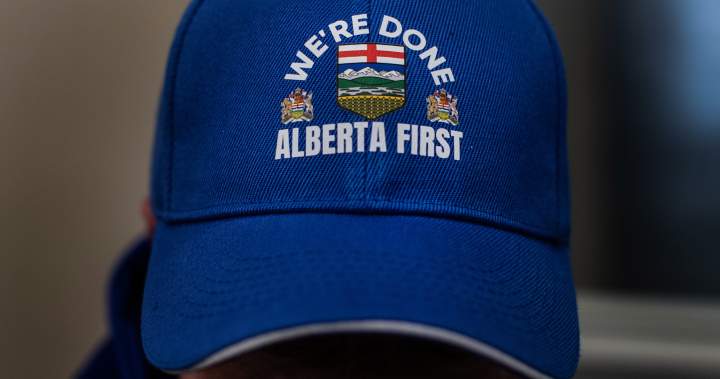
Every day across Alberta, groups are gathering to sign a petition to force a vote on the province leaving Canada — but when faced with the costs and consequences of doing so, only half of those interested in separatism are truly committed to following through.
That’s according to new data released by Ipsos after it polled about 2,000 Canadians, between Jan. 9 and 14, as part of its Confederation Stress Test study.
The pollster asked about 500 people each in Alberta and Quebec about independence and found that while initial support in both provinces is about three in 10 residents, a deeper dive revealed that support in the Prairie province varies.
When asked if they would vote for their province to begin the process of separating from Canada and seeking a new agreement to define its future relationship with the country, approximately 29 per cent of people in Alberta and 31 per cent in Quebec said yes. (Ipsos said that includes those who would definitely or probably vote yes, and those who say they would lean towards it.)
However, the Ipsos research that “stress-tested” those sentiments by introducing real-world consequences revealed that actual committed support for separation is roughly half the levels in both provinces.
Only 15 to 16 per cent of Albertans and Quebecers maintained their support after considering possible downsides such as standard of living declines, pension losses or trade renegotiations.
The stress test methodology, which Ipsos said asked separatist supporters whether they would maintain their position under five different challenging conditions unique to each province, revealed nearly identical patterns.
In Alberta, there are three distinct kinds of separatists: committed, conditional and symbolic.
- Ready to pay the price: the most committed who would maintain support for leaving regardless of the economic or social costs made up 56 per cent of respondents who said they would vote to leave Canada.
- Still deciding: those whose support was conditional, and would waver depending on the conditions and circumstances, made up 25 per cent of respondents.
- Just sending a message: the symbolic separatists who are using the independence threat primarily to express frustration rather than genuine intent to leave, and whose support Ipsos said would collapse when costs or consequences appear, made up 19 per cent. Ipsos said economics outweigh anger amongst this group.

Get breaking National news
For news impacting Canada and around the world, sign up for breaking news alerts delivered directly to you when they happen.
Ipsos said that means that for roughly half of separatist supporters in both provinces, independence is more a political message to Ottawa than a plan they are prepared to suffer costs and sacrifices to achieve.
Quebec showed a similar distribution of numbers as Alberta, which Ipsos said suggests the psychology of separatism operates similarly regardless of language, culture or specific grievances.
However, there were slight nuances: Quebecers were more likely to say their reason for voting “yes” is that the province’s future would be better served outside of Canada, while Albertans were more likely to say their reason for voting “yes” is because the province has historically been mistreated within Confederation.
Ipsos said the most committed separatists in both provinces were more likely to pick future prosperity as their reason for being a “yes” voter than conditional or symbolic separatists.
Ipsos said while 91 per cent of the committed separatists feel Alberta is deeply alienated from Canada, they acknowledged policy reforms could help.
The research suggests governments will have to try a range of policies to lure different separatist groups back into the fold.
Of the most committed separatists in Alberta, 70 per cent would consider joining the United States instead of becoming an independent nation.
The poll suggests 800,000 of Alberta’s five million people are truly ready to consider independence, while the other 4.2 million are not.
The data come as competing groups are pushing for a referendum on the issue: on one side is the “Forever Canadian” petition, which was launched to counter separatists who want a referendum on Alberta independence.
Former Alberta deputy premier Thomas Lukaszuk’s Forever Canadian petition aims to make it official policy for the province to stay in Canada.
It was successfully approved by Elections Alberta after approximately 438,000 signatures were collected — smashing the 294,000-signature threshold it needed to reach to initiate a possible referendum.
After the Forever Canadian petition was approved, new rules by the Alberta government came into effect.
One of the changes was lowering the signature requirements for citizen-initiated referendums while also increasing the length of time petitioners have to collect the necessary signatures to get a question on a ballot.
As a result, the pro-independence group needs to collect at least 177,732 signatures by May 2 — of which 10 per cent must be eligible voters from the last provincial election.
The signatures must then be validated by the province’s chief electoral officer, before the petition can be presented to the Alberta government.
The referendum proposal in question, put forward last year by the separatist group the Alberta Prosperity Project and being collected under the banner “Stay Free Alberta,” was proposed as: “Do you agree that the Province of Alberta shall become a sovereign country and cease to be a province in Canada?”
It’s being led by Mitch Sylvestre, the chief executive of the Alberta Prosperity Project and a United Conservative Party constituency association president.
Stay Free Alberta has been holding signature-collecting events for the past three weeks, with long lines reported at sites across the province.
Sylvestre has said the aim is to surpass the more than 400,000 signatures Lukaszuk’s petition garnered.
Ipsos polled 2,000 Canadians between Jan. 9 and 14 as part of its Confederation Stress Test study, including 500 people in Alberta and 500 in Quebec. The national poll is considered accurate to within +/- 2.7 per cent, 19 times out of 20, while the provincial results are considered accurate to within 5.4 per cent.
Read the full article here