





Becoming a king of lions is as dramatic in real life as it is in the movies. A new four-part documentary series, Lion, captures the journey of a cub named Kio in Kenya’s Maasai Mara National Reserve as he grows into a young lion king.
Along the way Kio encounters dangers — including buffalo, hyenas, people, other lions and fire. He also experiences exile, brotherhood, loss and triumph. Documentary crews, including local Kenyan filmmakers, followed Kio and his pride for four years. The team logged more than 1,400 hours of filming days over 52 shoots. Executive producer Mike Gunton, creative director of BBC Studios Natural History Unit, teamed with Hollywood actor and director Jon Favreau to tell the young lion’s story.
Following the cub was a risky move. About half of lion cubs don’t survive to adulthood. The filmmakers didn’t know if Kio would make it through the rainy seasons when the crew left the pride’s land. “I was always waiting for that phone call,” Favreau said in a news briefing. The call came whenever the field crew “spotted Kio, and he’s a little bit older and he’s doing well.”
Favreau directed the 2019 live-action version of The Lion King. His team created that world digitally, directing every aspect of the action. But with Kio’s story, “we had zero control over what happened,” Favreau said. “We were really committed to not manipulating the footage using anything but narrative tools like music and editing.”
Lush cinematography captures the beauty of the Kenyan landscape. Every shot could easily be a painting. Sunsets silhouetting elephants and lonely trees, midnight skies full of stars, and marshlands that look like paradise are treats for the eyes. A score by Academy award–winning composer Hans Zimmer adds emotional depth to the gorgeous images.
Stabilized camera platforms on arms hanging off the back of pickup trucks allowed the crews to film the lions at eye level. That, Favreau said, “gave us a whole other layer of emotional dimension, because that’s how I would cover a scene to get emotional connection with a human actor. You want to be eye level, and you want to see what they’re thinking.”
Quiet drones also added unique perspectives. And the cameras had sensors that allowed the filmmakers to shoot in the low light before sunrise and at sunset, just the times when lions tend to do interesting things, Gunton said in the briefing.
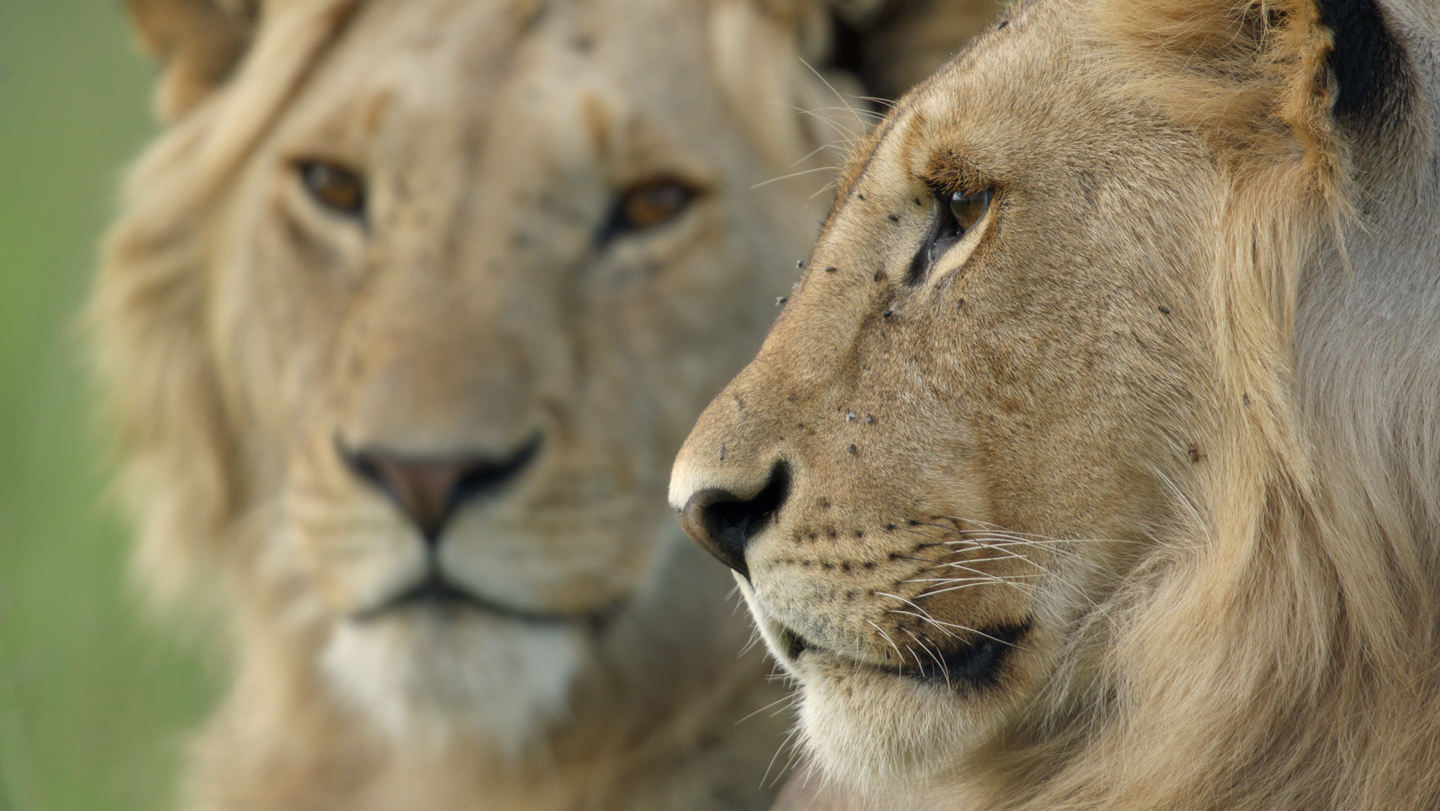
Even though the visuals are stunning, the filmmakers don’t shy away from the harsh realities of life on the plains where Kio and his pride live. For instance, black flies are ever-present, crawling and swarming over the lions’ faces and bodies. And some heart-stopping moments of action left me gasping in surprise and horror. But there is no gore. Deaths take place largely off-camera, and any animal-on-animal violence is G-rated.

The choice not to show especially difficult moments sometimes left me with unanswered questions. For instance, in the opening scene Kio takes on a male lion who is bigger, stronger and older than he is. That scene is revisited in a later episode, but the audience is left to assume the outcome of the scuffle. Who won the fight is something only the lions know, Gunton said.
Rainbow-colored birds and a diverse cast of other wildlife make guest appearances, illustrating the biodiversity of the African savannah. Some of those creatures provide comic relief, others a sense of menace. Buffalo are not to be trifled with, as Kio and I both learned.
Each of the four chapters of Kio’s story begin and end with a cliffhanger. Lion has plenty of action and adventure but is also filled with quiet family moments and punctuated with humor.
In the fictional Lion King, becoming a ruler is a solitary pursuit. But real-life male lions ascend the throne as a band of brothers. Kio and his brothers must learn to work as a team to hunt, defend each other and their pride and overcome older male lions. A male lion would probably not last long without his brothers. Kio is the youngest of his brotherhood but takes some brave stands as the teenage lions learn to be leaders. Together they ascend a metaphorical throne and win the favor of a pride of females.
Kio’s story is also the tale of his mother, Summer. She was always going to be a star of the film, Gunton said. She was one of four females in the pride the team thought they would follow. Summer had an extra ingredient. She was going to give birth to some cubs. “She was old,” Gunton said, “and these were probably going to be the last cubs she would ever have.” About halfway through the first year of filming the crew realized that Summer’s relationship with Kio was something special. Summer knew it too. “It was almost as if she knew he was going to be special and he was going to be her last chance,” Gunton said. “And even though he was a quite a weak little cub, really, there was something about him which just was amazing.”
Summer’s star power is evident as the lioness defends her cub, feeds her pride and teaches the brotherhood survival skills they will need when she is no longer with them. Her power and grace are on full display as she stalks and takes down prey. Summer’s softer side shows often as she rubs noses with and grooms her sisters, Kio and the males of their pride. She is a true queen among lions.
The series premieres August 19 on National Geographic and will be available for streaming on Disney+ and Hulu the next day. The soundtrack will also be available for streaming on August 21.
Read the full article here