





Physicists have just dropped a new precise measurement for gravity.
The newly published value for the strength of gravity, known as “G” or “Big G”, is significantly smaller than some previous measurements, researchers report in the April Metrologia. The disagreement reflects a long-running trend, and could mean there are hidden factors affecting these types of gravity experiments.
Since Isaac Newton published his theory of gravity in the 17th century, researchers have been trying to measure the strength of gravity. But as the weakest of nature’s four fundamental forces, it’s the hardest to measure precisely. A dozen precision experiments in the past 50 years have found a spread of values.
“All the other fundamental constants are measured very precisely, and big G is kind of this outlier,” says physicist Michael Ross of the University of Washington in Seattle, who was not involved in the new study. For example, the fundamental constant that defines the strength of the electromagnetic force is known with about 100,000 times less uncertainty.
Narrowing in on G won’t affect how we measure the weight of objects in our daily lives. But precisely knowing the fundamental constant is important to ensuring nothing crucial is missing from our understanding of gravity. If disagreements between measurements of G were found to be a reflection of nature, Ross says, it would completely break physics. “That’s why we spend so much time really trying to nail down these numbers, because they do really control the whole universe.”
The most common way to measure G involves suspending masses by fibers or wires to measure the gravitational pull between them. In 1798, English scientist Henry Cavendish developed one such setup, called a torsion balance, and scientists have been refining the method ever since.
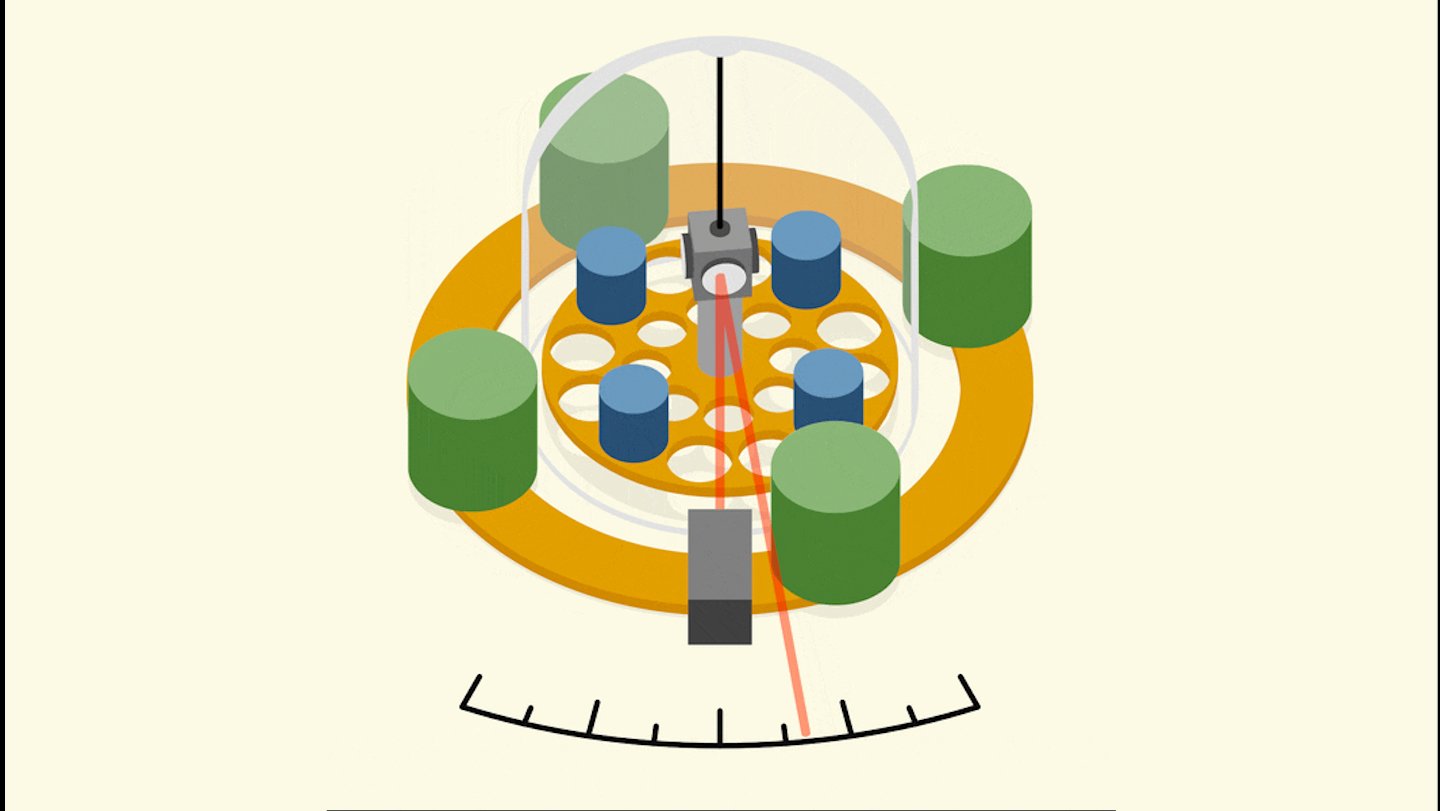
For the new study, physicist Stephan Schlamminger and his colleagues re-created a torsion balance experiment that was first performed in France in the early 2000s. In that setup, four large masses on a rotating ring encircled four smaller masses on a suspended disk. G was calculated by measuring the minute movement of the small masses as gravitational forces pulled them toward the larger masses.
By focusing on an existing technique, the team hoped to avoid simply adding yet another data point from an entirely new approach.
“The experiment took me about 10 years to complete,” says Schlamminger, of the National Institute of Standards and Technology in Gaithersburg, Md. “The results emphasize how difficult it is to measure this gravitational constant.”
The re-created experiment followed the French setup as closely as possible. To avoid biasing the result, the researchers hid part of the calibration from themselves until the end. Along the way, they also found previously unaccounted-for effects, including air pressure. The team eventually arrived at their new value for G: 6.67387 × 10⁻¹¹ meters cubed per kilogram per seconds squared.
That value is 0.0235 percent lower than the results of the original French experiment — a notable difference given the measurement’s precision — but closer to the value officially recommended by the Committee on Data of the International Science Council, which evaluates measurements of fundamental constants and publishes recommended values.
While the result won’t end the debate, it adds an important new data point and one the researchers hope will help scientists continue the quest for a trustworthy G.
Read the full article here