






Some New York students and teachers will be returning to classrooms outfitted with an uncanny-looking — and potentially unwelcome — AI-powered assistant come September.
The Salamanca City Central School District, located roughly 60 miles south of Buffalo, signed a $57,590 contract (PDF) with robotics startup Realbotix to introduce AI tools and a humanoid robot into select technology classes in Salamanca City Central High School.
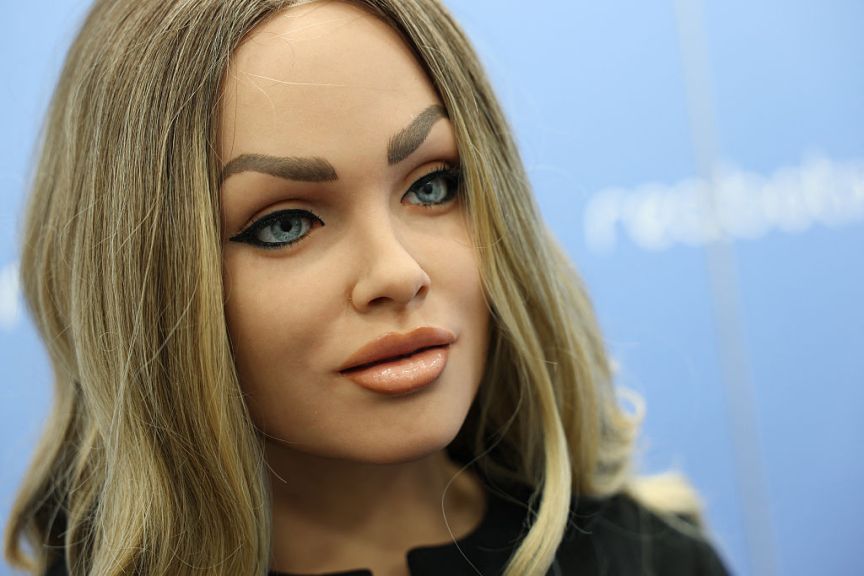
The humanoid robot, named Sally (pictured above), is one of Realbotix’s M-series models. It’s designed to mimic a human appearance, with silicone skin and a wide range of facial movements, though it’s limited to a stationary sitting position.
The Realbotix press release says that the robot “uses natural conversation, facial expressions and real-time interaction” to encourage student participation. Students will be assigned personalized ID numbers to interact with the robot, which will reportedly remember and respond to their learning data and previous questions.
In addition to the robotic teaching assistant Sally, Realbotix is integrating its Optio AI model into the school district to serve as an at-home tutor for round-the-clock homework support. The company says that both Sally and Optio are designed with education-specific safety guardrails in place.
Human educators will remain in Salamanca City Central High School’s robotics classrooms, where they’re expected to do most of the teaching and monitor the robot’s responses to students.
Optio initially will be available to high school students in AI and robotics classes, with plans to expand the program to 500 students in the fall.
“Many schools are taking the easy solution of simply banning [AI], but I have found that students will find a way around most rules that schools put in place,” Salamanca City Central District Superintendent Mark Beehler said last week in a written response to a Syracuse.com journalist. “I also believe that it is critical for schools to teach proper use of technology, not simply exclude it.”
The news spurred pushback from the teachers union and some members of the community.
“The future of education isn’t more artificial intelligence,” New York State United Teachers president Melinda Person told CNET in a written statement. “It’s more authentic human intelligence: more relationships, more mentorship and more opportunities for every child to be seen, known and inspired by a great teacher.”
Local parent Sierra Abrams responded to a district Facebook post about the partnership, calling the technology an inappropriate imposition.
“We already have so many issues in our community, including environmental issues,” she wrote. “I just don’t understand the concept of adding AI onto that.”
AI in education
Schools have been grappling with the perils and promise of generative AI tools since ChatGPT burst onto the scene nearly four years ago, over issues ranging from cheating and cognitive development to the need to provide students with training for jobs that will have AI at their core. The rapid changes have spurred grassroots parent and teacher groups, including District 14 Families for Human Learning and the Coalition for an AI Moratorium, to petition state legislators to instate a two-year pause on AI integration in K-12 classrooms.
The Trump administration, meanwhile, has taken a decidedly positive stance toward adopting AI in education. US Secretary of Education Linda McMahon has emphasized that AI integration is one of the main priorities for her department, which has dedicated millions of dollars toward that goal.
Melania Trump and a Figure 03 humanoid robot during the Fostering the Future Together Global Coalition Summit.
Oliver Contreras/Getty Images
First Lady Melania Trump has also championed AI in the classroom, appearing at a summit with an AI-powered educational robot named Plato to promote her Be First: Fostering the Future initiative. At that event, she spoke of placing AI-powered robots in children’s homes to “aid their education” and “boost analytic skills and problem solving.”
More broadly, President Trump has thrown his full support behind American AI companies. In December, for instance, he signed an executive order designed to deter state governments from creating “cumbersome legislation” that could impede the construction of AI data centers or the development of LLMs.
Teachers and robots
The Salamanca City Central School District is part of Apple cofounder Steve Wozniak’s Woz Ed STEM curriculum program, which focuses on science and technology education. Aside from spending money on contracts such as the Realbotix integration, the district offers activities including a drone and robotics camp and free Makerspace access to students.
The district is located on the Allegany Indian Reservation and serves 1,300 students; nearly one-third of the student body is Indigenous. According to the US Census Bureau, Salamanca has above-average levels of poverty. New York Focus reports that roughly four in five of the district’s students are economically disadvantaged — and critics are concerned that the integration of AI in schools will disenfranchise the student population of the already underserved area.
A NYSUT spokesperson said over email that the details of the contract between the Salamanca City Central School District and Realbotix were not shared with teachers ahead of the announcement, and that the superintendent has instructed staff members to communicate concerns to him instead of taking them to social media.
“Teachers were not consulted about the placement of this AI robot, and the contract could [instead] hire two actual human teaching assistants in classrooms for the district,” the spokesperson wrote.
“The program is intended to complement, not replace, teachers by giving students supervised access to emerging AI and robotics tools as part of the district’s existing STEM curriculum,” a Realbotix spokesperson told CNET over email.
A representative for the Salamanca City Central School District did not immediately respond to a request for comment.
“Our students are not lab rats”
Then there’s the technology itself. While LLM-powered chatbots can scour vast troves of information to generate answers, essays and more within seconds, it’s also prone to errors and misrepresentations, known as hallucinations.
Beehler, the district superintendent, told New York Focus that the integrated LLMs will respond to questions with “I don’t know” rather than hallucinate to answer students. It’s unclear, however, how a large language model would identify that it’s about to hallucinate an answer.
The teachers union objected to aspects of both the technology and the company tapped to provide it.
“Our students are not lab rats. They should not be treated as such,” the NYSUT spokesperson wrote. “There are serious concerns about this technology, its implementation and how Realbotix sold it to district administration in the first place. Salamanca should not be a springboard for another company’s jump into trying to sell districts a new gadget they don’t need, especially a company with the background of Realbotix.”

Multiple media reports have tied Realbotix to the adult-product business RealDoll, which produces hyperrealistic robot adult toys. RealDoll is a subsidiary of Simulcra, which was acquired by Realbotix in 2024.
The Realbotix spokesperson told CNET that there is no relationship between RealDoll and the team working on Sally.
“Realbotix LLC focuses exclusively on non-adult commercial applications, including healthcare and education,” the spokesperson wrote. “No adult-products company has any involvement in the Salamanca project or in any product developed by Realbotix LLC.”
Realbotix and RealDoll do not share employees, payroll, physical locations or technology, according to reporting by New York Focus. The publication also reported that Realbotix is planning to divest itself of RealDoll by the time Sally is implemented into the Salamanca classrooms.


See full bio
Read the full article here