





There’s a new speed demon in the galaxy.
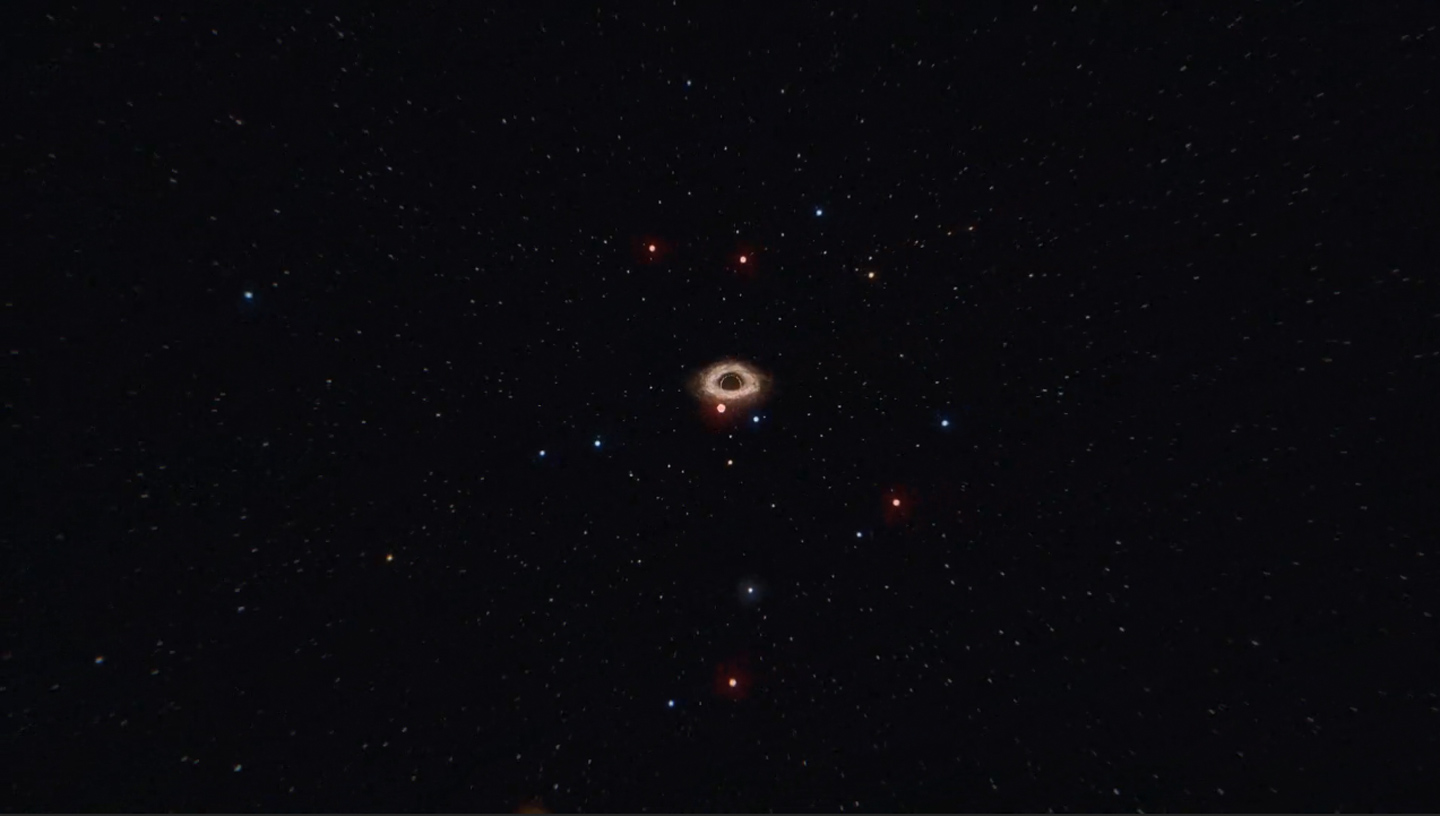
Astronomers spotted a star that reaches top speeds of 25,000 kilometers per second, about 8 percent the speed of light. But the star’s real superpower is its location, researchers report Aug. 19 in Nature. It’s the closest known star to the Milky Way’s supermassive black hole, Sagittarius A*, and it could help scientists measure the black hole’s most elusive characteristic: spin.
“The star which we have discovered has such a great potential, and we’re really all excited about it,” says astronomer Stefan Gillessen of the Max Planck Institute for Extraterrestrial Physics in Garching, Germany. Measuring that spin could help scientists better understand black hole physics.
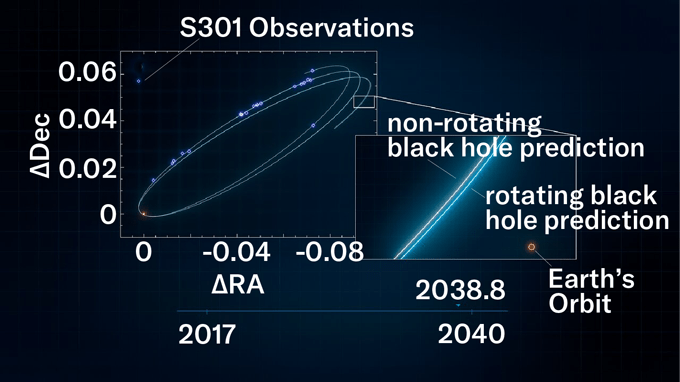
The new star, dubbed S301, was discovered by the GRAVITY+ collaboration, which uses the European Southern Observatory’s Very Large Telescope Interferometer to see objects 4 billion times fainter than what you can see with your eye. The star is about 50 percent larger than the sun and was first seen in images taken in 2023. To map the star’s 8.7-year orbit, astronomers combined two subsequent years of observations with historical data back to 2017.
S301 is in an extremely elongated orbit that brings it just 1.7 billion kilometers from Sagittarius A* — just a bit farther than the distance between Saturn and the sun. At this distance, as the black hole spins, it should subtly change the star’s orbit over time. By tracking the star’s orbit over years, scientists will eventually have enough data to calculate the black hole’s spin, Gillessen says.
Stars’ orbits have already helped scientists calculate Sagittarius A*’s mass, which is about 4 million times that of the sun, but measuring spin requires a much closer star. Researchers have been interested in black hole spins because they can help astronomers understand how the object has grown.
A fast spin suggests the black hole has been consuming material in a regular manner, says astrophysicist Laura Brenneman of the Harvard-Smithsonian Center for Astrophysics in Cambridge, Mass., who was not involved with the study. A slower spin indicates the black hole fed from a more chaotic buffet. Spin is also thought to influence a black hole’s jets and winds, making it a useful puzzle piece for understanding a black hole’s effects on the surrounding galaxy.
The spin of a black hole can also be measured indirectly by studying the X-rays emitted by gas near some black holes and gravitational waves created in the collision of two black holes. But these methods require modeling and assumptions that leave some debate over whether the spin is correct.

“They’re still, in my opinion, good measures, but they are indirect,” says astronomer Christopher Reynolds of the University of Maryland in College Park, who was not involved with the study. “This [star] gives us the opportunity to make a much more direct measurement.”
A precise measurement of the Milky Way black hole’s spin would also bring Einstein into the equation. A black hole’s spin is predicted by general relativity so a lack of spin or spin exceeding the maximum limit set by the theory could pose a challenge, Reynolds says, though scientists do not expect this to be the case.
Read the full article here