






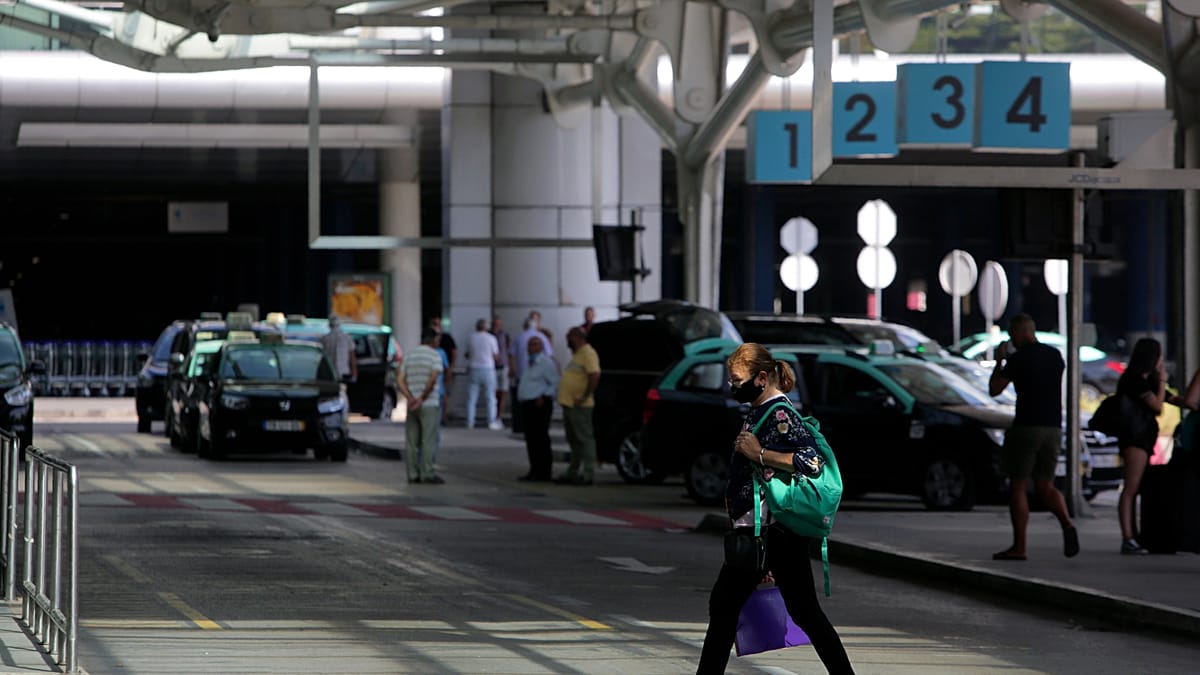
Fake taximeters, kilometre-long detours, cash-only payments. Social media is awash with reports of alleged scams involving taxis operating from Lisbon Airport.
“A trap for tourists,” is how Josien Nation, a content creator living in Portugal, described it in a video posted on her Facebook page earlier this month.
In the video, Nation says taxi drivers charge more than they should or simply do not have the meter running.
“Taxis are just a scam,” she adds.
Nation also detailed two possible scenarios that can lead to getting scammed.
In the first, a tourist negotiates the price with the driver for the journey between the airport and their destination. The driver sets the price and the meter stays off.
In the second, a tourist does not negotiate the price, and the meter is not switched on, so the taxi driver decides on whatever fare they want at the end of the journey.
A user on Reddit highlighted another example: “I have been taking taxis regularly for more than 10 years to go from the airport to Largo do Rato,” they said.
“The journey usually costs around 11 euros. Twice this week, the driver tried to pull a fast one on me: either by taking unnecessary detours of several kilometres or by using fake taximeters on their phone. They then present a fare of 19 euros, 21 euros or even more, to be paid in cash.”
Zeynep Tinaz Redmont, a Turkish journalist living in Portugal, also recalled an occasion when she was charged more than she should have been for a trip to central Lisbon.
“In recent years, taking a taxi from the airport to downtown Lisbon has become a stressful experience. When we go to the airport, the fare usually does not exceed 14 euros. The return journey is another story,” she wrote in an article published in Diário de Notícias in May.
“On one occasion, I politely pointed out to the driver that he had not turned on the meter. He braked sharply just as we left the airport and said: ‘If you want to get out, get out. The journey has a fixed price: 25 euros.'”
She went on to explain that she ended up agreeing to pay 20 euros for the trip after telling the driver that she travelled frequently and had never heard of such a fare.
Such accounts have now gained prominence after the Public Security Police (PSP) carried out a road inspection operation at the arrivals area of Humberto Delgado Airport in Lisbon, in which 67 offences related to taxi activity were recorded.
The Lisbon Metropolitan Command said in a statement on Wednesday that, as part of Tuesday’s operation, around a hundred taxis were inspected, resulting in 32 offences for “improper positioning of the taximeter,” out of a total of 67.
Among the offences, a further eight related to the absence of a CMT (Taxi Driver’s Certificate), six to a lack of mandatory documents, six to expired fire extinguishers, three to being without a valid inspection, and three cases involving the lack of “Group 2” certification, which is mandatory for taxi drivers.
Two offences were also recorded for outdated taximeter calibrations, two for taxis being in poor condition, one for failure to use appropriate restraint systems, one for lack of insurance, one for driving under the influence of alcohol, and one for parking in a private car park.
The PSP also issued two notices ordering drivers to present documents and carried out two external investigative measures relating to one of the drivers.
The PSP’s operation went down poorly with the National Association of Road Transport in Light Vehicles (ANTRAL), which accused authorities of staging a “media show” at the taxi rank at Lisbon Airport’s arrivals area.
In a statement, ANTRAL said the operation effectively paralysed the process of picking up passengers and left the taxi rank deserted, creating a “degrading and frightening” image of the country for tourists.
The association representing the sector stressed that it had nothing against inspections and said it has been actively fighting illegal touting at the facility. However, it objected to the choice of location and the method used, particularly the inspection of vehicles while passengers were already on board.
For the organisation, carrying out the operation at this strategic point of the airport and “in this manner” appeared to be aimed at “other ends,” harming passengers and the taxi industry.
Read the full article here