




Neptune’s moon Nereid may be the sole survivor of an ancient moonpocalypse.
A new study suggests that the strange satellite was born in a steady, circular orbit around Neptune, then tossed into its current elongated orbit during a chaotic encounter with a Pluto-sized body that ejected or pulverized all its sibling moons. This idea counters the assumption that Nereid formed in the Kuiper Belt, the cold reservoir of space rocks in the outer solar system, and was pitched into its present orbit later, researchers argue May 20 in Science Advances.
“Maybe it got perturbed outward, rather than kicked inward,” says planetary scientist Matthew Belyakov of Caltech. “Nereid is that last remaining signature of the original satellite system.”
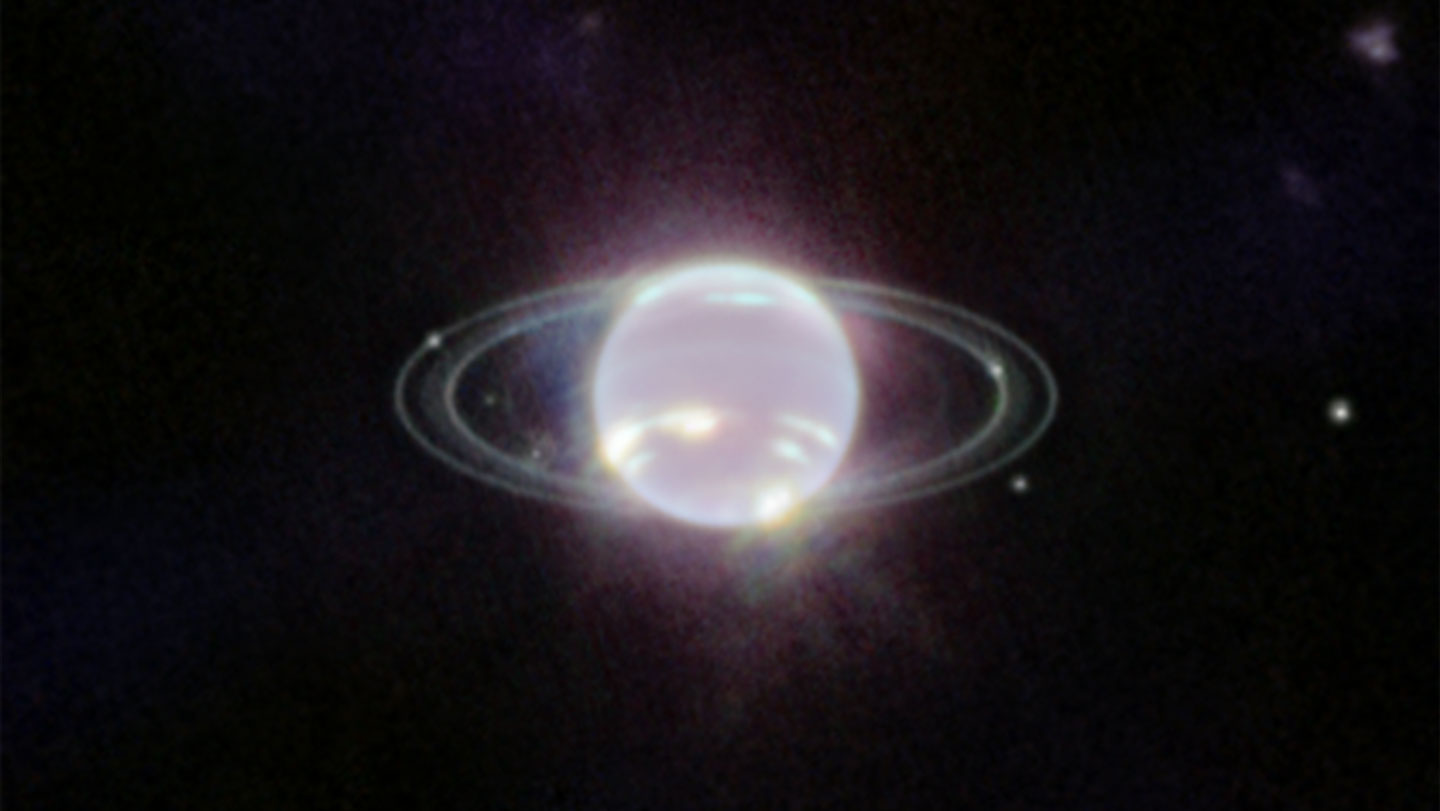
Neptune’s largest moon, Triton, orbits backward and makes up more than 99 percent of the mass of all the planet’s moons combined. Most of Neptune’s other moons orbit the planet from a shorter distance and are small and rubbly, suggesting they’ve been through a lot of collisions. Planetary scientists think Triton came from the Kuiper Belt and wreaked havoc on the rest of the moons when Neptune captured it billions of years ago.
Nereid stands alone. It orbits in a wide ellipse far from Neptune. That puts it in a family of moons from across the solar system called irregular satellites, many of which are also thought to be captured Kuiper Belt objects. But it’s brighter, larger, more eccentric and closer to its host planet than other irregular satellites in the solar system. “Nereid always is an outlier,” Belyakov says. Maybe its origin story was an outlier, too.
Belyakov and colleagues compared James Webb Space Telescope observations of Nereid’s makeup with those of other Kuiper Belt objects. Nereid wasn’t a good match for any of them.
That left the possibility that Nereid formed locally. Belyakov and colleagues ran computer simulations of Triton’s known chaotic arrival at hundreds of different masses and orbits for Neptune’s original moons, including the destroyed ones.
None reproduced Nereid’s exact present-day orbit. And some ended with Triton leaving the system or crashing into Neptune. But about 20 percent produced a moon on a Nereid-like orbit, without destroying Triton. That’s enough to make the story believable, Belyakov says.
Nereid itself is still largely mysterious. The best picture we have of it is about five pixels across, from the Voyager 2 mission in 1989. Belyakov is holding out for a spacecraft flyby someday. “That’s the next frontier, missions to the ice giants,” he says.
Read the full article here