




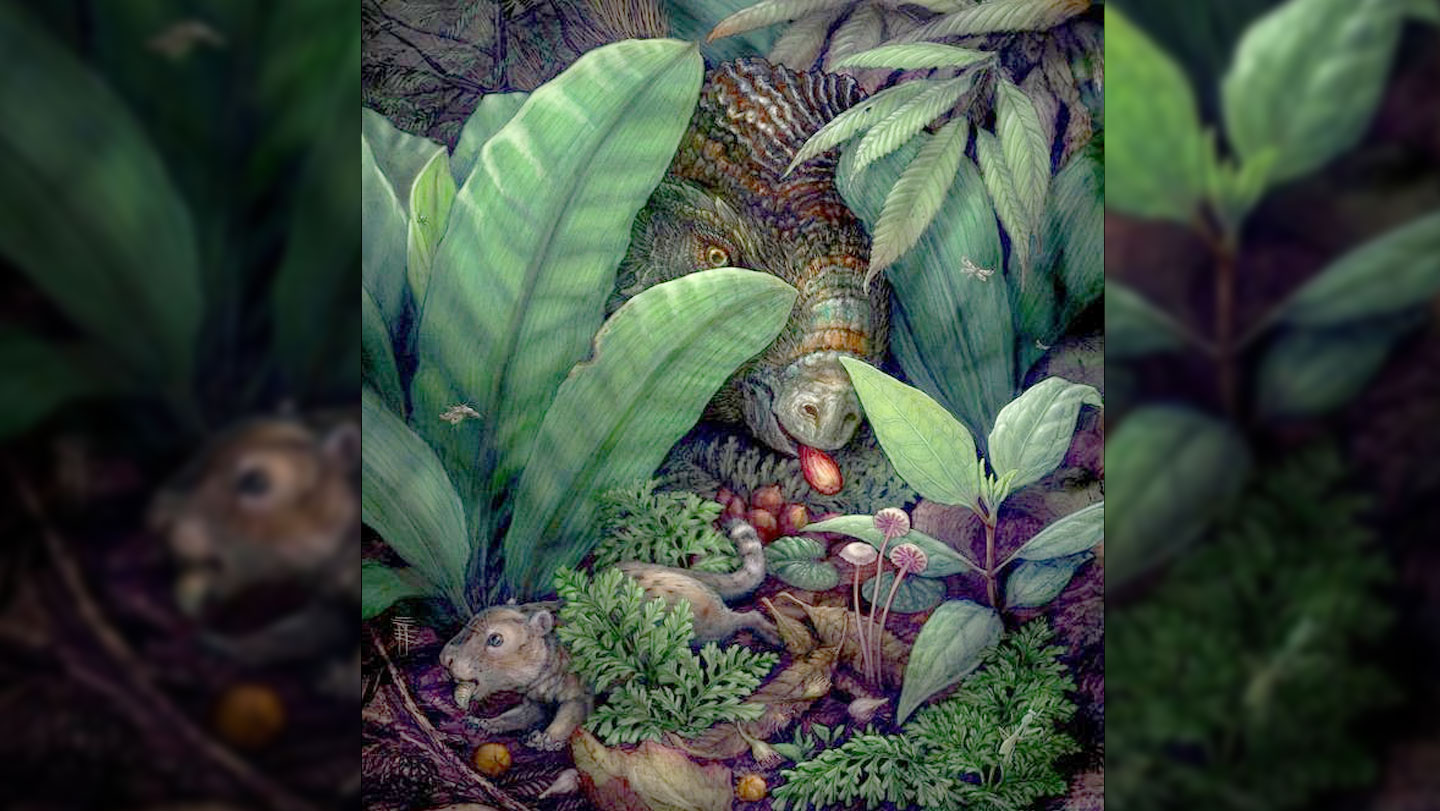
Fruit salad may have been on the menu for some dinosaurs.
Over 74 million years ago, there was a richer garden of fruit- and seed-bearing plants than scientists thought. A fossil analysis suggests that tall forest trees spread winged seeds and fed animals with fleshy, blueberry-sized fruits long before the reign of the dinosaurs ended, researchers report June 25 in Science.
The findings upend our understanding of the evolution of flowering plants, say paleoecologist Jaemin Lee of the University of California, Berkeley and colleagues. The traditional view was that flowering plants, called angiosperms, used mostly wind and other inanimate means of seed dispersal until the end of the Cretaceous Period. It wasn’t until an asteroid struck Earth 66 million years ago, causing a mass extinction event that killed all nonavian dinosaurs and made way for the Age of Mammals, that angiosperms hit their stride. In this new world, the plants evolved a wider, more complex repertoire of seeds and fruits that were often eaten and carried away by animals.
But an analysis of fossil diaspores — structures that include fruits and seeds — from the Late Cretaceous challenges this narrative. Lee’s team examined 450 fossils that were unearthed from a layer of ancient volcanic ash in south-central New Mexico from 1992 through 2016. The diaspores took on nearly 80 different shapes. Some had winged forms while more than a third were fleshy like berries. The largest were about the size of a small date.
“There are rocks with a bunch of large diaspores preserved together,” Lee says. “They make me think of trays of grapes or pistachios.”
Until now, the diversity of diaspore types prior to the extinction was thought to be low, says Brian Atkinson, a paleobiologist at the University of Kansas in Lawrence who was not involved in the work. And records of large, fleshy fruits were few and far between. “This study suggests that bigger diaspore sizes were certainly well-established before the end of the Cretaceous,” Atkinson says. “That’s a very important finding.”
Today, animals such as birds, mammals and reptiles routinely eat the fruit of flowering plants, excreting or discarding leftover seeds. The similarities between these ancient diaspores and modern ones strongly implies that Cretaceous animals, perhaps some pterosaurs and extinct rodentlike mammals, would have enjoyed the fruits, Lee and colleagues think. Cretaceous birds and dinosaurs, which are known to have fed on diaspores from other plant groups, such as conifers, may have switched to angiosperms as their fruits became available.
Fossilized, diaspore-speckled dung from the Late Cretaceous, turned up in previous work, suggests that vertebrates ingested diaspores. But it’s hard to know which animals the poop belonged to. “Matching poops to their extinct producers can be challenging,” Lee says.
Overall, the findings align with other patterns of angiosperm evolution in the Cretaceous, says paleobotanist Selena Smith of the University of Michigan in Ann Arbor. The plants were rapidly evolving their leaves, growth forms and overall size. “It only makes sense that the reproductive structures would be similarly evolving during the Cretaceous as plants are becoming more efficient and specialized,” Smith says.
These plants eventually became the dense, angiosperm-dominated forests we know today. They just appear to have gotten their start during a time when the local fauna looked very different. The next step, Atkinson says, is sampling other fossil sites that date to the Late Cretaceous. That would help confirm that these fruits filled prehistoric forests around the world.
Read the full article here