




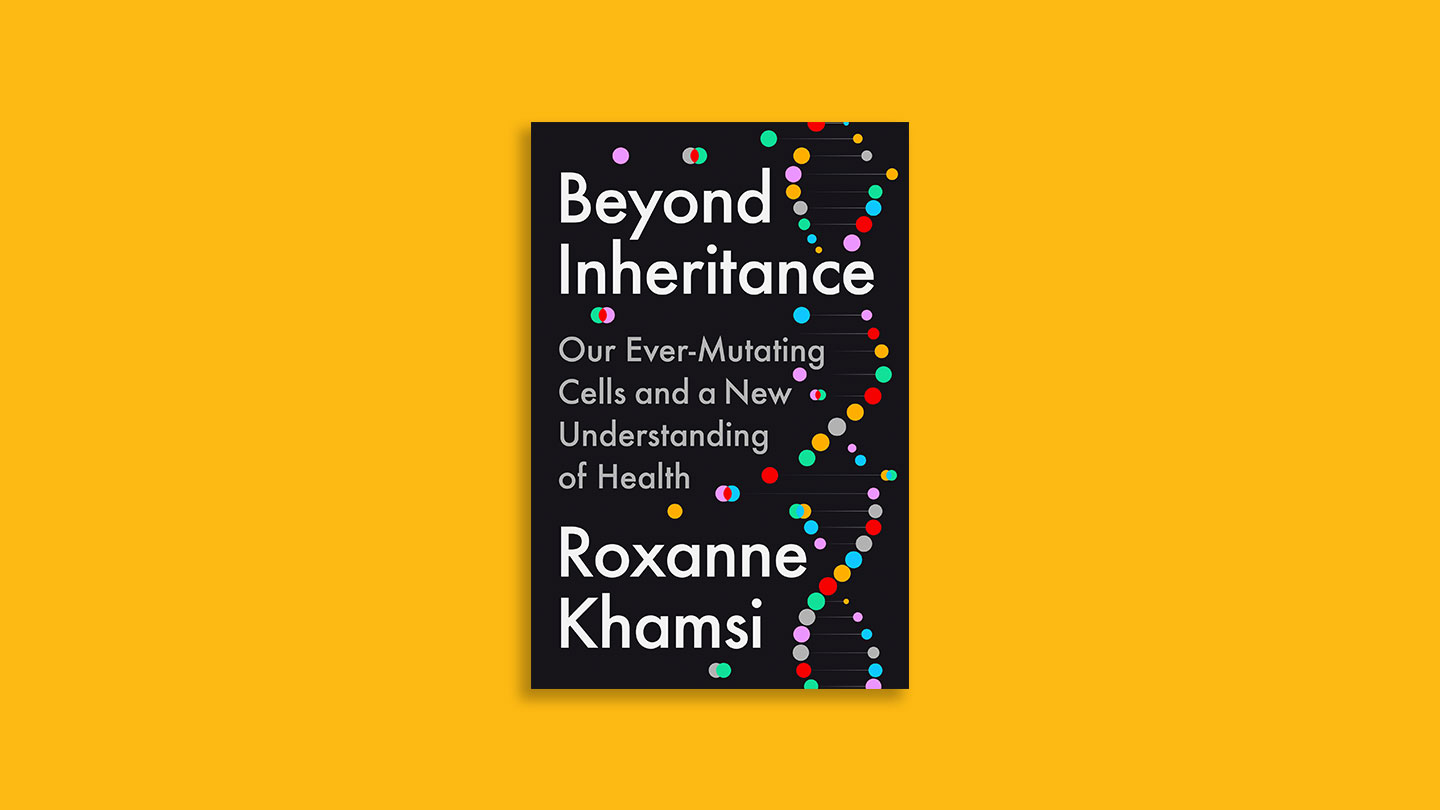
Beyond Inheritance
Roxanne Khamsi
Riverhead Books, $30.00
It’s easy to think of the human body as a single, fully integrated unit. After all, stub your toe all the way at one end of your body, and your brain registers it at the other. A suite of muscles works together to hop up-and-down and the lungs fill with air to expel curses from your mouth. In this moment, your body is one organism, one set of cells all pulling together against the world — and whatever it was that hurt your toe.
But while our cells all work together to help us walk, eat and argue with each other on the internet, they are not all pulling together toward the same goal all the time. Each one of the body’s 30 trillion to 40 trillion human cells is its own world, with its own set of DNA that accumulates its own changes over time.
These mutations can mean nothing, but they can also mean everything. While many mutations are inert, others cause harm. Still others bring hope, and could correct some of the body’s problems, science writer Roxanne Khamsi explains in Beyond Inheritance. The book draws on the latest research across multiple fields of science to show that mutations are with us throughout our lives, shaping our health and our lifespans.
Many people might think of mutations as things that arise and take over only in times of trouble such as cancer. Otherwise, mutation is something that matters only if it’s passed down to the next generation — whether it produces a new eye color or a serious genetic disorder. But mutations do far more than determine what we look like when we’re born and the manner in which we die, Khamsi argues. “Our genetic destinies are not necessarily defined by what we inherit from our biological parents,” she writes.
Khamsi details the effects of mutations arising in adult cells with contagious fascination. The reader doesn’t need to be conversant with different types of mutations or even exceptionally clear on what DNA is made of. Khamsi’s easy, friendly writing style makes understanding concepts such as tumor suppressor genes and cellular competition simple and quick.
When mutation comes to mind, it’s easy to jump to the worst that could happen — cancer, early-onset dementia, genetic disorders that cause skin to blister painfully when touched and more. Here, Khamsi’s well-researched, reassuring presence comes to the fore. Yes, mutations can and do cause these things. With that knowledge comes hope. Khamsi expertly weaves together the stories of patients, clinicians and scientists to show that understanding mutations can lead to better treatments and cures.
Some of those cures, Khamsi points out, might even come from within our own bodies. While there are the genetic tweaks that can turn regular cells into destructive weedlike tumors, there are others that can call them to a halt. In some cases, a genetic defect can spur cells to mutate back toward health and take over an organ like a beneficial weed, leaving better function and health in their wake.
As an example, Khamsi offers up tyrosinemia, in which a common protein building block builds up in the liver and other organs. Without a transplant, the condition can be fatal for infants. In some cases, though, scientists have found clusters of affected cells mutating to a healthy state. Someday, researchers might be able to harness the skills of these mutating cellular heroes to stop the condition. “We so often think of mutation in a negative light,” Khamsi writes. “But sometimes it can be a force for healing. Sometimes, mutation is what saves us.”
Genetic mutations could also be responsible for other, less dire fates. Accumulated mutations could be the secret to aging and the limits of lifespan, Khamsi explains. There are even companies attempting to halt aging by killing highly mutated cells. But just because we can, she argues, doesn’t always mean we should. “We need to ask if we could do so with enough precision,” she writes.
Mutation is both normal and inevitable, Khamsi shows. Our cells are constantly evolving within us, and we should consider whether those changes are good or bad before we ride in to stop them. Beyond Inheritance encourages us to think of mutation not as something positive or negative, but rather, something that simply is. It’s an important consideration as we seek to cure disease. “Humans are the first living creature seeking to shape our genetic destinies,” Khamsi writes. “However, we may need to ask whether it would always be wise.”
Science is only at the beginning of understanding how dynamic our living cells can be, Khamsi concludes. “Rather than seek to put an end to all mutations full stop, we should welcome the helpful ones and accept the harmless ones as a part of who we are,” she writes. “Our bodies are brimming with genetic possibilities with the power to shape our future.”
Buy Beyond Inheritance from Bookshop.org. Science News is a Bookshop.org affiliate and will earn a commission on purchases made from links in this article.
Read the full article here