




The Canadian government awarded millions worth of contracts to the son of Iran’s former vice-president, despite an ongoing investigation into allegations he helped the Islamic Republic evade sanctions and develop missile systems, documents obtained by Global News reveal.
Since founding two companies in Alberta, an Edmonton resident named “Sal Ghafouri” has received more than $2 million in federal and provincial contracts, including from the RCMP and Department of National Defence, public records show.
The 45-year-old was part of an official Canadian trade mission to Latin America, received a federal business grant and was invited to “propose legislation” to the Alberta government at consultations backed by the province’s economic development minister.
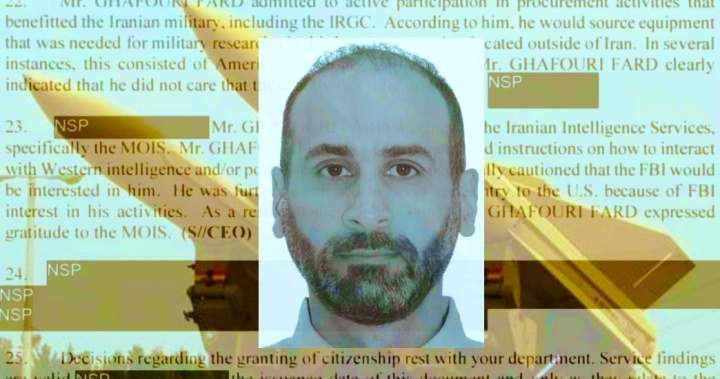
But according to newly released records, Ghafouri is actually Mohammad Reza Ghafouri Fard, an Iranian who has been the subject of a long-running Canadian investigation into his alleged work for Iran’s military and Islamic Revolutionary Guard Corps.
The son of Hassan Ghafouri Fard, an Iranian politician who served as the country’s vice president, Ghafouri was “involved in the research and development of Iranian military technologies,” according to a recently declassified Canadian Security Intelligence Service report.
Before immigrating to Canada in 2013 and going into business as “Sal,” Ghafouri allegedly helped develop a guided anti-aircraft missile system and a jamming tool to “confront American aircraft” for the Iranian military and Revolutionary Guard, or IRGC.
He was also part of a “covert procurement structure” that used a front company in Southeast Asia to purchase components that were needed for Iranian military projects, CSIS alleged in its report detailing his alleged past work for the regime forces.
The allegations concern the four years CSIS alleges Ghafouri worked as an engineer at Iranian company Rabi Kosar, which the report said sold its products to SA Iran, a satellite of the Iranian Ministry of Defence, which in turn provided them to the military and IRGC.
Ghafouri “admitted to active participation in procurement activities that benefited the Iranian military, including the IRGC,” the CSIS Security Screening Branch wrote in its Jan. 13, 2023 report on Ghafouri.
The procurement network was needed because the materials were not available to Iran due to sanctions, but “Ghafouri Fard clearly indicated that he did not care that these activities were prohibited,” CSIS added.
After moving to Alberta through the government’s skilled worker program, Ghafouri returned to Iran in 2015 and met twice with members of Iran’s Ministry of Intelligence and Security, or MOIS, the CSIS report also said.
“During Mr. Ghafouri Fard’s first meeting with the MOIS, he provided details of his employment in Canada,” according to the CSIS report, marked “secret” but recently made public in court.
“He was asked if he travelled to the U.S. and whether he had contacts with either Canadian or American intelligence services,” added the report, which noted he was a permanent resident of Canada at the time he met the MOIS.
“During the second meeting, he was given detailed instructions and warnings, as they related to police or intelligence services approaching him while living in Canada,” it said.
“He was advised to never travel to the U.S., as he would be of interest to the Federal Bureau of Investigation due to his involvement with Rabi Kosar,” it said, adding he thanked the Iranian agents for the “heads up.”
The report, which CSIS shared with immigration investigators more than three years ago, noted that “one of the functions of the MOIS outside of Iran is to acquire technology for Iran’s military industry.”
Canada launched a crackdown on Iranian regime officials living in the country in 2022 and has been attempting to deport them along with others who have aided Tehran as it has repressed its citizens and sponsored terrorist groups.
But the Ghafouri case stands out for the seriousness of the allegations about his suspected role in Iranian weapons proliferation, the length of time it has taken the government to act and his extensive contract work for Canadian agencies.
“This is yet another example of the way Canada has failed to take seriously the threat,” said Iranian-Canadian human rights activist Kaveh Shahrooz, who reviewed the CSIS report on Ghafouri for Global News.
“Our politicians pay a lot of lip service to countering the Iranian regime’s nefarious influence in Canada. But cases like this show that we fail to conduct even the most basic due diligence on those with strong, direct ties to Iran’s regime.”
CSIS declined to comment. It shared its security screening report on Ghafouri with Immigration, Refugees and Citizenship Canada, which also declined to comment.
In May 2026, the immigration department informed Ghafouri it was launching proceedings to deny him from obtaining citizenship on the grounds that he is a “threat to the security of Canada.”
Ghafouri did not respond to questions. His lawyer, Bjorna Shkurti, said she could not comment because the matter was before the court.
“What I can say is that my client has lived in Canada for over a decade and has undergone multiple security screenings, both as a temporary resident and as a permanent resident,” she said.
“He strongly disputes the allegations made against him and intends to pursue all available legal avenues until the matter is fully resolved.”
None of the federal government agencies that gave contracts to Ghafouri’s companies responded to requests for comment by deadline.
But records show that while Ghafouri was flagged by immigration investigators for national security reasons in 2017, he nonetheless went on to win government procurement contracts, including two worth more than $1.5-million from the Canadian military.
Even after CSIS completed its security screening report in 2023 and sent it to immigration authorities handling his case, Ghafouri’s companies continued to benefit from federal money.
In 2024, Innovation, Science and Economic Development Canada awarded Melanite Group a $15,000 grant “to adopt new technologies.” Six months later, the company won another contract from the Canadian Armed Forces.
The case suggests that Canadian agencies are not talking to each other, said University of Ottawa political science Prof. Thomas Juneau, who specializes in Iran and national security and reviewed the CSIS report for Global News.
“To some degree, these processes and silos are necessary if we want the system to be fair and not arbitrary,” he said. “But the system just goes to the other extreme.”
“I mean, it’s absurd,” he said.
Juneau said he had interviewed three dozen Iranian-Canadians for a forthcoming book on transnational repression.
“And one thing that constantly came up was the presence of regime, regime-adjacent and regime family members here.”
Military service is compulsory in Iran, but the children of high-level regime members can get a pass, if they are studying at Western universities. Ghafouri wrote on his Canadian immigration forms that he was exempted from army duty.
Instead, he came to Canada in 2005 to earn his master’s degree in engineering at Dalhousie University in Halifax. He dropped out after just one week, citing a family emergency, according to thousands of pages of documents on his case released to Global News.
The records show he returned to Iran, where his father was a conservative Member of Parliament and former vice-president to Akbar Hashemi Rafsanjani, a leader of the 1979 Iranian revolution that brought fundamentalist clerics to power.
Ghafouri told CSIS he “deeply respects his father but recognizes that they differ ideologically,” the report said. He said his father was “not a hardliner,” but Juneau said that while reformists, moderates and hardliners differed on policies, “it remains that they’re all regime loyalists.”
Upon arriving home from Nova Scotia, Ghafouri went to work as an engineer at Rabi Kosar, a company devoted exclusively to research and development projects for Iran’s military, according to the CSIS report.
His first project was a system called Shahin, also known as Hawk, according to a CSIS report, which described it as a medium-range anti-missile system developed by the U.S. army.
In 2010, Iran unveiled its first domestically built air defence system, which it boasted was better than Hawk and equipped with Shahin missiles with a 150-kilometre range, CSIS noted in its report.
The Iranian army called it Mersad, and said it was a “completely indigenized system developed by the Iranian experts and technicians to promote the country’s combat power.”
Ghafouri’s next project was an electronic warfare project called RAAD, which used radio signals to jam enemies’ communication capabilities, he told CSIS in an interview, the report said.
The IRGC air force unveiled RAAD in 2012 and said it was “designed to confront American aircraft at a distance of up to 50 kilometers, through the use of associated missiles,” CSIS wrote.
His third project was called SINA, a direction-finding system with military applications that could locate ships in the Persian Gulf and determine their direction of travel, according to CSIS.
The CSIS report said that while Ghafouri claimed he did not deal directly with the Iranian military or IRGC, he was in contact with SA Iran, which the intelligence agency said was “a satellite company of the Iranian Ministry of Defence (MoD).”
“The MoD would then provide the products to the military or IRGC. Mr. Ghafouri Fard maintained contact with an SA Iran buyer, to ensure that these projects would be suitable for military use and that the purchased equipment met military standards,” CSIS wrote.
A company called SAIRAN is sanctioned by the U.S. for its role in developing Iranian missiles and Shahed drones that Russia uses in Ukraine. The U.K. sanctioned SAIRAN in 2020 for manufacturing electronic components for Iran’s weapons systems.
Eighteen months into his job at Rabi Kosar, Ghafouri was reassigned to a new role as a project manager at the company office that illicitly imported components needed for its military projects, CSIS said in its report.
“Working with engineers to identify which specific parts were needed, he would provide the requirements to a Malaysian-based contact, who in turn would source their requirements from third-party countries, to include the United States,” it said.
Using the Rabi Kosar procurement network, Ghafouri launched his own company, Sima Technologies, in Iran in 2009, but the business failed, the CSIS report said.
CSIS said he joined two demonstrations organized by Iran’s Green Movement, which was protesting the 2009 re-election of president Mahmoud Ahmadinejad.
But he then returned to Canada in 2013 as a permanent resident and, after a period of unemployment, worked as a research assistant at the University of Alberta, according to his resume.
He then founded Melanite Group, which lists government “procurement” as one of its services, and says its clients included the governments of Canada, B.C., Saskatchewan, Manitoba and Ontario, as well as the International Atomic Energy Agency.
In 2018, Ghafouri incorporated a second company, Radian Group Ltd., which also received government contracts. He is the only director of both firms, which share a common address and phone number, according to Alberta corporate records.
He registered the companies as Mohammad Reza Ghafouri Fard, which is the name on his Iranian passport. But on government contracts, he used the name Sal Ghafouri. On his immigration application, he wrote that Salman was his nickname.
Documents viewed by Global News show that Melanite and Radian won multiple contracts to procure materials for federal agencies — among them, the RCMP, which hired Ghafouri to purchase a borescope imaging device.
The defence department also hired him to supply “snow vehicle parts” to CFB-Shilo in Manitoba, where Canadian, U.S. and allied troops are trained. He got another military contract to procure six vehicle lifts in Halifax.
The Correctional Service of Canada awarded Melanite a $100,000 contract in 2019, while in 2021 the company won a $380,000 contract from Innovation, Science and Economic Development Canada.
Melanite not only received government contracts, but also filed complaints when it was not awarded them. In 2019, the company alleged it was improperly disqualified from a military contract, while in 2021 it alleged “irregularities” in the bidding process.
Originally a “one-man show,” Melanite has grown “into a team of several employees, consultants, and contractors,” according to documents filed in Federal Court.
“Since its inception, it has proudly served all levels of government in Canada by supplying equipment and services to organizations such as universities, municipalities, and provincial and federal departments.”
Melanite’s most recent contract was in 2024, when it was granted a $50,000 job from the Canadian Forces to supply “road motor vehicles” to Borden, Ont., the location of the military’s largest training base.
Four years after moving to Canada, Ghafouri submitted an application form for Canadian citizenship. But records show his file was suspended within months at the request of the Canada Border Service Agency intelligence unit, which raised national security concerns.
A year after submitting his application, Ghafouri turned for help to his local Liberal MP, whose office made repeated inquiries with immigration officials on his behalf, even after being told the delay was due to “security verifications.”
He went next to Ralph Goodale, then the Minister of Public Safety, whose staff were also repeatedly advised that “security checks are ongoing,” according to immigration records.
Ghafouri then wrote to the director of the Canadian Security Intelligence Service, claiming in a letter that he had never been involved in any “military or political matter in Canada or abroad.”
He expressed his “dissatisfaction” with the security screening process and threatened legal action. His next move was a complaint to the National Security and Intelligence Review Agency.
Behind the scenes, national security officials were investigating Ghafouri, documents show, and in 2021, they determined there might be grounds to refuse him citizenship on security grounds.
The Canada Border Services Agency, meanwhile, did its own investigation and decided to launch deportation proceedings against him “due to his employment activities while in Iran.”
The CBSA withdrew the case last November, “due to an inability to use the required evidence,” according to government documents.
The documents do not specify whether the evidence in question was from CSIS. The CBSA declined to comment on the matter.
Ghafouri is now pursuing legal action against the immigration department, alleging the handling of his citizenship application has caused him “hardship and prejudice.”
He said the delays had forced him to miss a memorial service for his father, who passed away in 2023. He was also unable to join Canadian government trade missions, he said.
He has asked the court to award him $5,000 to $25,000 for his troubles.
In materials filed in court, Ghafouri said he had answered CSIS’s questions “in a truthful and forthright manner,” had made significant contributions to Canada and was not a security threat.
Government agencies would not have contracted his services or invited him on overseas trade missions if he was a threat, according to his court submissions.
“It’s hard to see, if there were real security concerns, how he would be permitted to engage in such business activities,” his lawyer argued.
“We have built our family, professional and community endeavors in Edmonton, Canada,” Ghafouri wrote. “And the uncertainty and delays associated with the processing of the citizenship applications and whether we will be able to stay in Canada permanently has placed a big toil on our family.”
Stewart.Bell@globalnews.ca
Read the full article here