





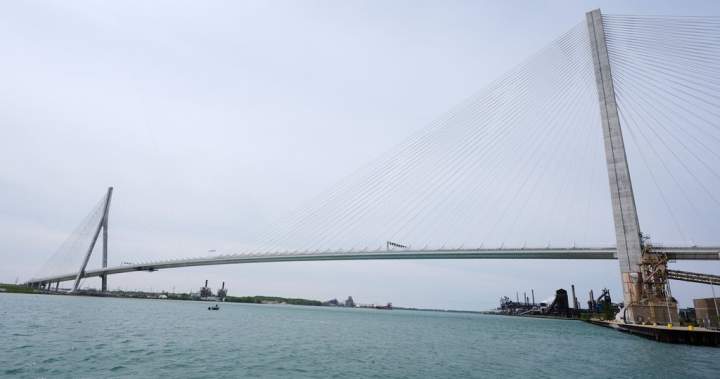
EDITOR’S NOTE: A previous headline to this story incorrectly suggested Canada will not be holding an event to mark the opening of the Gordie Howe International Bridge. There will be a Canadian ceremony but it will no longer include representatives from the U.S. as originally planned.
Canadian government officials will no longer be celebrating the opening of the Gordie Howe International Bridge with American representatives at this week’s ribbon cutting event, Ottawa said Tuesday after U.S. President Donald Trump threatened steep new tariffs on Canada.
“In light of trade action threatened by the United States earlier this week, it would be inappropriate to proceed with a celebratory event between the two countries,” a spokesperson for Infrastructure Minister Gregor Robertson’s office said in an emailed statement.
The bridge is scheduled to open to traffic on July 27 under a new revenue-sharing agreement with the U.S. that was struck after Trump delayed the opening by over a month.
A joint Canada-U.S. ribbon cutting ceremony was set for this Friday ahead of the opening.
Following the new deal, Canadian and American officials have sought to portray the opening of the bridge as a symbol of enduring ties between their nations despite economic and diplomatic tensions with the Trump administration.
“What I can tell you is that in terms of the agreement, it appears that there’s no distance between us and the Canadian government,” U.S. Ambassador to Canada Pete Hoekstra told Global News in an interview last week.
“We’ll have a ceremony on July 24. I expect that the people who made that agreement (agree) that it will open on the 27th.”


Get breaking National news
Get breaking Canada news delivered to your inbox as it happens so you won’t miss a trending story.
However, Robertson’s office suggested Friday’s ceremony will instead be celebrated separately by the Canadians and the Americans, after Trump on Monday signed executive orders to impose 50 per cent tariffs on several Canadian goods in 30 days’ time.
Robertson will join other federal officials at the Canada-only ceremony.
“The Gordie Howe International Bridge remains a vital infrastructure project that reflects years of hard work and will be a major economic driver in the region, expanding options for commuters, tourists, businesses, and families,” the Canadian statement said.
“In turn, we remain committed to opening the bridge on July 27, and to celebrating this milestone among Canadians on July 24.”
The statement noted the deals struck with the U.S. over the bridge “remain unchanged.”
The 15-year agreement to open the bridge connecting Windsor and Detroit is separate from the deal Ottawa signed in 2012 under the Harper government, which committed Ottawa to shouldering the full $6.4 billion cost of building the bridge while sharing ownership with Michigan.
Under that plan, which was approved by Trump during his first term, the two sides would split toll revenues only once Canada’s construction debt, including interest, was paid off.
The new agreement between the Carney and Trump governments would split the toll revenues between Canada and a “regional “economic development fund” for the first 15 years, and gives the U.S. a say on any toll changes greater than 10 per cent, a Canadian government source told Global News.
Neither country has published its terms and confusion around the new deal has run rampant over the last week.
Prime Minister Mark Carney told reporters last week that only “net revenues” would be split for those 15 years, and any toll revenue after that will only be shared after Canada’s debt is repaid.
“Those net revenues are after operational costs, so it’s manning the toll booths, it’s maintenance, it’s snow removal — a series of other operational costs,” Carney said.
Carney said his government expects that “after those costs for the first few years, net revenues will be modest. In fact, we expect them to be negative as traffic ramps up. So negative to modest in the first few years.”
“The underlying agreement that we have with Michigan remains the same, and so no sharing of tolls until all the debt is repaid,” he later added.
But two senior Canadian government sources told Global News the U.S. will indeed receive money collected during those first few years, noting tolls will make up the vast majority of revenues generated.
Both sources indicated it’s expected bridge expenses will exceed revenue for at least the first six years, meaning neither side would get money during that period, but that timeline could fluctuate based on the amount of traffic on the bridge.
Once the 15-year side deal is completed, the Liberals say the original financial terms under the 2012 agreement will come back into force.
Conservatives have called for the new deal’s full terms to be released publicly, and are looking at using parliamentary tools to force their disclosure.
—With files from Global’s Mackenzie Gray and the Canadian Press
Read the full article here