




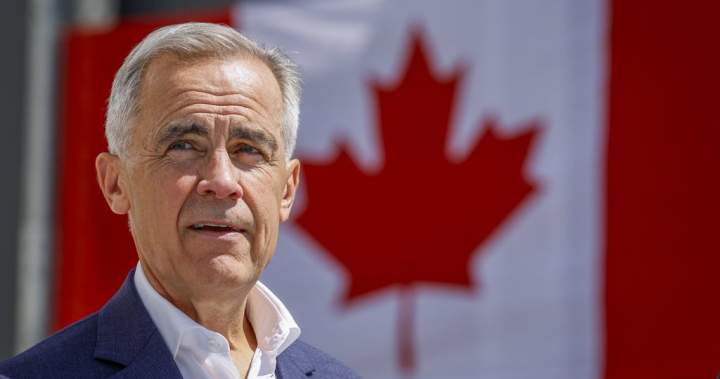
Prime Minister Mark Carney will gather scores of deep-pocketed investors in Toronto next week in a bid to fix Canada’s “Achilles heel” — a persistent lack of business investment dragging down the economy.
Hundreds of global and domestic investors with trillions of dollars in assets under management will descend on a downtown Toronto hotel on Sept. 14 and 15 for Canada’s first-ever national investment summit.
Carney, cabinet members, premiers and other Canadian business leaders will be there with lists of major projects across the country.
Alberta Premier Danielle Smith says she’s got a list of 34 proposed projects she’ll be shopping to investors at the summit; Saskatchewan Premier Scott Moe plans to pitch his provinces’ energy, critical mineral, defence and agriculture sectors.
New Brunswick Premier Susan Holt said she will be pushing multiple projects including a port expansion, a data centre in Lorneville, and a rehabilitation project of a power plant known as the Mactaquac lifetime achievement project.
The investment event is being co-organized by the Prime Minister’s Office with the Canada Pension Plan Investment Board and Public Sector Pension Investments, two of the country’s largest asset managers.
The summit is, in many ways, the manifestation of the capital-focused agenda Carney laid out 18 months ago when he first took office. Since that time, he has reoriented federal policy and Ottawa’s budget framework to funnel spending to critical infrastructure and other major projects.
Carney has set what experts consider a lofty goal of “catalyzing” $1 trillion in investments in Canada over five years.
Mahmood Nanji, a fellow with the Ivey School of Business at Western University, said Canada has suffered from a well-documented dearth of business investment for much of the past decade, which has fed into weak productivity and sluggish growth.
“This has been a bit of Canada’s Achilles heel over the last couple of decades. And this is why I think Prime Minister Carney, upon being elected, this was his big bet on rebuilding the Canadian economy,” Nanji said.


Get breaking National news
Get breaking Canada news delivered to your inbox as it happens so you won’t miss a trending story.
Critics usually blame that investment shortfall on a history of regulatory burdens and the long timelines and uncertainty facing project approvals in Canada.
The CPP Investment Board’s Insights arm published a report Monday surveying 65 of the world’s largest asset managers on how they view Canada’s investment opportunities.
While the energy sector stands out globally as Canada’s most attractive realm for investment, it also comes with the sharpest risks. Fears of policy reversals, regulatory fragmentation and scale or liquidity constraints were cited prominently by those surveyed.
The Conservative party points to what it calls “anti-development laws” and levies like the industrial carbon price as Liberal policies holding back the resource extraction and manufacturing sectors.
CPP’s survey of asset managers also highlighted Canada’s relative strengths in the competition for global capital.
Canada ranked well on openness to capital and execution in the energy transition, and trailed only Singapore when it came to policy stability and predictability. Nearly 70 per cent of investors ranked predictability as extremely important or essential in decisions about where to park their money.
Jeremy Kronick, president and CEO of the C.D. Howe Institute, said Carney has taken a number of steps to show that Canada is “open for business” since taking office in March 2025. The major projects office and One Canadian Economy Act look to streamline approvals for nation-building projects, for example.
Kronick said that’s enough to start shifting conversations about Canada as a destination for investment. But he suggested there’s more work to be done on other problems such as interprovincial trade barriers — the kind of regulatory snarls that can cause uncertainty about an otherwise viable project.
“I think there’s been enough done on the change in tone. I think regulatory processes are harder to change,” Kronick said.
Political opinion also has shifted in a way that could make it easier to win public approval for major projects, Nanji said.
Angus Reid polling from July suggested broad support for a new pipeline from Alberta to the B.C. coast, for instance. But major projects like these are also common targets for litigation, and Nanji said officials will need to do more to ensure Indigenous stakeholders are on board before making too many promises to investors.
“There are still risks. They’ve not been eliminated, but they’re not as big as they were perhaps a decade ago,” he said.
There are signs that external capital is already taking a renewed interest in Canada. Statistics Canada said foreign direct investment hit $96.8 billion in 2025, the highest level since 2007.
BMO chief economist Doug Porter said most of this inflow of foreign money so far has come in the form of mergers and acquisitions — not the kind of greenfield investments that organizers of the upcoming summit hope can get new projects off the ground.
The foreign direct investment figures are all the more encouraging given the backdrop of the Canada-U.S. trade war, Porter said. He said that, all other things being equal, he would have expected investment inflows to fall off in the face of President Donald Trump’s aggressive tariff agenda, which puts access to the U.S. market at risk.
All of the experts who spoke to The Canadian Press said the escalation of the tariff war over the past few weeks will definitely be part of the conversation at the summit. But it might not be a deal-breaker.
Summit participants are being presented with a list of projects that is likely to include ports, pipelines and critical mineral extraction. Nanji argued that means many of the opportunities being put in front of investors will be about getting Canadian goods to markets other than the United States.
“Some of the investors might be a little bit jittery about this relationship with the United States … but if some of these projects are going to be exporting goods to other markets, that may not necessarily factor into their decision,” he said.
Speaking to reporters at the Liberal cabinet retreat in Banff on Thursday, Carney suggested that his pitch to investors will focus on Canada’s reliability as a supplier in an uncertain world.
“Canada is about so much more than being next to the United States, OK? We have what the world wants,” he said.
Read the full article here