




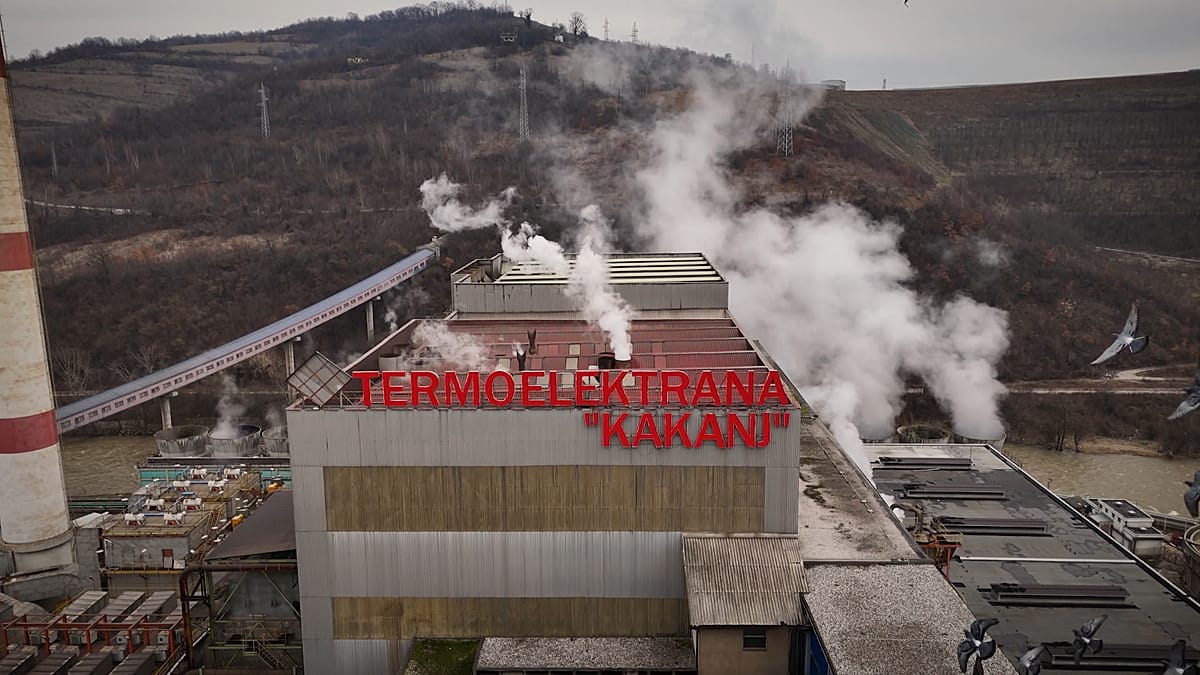
In Kakanj, an industrial town in the heart of Bosnia and Herzegovina, everything revolves around lignite. Thousands of jobs depend on it.
Here lie 440 million tonnes of coal, one of the largest deposits in Europe. I get special authorisation to enter the huge open-cast pit.
Coal was already being mined in Kakanj during the time of the Austrian emperor. Before World War I, some five thousand miners toiled here. Today, there are still 1200.
One of them is Omer Hrustić: “I was literally a kid when my uncle brought me to the work site. Yeah, it’s three generations, literally. My granddad, my grandfather, my uncle… every male figure in my family is tied to mining. Mining is a big part of my life.”
Production in Kakanj is now set to rise from 700.000 tonnes last year to 800.000 tonnes in 2026. This is despite the fact that burning lignite releases extremely high levels of pollutants. And there are massive emissions of CO2 and SO2.
Fossil fuels are the main cause of global warming and the climate crisis. Mining engineer Omer Hrustić knows this too: “As a society, we need to look for better ways to supply energy. When the time comes, we need to be prepared. But we are currently dependent on coal. And on our work, our hard work.”
There are seven state-owned coal mines in the Federation of Bosnia-Herzegovina, one of the two entities of Bosnia and Herzegovina (the other being Republika Srpska with two big coal mines). Their mountain of debt is totalling around one hundred million euros.
Financial disaster plus environmental problems: Why keep digging instead of phasing out coal? Iso Delibašić is the director of the Kakanj coal mine: “Bosnia and Herzegovina needs energy. The future of the coal mine must not be called into question.”
“Let’s do some maths”, I ask Delibašić, “take the coal you still have in the ground today, how many years could it last?” The coal mine director estimates, that the geological reserves of the Kakanj coal mines could last “for the next 40-50 years”.
Euronews: “In 2050, will this mine still be working or not?”
Delibašić: “We can say that Bosnia and Herzegovina still lacks a lot of energy. That’s why our future should not be jeopardised. Let’s take into consideration our geological coal reserves.”
Euronews: “Do you feel bad about helping to kill planet earth?”
Delibašić: “We produce coal. This coal is used by someone else. Do I feel bad about doing my job? Of course not!”
Let’s move on. The chimney of the Kakanj coal-fired power plant is as tall as the Eiffel Tower and emits huge amounts of pollutants and CO2. How does Bosnia and Herzegovina plan to become climate-neutral by 2050?
Bosnia and Herzegovina also committed to this goal at the Western Balkans summit in Sofia. The country is a member of the Energy Community, an international organisation in which the European Union and candidate countries develop rules for the energy market.
But Bosnia and Herzegovina is not complying. Some of the power plant units date back to the 1970s. Their remaining operating hours agreed have long since been exceeded.
There is a lack of modern filters. Yet, many of these very old reactors are still in operation. Why weren’t these units shut down long ago?
Bosnia and Herzegovina’s outdated coal-fired power plants emit over 200,000 tonnes of sulphur dioxide per year, eleven times more than permitted, reports Bankwatch, a network of regional non-governmental organisations.
The European Commission’s 2025 Country Report also strongly criticises Bosnia and Herzegovina’s energy policy. And the European Energy Community has initiated infringement proceedings.
In Kakanj, unit 7 is one of the big troublemakers. Power plant director Adem Lujnović blames the local weather conditions for high pollution levels: “When inversion weather conditions occur, we experience high levels of air pollution. It happens in the winter or summer, when we have stable weather conditions and high air pressure.”
Years were wasted. Reforms were postponed. Laws were delayed. I ask the power plant director why the old units weren’t shut down long ago. “We had already considered switching to natural gas in 2010”, he says, “but it wasn’t cost-effective, coal was cheaper.”
Locals are paying a high price for this decision: with their health. Edina Dogdibegović lives on the outskirts of Kakanj. “The power plant burns two million tonnes of coal a year,” she says.
Air pollution alerts are issued in both summer and winter: “In January we had an air quality index of 9-9-5, very dangerous! 2000 micrograms of sulphur dioxide per cubic metre! Well above the limit!”
There are also emissions from a cement works and residential furnaces. There seems to be an increase in cases of cancer. “In one out of every two households, someone has been diagnosed with cancer,” reports Edina, “the government does not protect the people here.”
Many people in Bosnia-Herzegovina grow their own vegetables. This is also the case in Kakanj. However, the greens in the garden are poisonous. “Some analysis has shown an extremely high concentration of arsenic, cadmium and lead”, says Edina Dogdibegović, “and I just suggest to the people here not to use vegetables from here.”
The residents are afraid of poisonous vegetables, deadly air and cancer. But is all of this true? At the hospital in Kakanj, I meet an expert on respiratory diseases. Senka Balorda is one of the most renowned doctors in Bosnia and Herzegovina.
“Yes, we do have a problem in Kakanj”, Senka Balorda confirms. “I think that as reported for 2025, for the 35.000 citizens of Kakanj, we have 223 different cancer patients. That’s really huge.”
Euronews: “What is the connection between coal and the diseases?”
Senka Balorda: “The particle that we breath in goes through the trachea, the great bronchus to small bronchus, and at the end to the small, farthest paths of the smallest alveoli in the lungs.”
Euronews: “Can air pollution kill?”
Balorda: “Of course, because in this period large numbers of lung cancers have been discovered. I have sent seven of my patients to Tešanj hospital. All those seven patients have died. The air pollution is a direct cause of lung cancer.”
European Environment Agency and World Bank warn: High levels of air pollution in Bosnia and Herzegovina is responsible for over 3,000 premature deaths each year. When adjusted for population size, this is a European record.
All over the country, people heat their homes and cook with coal or wood. The high levels of particulate matter pollution are therefore at least partly self-inflicted.
In the mining town of Kakanj, every second private household uses coal. Every third household burns wood and the rest use pellets.
Right next to the mosque is a modern measuring station. The Kemal Kapetanović Institute has installed nine fixed air monitoring points throughout the Zenica-Doboj Canton, to which Kakanj belongs – plus two mobile stations.
Halim Prcanović knows all about dirty air. The scientist recently attended an international conference in London. Research findings prove that smog kills. Prcanović is concerned: “During last year and also this year, Kakanj has had a very high concentration of sulphur dioxide and particulate matter PM10.”
I am authorized to have a look on the measuring filters, they are black: toxic dust. With a loan from the World Bank, the authorities are promoting the transition: households are to stop using coal, Prcanović insists.
But what about the power plant? Halim Prcanović: “The thermal power plant has a very high chimney which is 300 meters tall and it pollutes a very big area.”
He shows me his computer screen: “And you see these peaks of sulphur dioxide in Kakanj? They are mostly from the thermal power plant’s chimney. That is the only source that can produce this high peak. It can be as high as 3000 micrograms per cubic meter. The yearly limit is 50 micrograms. So we are always above the yearly limit in Kakanj.”
Prcanović is horrified, facts and figures are bad: “I know that they are emitting about 70.000 tonnes of sulphur dioxide per year. They need to lower these emissions to about 1.500 tonnes SO2 per year. So, you see how far it is above the limit!”
What does the mayor of Kakanj city, Mirnes Bajtarević, think about all this? Let’s have a talk.
Euronews: “What is your recommendation? Should the coal power plant close down or not?”
Mirnes Bajtarević: “If you ask me whether I am currently in favour of closing, unfortunately I’m afraid I cannot say yes, as life in this town depends on these industrial centres.”
Euronews: “I understand that you defend coal for historic, social and financial reasons. Are you responsible for the suffering of people who are dying from coal and pollution?”
Mirnes Bajtarević: “I don’t see my responsibility in this way. I am in favour of the idea that we should keep living and working here.”
Euronews: “And what about clean air?”
Mirnes Bajtarević: “Clean air is very much my concern. It is our goal to exert pressure on higher authorities, so to speak, to ensure that they take all measures prescribed in the environmental permits. And I expect smart plans to be developed so that people who worked for years in these industrial centres don’t just become a number in the unemployment offices.”
By the end of the last year, the air quality over Kakanj was so bad that the mayor called for an emergency meeting. Several power plant units were temporarily shut down. A desulphurisation plant is being built in Kakanj. It is scheduled to go into operation at the end of 2027.
“The desulphurisation plant allows us to clean 1.5 million cubic metres of gases,” explains Kakanj power plant director Adem Lujnović.
“We currently have sulphur dioxide concentrations of 8,000 milligrams per cubic metre”, says Lujnović. “After desulphurisation, it will only be 150 milligrams. We could meet the European Union’s emission limits by 2028.”
Euronews: “When will the dirtiest power plant units be shut down?”
Adem Lujnović: “Block 5 will be decommissioned in 2027, Block 6 in 2035. Block 7 will run until 2045 or 2050, depending on the conditions.”
Euronews: “So where do electricity and heat come from, in the near future?”
Lujnović: “We are building a gas-fired power plant here. One day, this could also be powered by hydrogen.”
Euronews: “Phasing out coal, when it will be done?”
Lujnović: “Decarbonisation and the phase-out of coal should be completed by 2050.”
Euronews: “Your vision of the future?”
Lujnović: “We need a paradigm shift; there needs to be a change in the way of thinking, that’s the key.”
Thick smog also hangs over the capital of Sarajevo. I have an interview appointment with Sanel Buljubašić, the top decision-maker at Elektroprivreda BiH, the country’s largest electricity supplier.
Around 60% of electricity is generated from coal combustion. The state-owned company wants to restructure its energy mix… but there are financing problems.
Euronews: “Pollution levels are really high in Bosnia and Herzegovina and you are not complying with the European Union’s Large Combusion Plant Directive. Why are you not complying with your legal obligations?”
Sanel Buljubašić (General Director of Elektroprivreda BiH): “I think that we are very late with legislation, legislation that provides for a just transition. Especially in the context of building new facilitiesor more precicely, providing funds to build new energy facilities.”
Euronews: “What is your proposal?”
Sanel Buljubašić: “What we suggest is to adopt a special law that would provide for the faster construction of new production facilities from renewable sources.”
Euronews: “What is your wish-list for politicians and decision-makers, be it in Sarajevo or in Brussels?”
Sanel Buljubašić: “When we talk about a message to the European Union, we expect access to EU funds and to have equal treatment, similarly to citizens of the EU who have been through this process of just transition.”
Late with legislation? Ok, let’s have a chat with Vedran Lakić the energy minister of the BiH regional government. Ready for some tough talk with hard questions? “I am ready”, the minister says and invites me in.
Euronews: “Well, Bosnia and Herzegovina wants to become a member of the European Union and the EU published a 2025 country report which is quite straightforward, saying that no progress has been made regarding compliant legislation on electricity supply security and the country’s redirection from coal to renewables. So, why has no progress been made?”
Vedran Lakić: “We have several laws that need to be adopted by the State Parliament and that’s number one. It’s the State Electricity Law. Our energy sector has been sleepwalking for the past 10 or 15 years and we need to make some changes now quickly. We are not in a good shape. But the European Union is pushing us to finish those things.”
Euronews: “Regarding the EU’s 2025 country report on Bosnia-Herzegovina, it is written that there is an urgent need to implement a CO2 trading system and it’s not yet in place. Why?”
Vedran Lakić: “Yes, yes, you are absolutely right and I am hoping that the State Parliament will finish this procedure as soon as possible.”
And then there is the issue of CBAM, the European Union’s Carbon Border Adjustment Mechanism. To understand this, we need to take a step back. The European Union has set a target of achieving climate neutrality by 2050. This target is binding on all EU member states, and aligning with EU climate legislation is a requirement for any country wishing to join the EU. The Carbon Border Adjustment Mechanism (CBAM) is the EU’s policy tool to encourage cleaner industrial production outside the EU, by taxing imports like steel, cement, and aluminium, based on their embedded emissions.
Under CBAM, which entered into force on 1 January 2026, EU importers are legally responsible for reporting the embedded emissions of imported products, and are required to purchase CBAM certificates reflecting the carbon cost based on the EU Emissions Trading Scheme price, and submit annual declarations to EU authorities.
Bosnia and Herzegovina exports to the EU from a number of high-carbon sectors, including production of iron, steel and aluminium as well as electricity generation. “No exceptions are foreseen for Bosnia and Herzegovina from the obligations of CBAM”, says Ferdinand Koenig, spokesperson for the EU delegation in Sarajevo.
When exporters are unable to provide accurate and verified emissions data, they risk higher costs due to legal fees, and penalties incurred from failure to pay, trade delays, and could lose competitiveness compared to competitors from countries with robust reporting systems in place. Current estimates suggest that high-carbon sectors represent around 15% of BiH’s exports to the EU. “The future impact of CBAM will depend on the carbon intensity of industrial and electricity production and on BiH’s ability to report reliable emissions data in line with CBAM requirements”, Koenig points out.
Furthermore, Bosnia-Herzegovina has failed in recent years to establish a legal framework for the introduction of an EU-compatible Emissions Trading Scheme (ETS). “The EU Emissions Trading Scheme is an obligation for all countries wishing to join the EU”, emphasises Koenig. The introduction of an Emissions Trading Scheme will limit pollution, reward green solutions, and cut emissions affordably in Bosnia and Herzegovina.
Ferdinand Koenig: “The EU urges the relevant authorities in Bosnia and Herzegovina to make progress in this area. Currently, the country relies heavily on coal. Insufficient progress on climate policies mean the country is unprepared for the obligations of EU membership, and furthermore generates risks of trade penalties and higher costs for businesses.”
As regards the transition away from coal, the EU’s Just Transition policy framework aims to ensure a fair transition to a climate-neutral economy by 2050. “Within this context, EU funds have been made available to support a fair decarbonisation process in Bosnia and Herzegovina”, says Koenig, “for example through a recent project worth €5 million to facilitate just transition in coal dependent regions in the Western Balkans.”
Overall, the EU provides considerable support for Bosnia and Herzegovina’s transition to clean energy. The spokesperson for the EU delegation in Sarajevo is familiar with the figures: “Bosnia and Herzegovina has been allocated over €335 million in grants and favourable loans to accelerate its green transition by the EU, International Financial Institutions and EU Member States.”
Projects include the modernisation of the Čapljina hydropower plant (€18M), building two major wind farms in Poklečani (132 MW, €200M) and Vlašić Travnik (50 MW, €91.7M), boosting energy efficiency in public buildings (€6M) and multi-apartment renovations (€3M), and rolling out large-scale public sector upgrades through the Regional Energy Efficiency Programme (REEP+) in Sarajevo Canton (€10M), Zenica-Doboj (€11M), Tuzla Canton (€10.7M), and Republika Srpska (€1M), while also receiving €4.5M for EU energy policy alignment, sector reforms, and stakeholder engagement to strengthen its climate and energy framework.
Moreover, a significant proportion of the up to EUR 976.6 million available under the Growth Plan for Bosnia and Herzegovina supports this objective. “By effectively implementing its Growth Plan reforms, and in particular on energy transition, emissions reduction, and institutional alignment with EU climate policies, Bosnia and Herzegovina could unlock up to €100 million in EU financial support to modernise its economy and accelerate its green transition”, says Koenig. “Currently, Bosnia and Herzegovina is yet to launch the implementation of its Reform Agenda, including ratification of the Loan and Facility Agreements requesting the pre-financing and the appointment of a Coordinator.”
There is no doubt: Bosnia and Herzegovina has considerable clean energy potential, and there would be significant benefits for the country’s citizens from making progress on the clean energy transition. However, there are doubts about the effectiveness of the political decision-making processes. Historically rooted tensions between the different parts of the country are being exploited by regional politicians, whilst separatist tendencies in the Republika Srpska are blocking or delaying legislative initiatives that are crucial for the state’s reform agenda and EU accession.
Our last stop is the Zenica pit, the heart of Bosnia-Herzegovina’s mining industry, the heart of the region’s mining history. The mine was founded in 1879. The miners call their underground tunnels “Stara Jama”, meaning “Old Shaft”. Now it is being filled in, the pit is closing down.
Zenica coal mine director Mirsad Šahbazović has many years of experience, also abroad. He worked on projects in Saudi-Arabia and Sudan. Today he oversees the last days of Zenica’s Stara Jama pit.
Euronews: “How many people worked here before, how many will remain, next year?”
Mirsad Šahbazović: “Ten years ago, 1000 people worked here. Today there are some 500. Soon there will be only 20 left.”
Euronews: “What’s going to happen with the workers?”
Mirsad Šahbazović: “Some of our workers will be employed in other coal mines. Some will opt for early retirement. Some are waiting to be paid off and go to other countries in Europe.”
Euronews: “How do you feel about closing down the pit?”
Mirsad Šahbazović: “A few months ago was a very emotional moment. We cut the rope that had been used to extract coal from underground for more than 100 years. This was a very, very sad moment.”
Mirsad Šahbazović proposes preserving at least some parts of the coal mine as a mining museum. Does this industrial hertage site have a future as a tourist attraction? Nothing has been decided yet. The problem here, too, is financing.
Mirsad Šahbazović: “This place is one of the oldest original coal mines constructed in the Austro-Hungarian period in Europe. Our idea is to keep this machinery for the next generations to see what has happened here.”
Restructuring the energy sector requires plans, money and political will. This is precisely what has been lacking in recent years. A country on a side track? Or rolling towards the European Union? Bosnia and Herzegovina must choose which path to take.
Read the full article here