



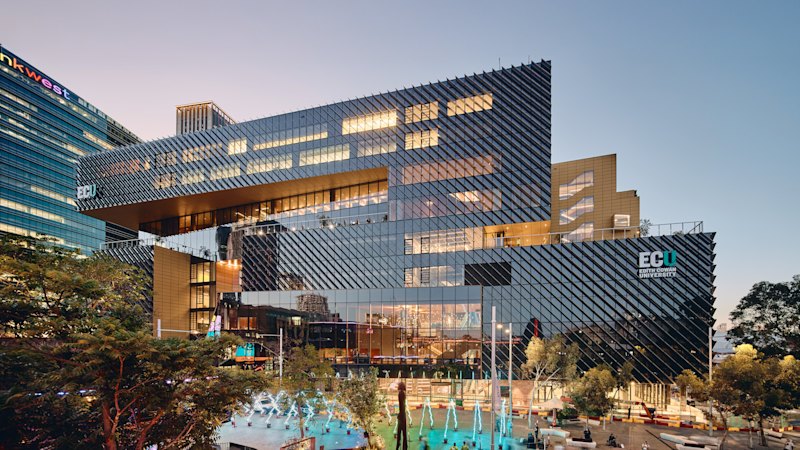
Perth’s newest cultural hub, the Edith Cowan University campus project, has won multiple architectural awards as “a spectacular example” of civic generosity and city revitalisation.
The WA Architecture Awards jury has praised the new ECU City building for linking Perth’s central district back together with a “dramatic new insertion into the blighted and divisive strip of railway land separating the CBD from the entertainment precinct of Northbridge”.
The state’s most prestigious architectural awards, announced at a gala event on Friday, celebrated ECU City by awarding it top prize in four categories, educational, interior and urban architecture, as well as WA’s highest award, the George Temple Poole Award.
ECU City was designed by Melbourne-based architectural firm Lyons with Silver Thomas Hanley and Haworth Tompkins.
“The virtuosity of that building can’t be understated,” said jury chair and architect Peter Hobbs.
“You’ve got a railway line and a bus station underneath it all and six acoustically isolated theatres and recording studios on top. It’s incredible to achieve all that from a technical point of view.”
He said the West Australian-based company Multiplex, recognised as a major global building contractor, deserved credit for meeting ECU City’s extraordinary technical challenge.
“They did it on time and on budget. It’s a world-class building.”
Lead architect Neil Appleton, from Lyons, told WAtoday earlier this year that ECU City’s novel “vertical campus” had emerged from its clients.
“I think what’s amazing about it is that it started with a really visionary idea from the university; they wanted to somehow represent and supercharge the idea of a collision between business, technology, creativity, with WAAPA and the school of arts and humanities, business, law and cybersecurity coming together,” he said.
“We structured the building like a mini city where there are streets in the air, laneways in the air. So it’s like you’re in a city, and you can look into the work going on inside classrooms.”
Hobbs said the $853 million ECU building, which spans 11 floors, is the opposite of a sprawling campus.
“People bump into each other on staircases and escalators. You’re kind of designing interaction and cross-pollination into the building,” he said.
“And it’s a very legible building – you can always tell where you are and it’s got amazing public art within it, like the big screen which is public art.”
In other award categories, Hobbs said a hallmark of this year’s winners were more modest aspirations, innovative solutions, sustainability and adaptive re-use of existing structures.
“The jury identified a ‘more with less’ theme, with architects responding to post-COVID cost increases and current cost of living pressures, managing to stretch budgets and wring every cent of value out of each design decision,” he said.
The jury members noted that several designs resulted in reduced energy demand, with the biggest gains coming from residential structures like Lathlain House, by Silva & Mustard.
“It’s a beautiful house built for the same cost as a project home,” said Hobbs.
“It meets the needs of a household with affordable and flexible designs that adapt to future needs.”
Another smaller scale winner is Marri Pavillions, a shed-prototype retreat set in a native bush landscape by Rezen Studios, using prefabrication, lightweight low-maintenance steel framing, and water-sensitive landscaping.
“Mies van der Rohe said ‘Less is more’, but we are doing more with less,” Hobbs said.
“It’s part of the zeitgeist now – you have the small house movement, modest well-designed houses with the ethical overlay of sustainability. I think that’s really strong.”
An unusual small project winner was St Thomas More Columbarium, or mausoleum, by Simon Pendal Architect.
“It’s a little place where you put ashes, very finely crafted and incredibly thoughtful,” Hobbs said.
Perth’s building tradition of brick work, based on the availability of natural clay, was evident among serious younger designers, he said.
“We do have a very healthy tradition, and there’s been a kind of a bit of a renaissance in brick building again.”
That trend was reflected in an award-winning multi-residential project in Eric Street Cottesloe by Officer Woods Architects.
“Its vocabulary is going back to an austerity era of building forms from the 60s and 70s,” Hobbs said.
Two city precinct projects won in the Commercial Architecture category – Nine The Esplanade by REX and Hassell, and the Enex 100 Redevelopment by Woods Bagot.
The lack of an outright winner in public architecture reflected difficult times for some design and construction projects caught out by post-COVID cost increases and cost of living pressures.
“We’re always competing against the mining sector, which exacerbates the labour shortage and demand for materials. It’s ongoing, and in a housing crisis there’s a lot of pressure for all of those things,” Hobbs said.
“In the apartment area, cost of construction has got to the point where lots of apartment projects can’t proceed because you can’t sell the units at a cost to cover building them.
“Given those circumstances, we identified how architects did well to make sure projects went ahead in some form, demonstrating high levels of ingenuity.
“Architects spend a lot of time juggling budgets and some fantastic work comes out of it as a result.”
 Victoria Laurie is a senior reporter and feature writer who has written for Good Weekend, The Australian, The Bulletin, The Monthly, HQ, Australian Geographic and The Weekend Australian Magazine.
From our partners
Read the full article here