




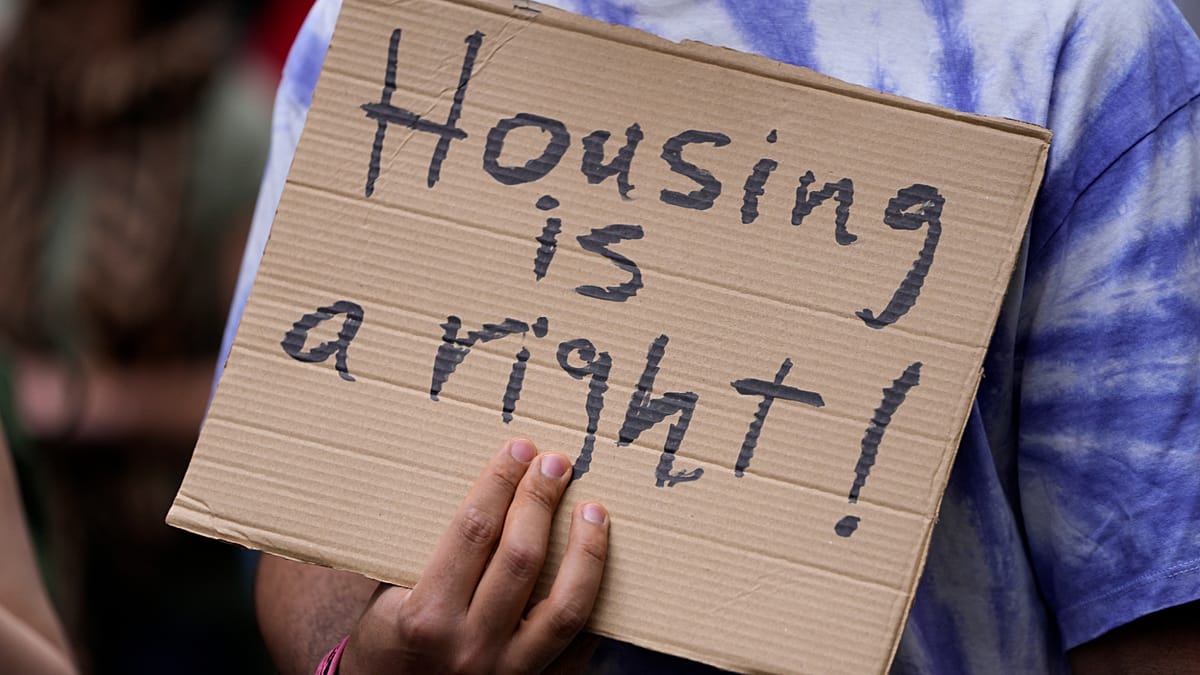
The Irish government has asked Economy Commissioner Valdis Dombrovskis to rethink plans to accelerate permitting procedures, stressing that faster approvals are vital to deliver housing and critical infrastructure. The request comes as the country faces a deepening housing crisis marked by soaring rents, widespread homelessness and chronic supply shortages.
Irish Housing Minister James Browne has recently called on housing developers facing financial strain on cost-rental developments to come forward and engage with his department, in a bid to keep projects viable. His remarks follow the recent collapse of a north Dublin cost-rental scheme, which was deemed financially unworkable.
Browne said there is a “very significant pipeline” of cost-rental developments aimed at workers who earn too much for social housing but are priced out of the private rental market. The social problem extends beyond Ireland, with EU data showing that house prices rose by 53% between 2010 and 2024 and rents by 25%.
EU governments are warning that Brussels’ attempts to simplify regulation through its so-called ‘omnibuses’ could be backfiring, as concerns grow that new rules may actually slow down urgently needed projects, a letter seen by Euronews reveals.
“Greater clarity and coherence of the EU rulebook in the area of EU permitting and environmental law is essential, if we are to drive down costs, build more homes, make a success of the twin transition (…) and stay competitive globally,” reads the letter led by Ireland and backed by six other EU countries.
Alongside Ireland, Austria, Greece, Lithuania, Poland, Slovakia, and Slovenia, argue that the issue is not overregulation but poor alignment of EU laws. While the seven countries support cutting bureaucracy, they warn that current proposals may do the opposite.
Europe’s sluggish permitting processes
At the heart of the issue is how long it takes to approve major projects in Europe — like housing developments, renewable energy plants, transport networks and digital infrastructure.
These projects are seen as essential for economic growth, energy security and maintaining global competitiveness, but they are often slowed by complex approval processes that involve multiple layers of both EU and national rules.
Governments are calling for clearer, more coherent rules, warning that without better coordination between environmental and business rules, the EU risks undermining both its green transition and its economic competitiveness on the global stage.
The European Commission has tried to fix this by proposing faster environmental assessments. In theory, this should help projects get approved more quickly. But governments say the new rules don’t always fit neatly with existing environmental laws, meaning authorities may struggle to apply them in practice.
Competitiveness, the EU’s mantra
Since the 2024 European elections and the launch of a new European Commission cabinet, EU policymaking has undergone a seismic shift from regulation to deregulation in order to drive competitiveness.
This is in response to sustained weak economic growth, industrial competition from the United States and China and geopolitical instability with the war in the Middle East raising the prospect of long-term high energy prices and inflation. In this context, the ten European Commission ‘Omnibus’ packages — fast-tracked bundles of legislative simplifications — were designed to make Europe move faster and become more investment-friendly.
For the Commission and pro-business voices, simplification is about stripping away administrative hurdles to boost investment and growth. Commissioner Dombrovskis has called it a necessary “deep clean” of EU legislation to sharpen Europe’s competitive edge.
“We set ambitious targets to reduce overall administrative burden by 25% for all businesses, by 35% for SMEs, that would imply cuts in terms of annual administrative costs of some €37.5 billion,” Dombrovskis told Euronews on Friday at the Delphi Economic Forum in Greece, dubbing competitiveness an “overarching priority”.
Critics argue the Omnibus packages are deregulation by stealth, chipping away at key pillars of the Green Deal and weakening environmental and social protections under the banner of efficiency.
“Europeans need housing and energy laws that are put into work – not fewer protections. Today’s housing and energy crises stem from a poorly regulated market that prioritises profit over affordability and sustainability,” said Sonja Leyvraz, policy officer for buildings and circular economy at the NGO European Environmental Bureau.
Read the full article here