




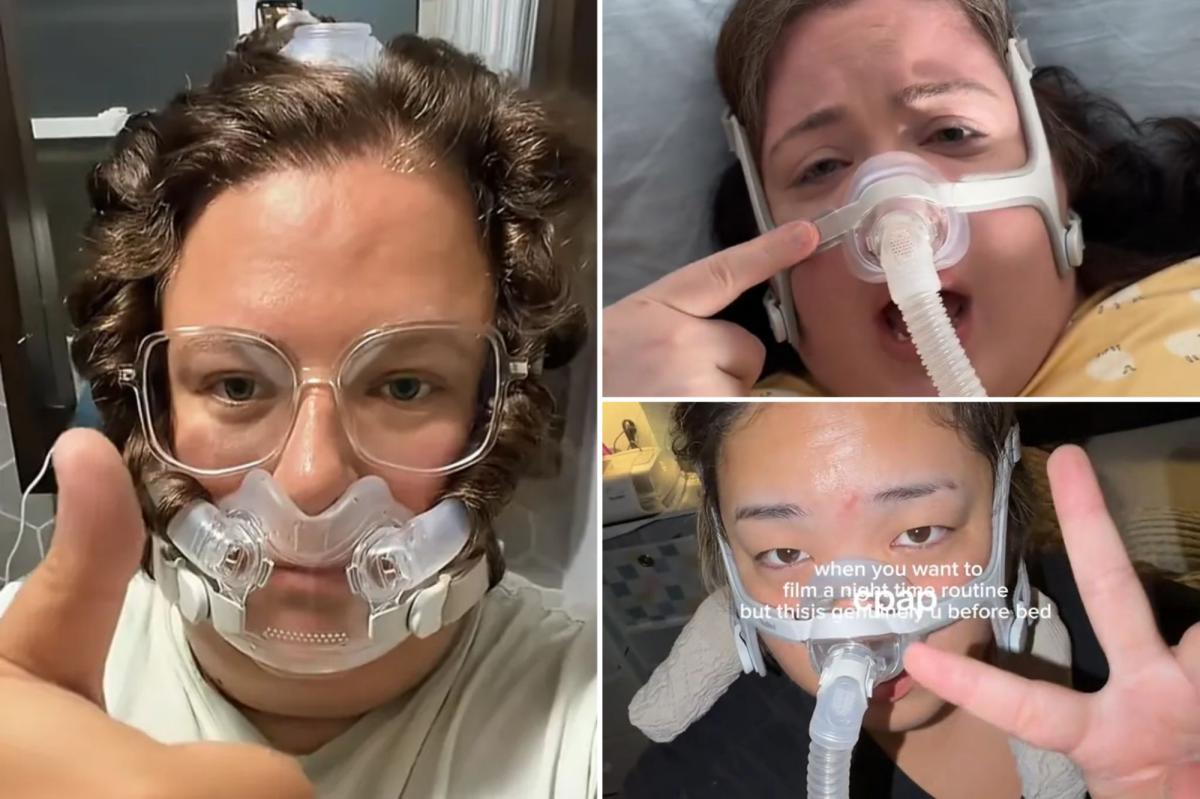
Forget silk rods and curling socks. Kayla Fawcett found a new beauty tool in the last place you’d expect: her CPAP machine.
One night before bed, the Wisconsinite wrapped her hair around the soft tubing of her headgear, clipped it in place and hit record. She sent the video to friends, who convinced her to post it on social media.
By morning, she had a head full of bouncy curls — and a viral hit, racking up more than a million TikTok views and a comment section full of people eager to try it themselves.
“So many women were commenting that this changed their lives,” Fawcett, 32, told The Post. “Others stated that they were encouraged to try using their CPAP again after quitting because, let’s face it, they suck to wear.”
The unexpected hack landed Fawcett in a growing online community giving the once-unglamorous sleep-apnea devices a makeover — pushing back against stigma, challenging stereotypes and celebrating the power of a good night’s rest.
Enter the CPAP baddies: a movement aimed at taking the stigma out of wearing a continuous positive airway pressure device — and having some fun with it.
“CPAP users are more than weird old uncles that snore loudly. We’re young, we’re sexy and not afraid to say it with our masks on — and that’s baddie behavior,” said Rogue Schmidt, a 31-year-old who uses the device to treat “severe” sleep apnea.
“Say what you want about an algorithm or TikTok trend but I think if I had seen more people my age talk about sleep disorders, I would have gotten treatment a lot sooner,” she added.
And the stakes are high.
More than 80 million Americans are estimated to have obstructive sleep apnea, or OSA, a chronic condition in which the upper airway partially or completely closes during sleep, repeatedly interrupting breathing.
The disorder can wreak havoc on sleep and leave sufferers with daytime fatigue, trouble concentrating, memory problems, headaches and mood changes.
“I was sleeping 10 to12 hours a night and still drifting off on the train,” said Schmidt, a comedian based in NYC. “My hair was falling out, I was in a constant state of brain fog, and my partner was sleeping in earplugs to drown out my snoring.”
Left untreated, OSA is associated with serious health problems including high blood pressure, stroke, heart disease, Type 2 diabetes, depression and cognitive decline.
The good news? OSA can be managed.
CPAP machines are considered the “gold standard” treatment. The devices use a small motor to push a steady stream of pressurized air through a tube and into a mask, helping keep the airway open during sleep.
Yet despite their effectiveness, many people who could benefit from CPAP therapy don’t use their machines as directed or forgo them altogether.
For some, the problem is physical. The masks can be uncomfortable or cause claustrophobia, while side effects can include skin irritation, dry mouth and difficulty sleeping with the headgear.
But stigma can be just as powerful. Fear of looking unattractive, appearing awkward in front of a partner or being judged by others can keep people from sticking with the treatment.
That’s where the baddies come in.
“At the core, being a CPAP baddie means taking something that’s widely misunderstood and refusing to be embarrassed by it,” said Amber Ana, a CPAP user. “We’re a community of people who are embracing it, being cute while we do it, and not caring about other people’s opinions or stigma.”
The movement is also challenging the stereotype of what someone with OSA looks like. Many people with the condition go undiagnosed, with women, younger adults, those with lower body mass indexes and those with limited access to healthcare often being overlooked because they don’t fit the traditional male-centric patient profile.
For Mabel, a 30-year-old nurse from Los Angeles, it took someone close to her to recognize the warning signs.
“I actually didn’t start using a CPAP until fairly recently. It wasn’t until my boyfriend told me he had watched me stop breathing in my sleep that I realized I should start prioritizing my health more and get it finally checked out,” she said.
“It has been fun to embrace something I used to be ashamed of. And honestly, I’m more focused, I’m happier, I’m more relaxed, and my health markers are better.”
Ashley Noll
“I hope the CPAP baddie trend encourages people to pay attention to the signs their body gives them and prioritize their health,” Mabel added.
The trend is already having a real-world impact.
“I’ve used a CPAP for a couple years, and I was embarrassed about it at the beginning,” said Ashley Noll, a 35-year-old from the Chicago area who went viral after posting a TikTok of herself using her headgear as curlers after seeing Fawcett’s clip.
“My comments filled up with women telling me they’d been putting off sleep study for years, or that they’d stopped wearing their machine because they felt ugly in it and were going to start again,” she said.
But it isn’t just women embracing the label.
“For me, being a ‘CPAP baddie’ is about really doing what I can to care for my health and not being ashamed of the tools and treatments that can help me be the best version of myself,” said Adam Shenk, a 43-year-old from Harrisonburg, Virginia.
“If someone has been on the fence about getting evaluated for sleep apnea or using CPAP, I hope seeing people talk openly and even have fun with it can make that conversation feel a little less intimidating.”
The movement is being spearheaded by Resmed, a respiratory device maker that is seeking to shift the conversation around CPAP therapy and change how people think about sleep apnea.
“We want someone to find CPAP Baddies and think, ‘Where have these people been?’” said John Barger, Resmed’s senior director of brands and one of the CPAP baddies founding members.
He hopes the campaign makes CPAP users feel less alone and self-conscious — and those who are hesitant about treatment feel less intimidated by it.
The message is going wide. Over the past 90 days, Barger said Resmed’s CPAP baddies content has reached more than 16.2 million accounts across Instagram and TikTok, while its accounts have amassed more than 13,000 followers across the platforms.
Individual creators, including those featured in this story, have added hundreds of videos of their own, helping turn a medical routine once shrouded in shame into a source of pride.
And it’s no longer just an online phenomenon. Resmed has begun hosting in-person CPAP baddies events, giving users a chance to meet, swap stories and celebrate their shared experience.
“Movies and TV have always made these things look dorky, and meanwhile, they are literally keeping people alive,” Noll said.
“It has been fun to embrace something I used to be ashamed of,” she said. “And honestly, I’m more focused, I’m happier, I’m more relaxed, and my health markers are better. It’s part of my daily life now and I’m not hiding it.”
Read the full article here