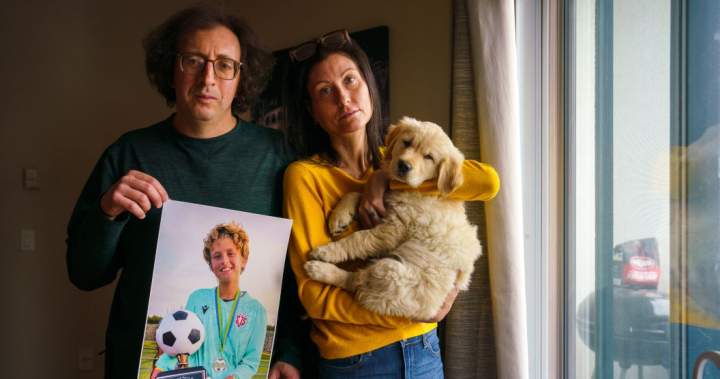
The parents of Henry Losco, a Regina boy who died of carbon monoxide poisoning, are suing the corporations they say were responsible for safety errors that led to his death.
In the statement of claim filed on May 29, Marina Hills and Sergio Losco, the parents of 11-year-old Henry Losco, allege companies including Skyward Living Properties, the property manager responsible for overseeing their downtown apartment where Henry died, failed to protect the building’s residents and caused the avoidable death of their son as well as other harm to the family.
Such harm includes the physical toll on his father from the carbon monoxide leak in their apartment last December, and the mental health issues his mother suffered from after the boy’s death, it says.
The lawsuit claims the building’s maintenance workers, who work for the property management company, were seen removing carbon monoxide detectors in response to complaints about them going off in the Albert Street complex.
Court documents say the workers told residents the “detectors needed to ‘air out,’” and the so-called false alarms were being caused by cigarette smoke.
By removing those detectors, the management company was said to have “deprived the residents of their only warning system against the silent and deadly accumulation of carbon monoxide gas.”
The workers also failed to check if carbon monoxide was present after a resident complained about his personal alarm also detecting the gas, one day after two new boilers were commissioned, in December 2025, the lawsuit said.
Later that day, Henry lay down in his bedroom, lost consciousness and died of carbon monoxide poisoning. His father was also unconscious in the living room but recovered. Marina returned home from work to find her husband and son.

Get daily National news
Get daily Canada news delivered to your inbox so you’ll never miss the day’s top stories.
“Following the incident, the premises were declared uninhabitable,” according to the statement of claim.
A lack of notification, planning and training all led to the suit against the property managers, it claims.
The suit also names the building’s owner, Anderson Holdings; the company responsible for the boiler installation and other work at the property, Anderson Builders; and the company that made the boiler, Ariston Canada, as defendants.
Global News reached out to all four defendants for comment. No responses were received at the time of publication and no statements of defence had been filed.
The allegations have not been tested in court.
Anderson Holdings was responsible for the apartment building’s safety, the documents said. They pointed to several clauses in the lease agreement where the landlord agreed to ensure the building was safe and the tenants could enjoy the property.
By not providing functional carbon monoxide detectors and failing to adequately train staff, the parents claim the owner did not meet the standard of care it owed the family.
Anderson Builders installed two boilers last summer, according to the suit.
“The standard of care required of Anderson Builders included, at a minimum, ensuring the boilers were installed in accordance with all applicable codes, manufacture specifications, and industry standards,” the statement of claims reads.
It alleges the family was harmed by the company’s failure to confirm the installation was done correctly, to avoid carbon monoxide poisoning, and by not doing so, contributed to Henry’s death.
The family’s claims against the boilermaker, Ariston Canada, say it failed to abide by the “well-established principle that a manufacturer owes a duty of care to” the purchaser of its product, as well as the “ultimate consumer,” meaning the residents.
An alleged failure to design, manufacture and supply safe boilers is the basis of their suit against the manufacturer. In March, the company issued a safety notice for all FTG series boilers, which were in the Albert Street apartment building, saying that any made on or before Jan. 8, 2026, should be serviced due to the risk of a carbon monoxide leak.
“The safety notice referenced ‘recent field observations’ indicating the delayed ignition issue, from which the Plaintiffs (Henry, Sergio and Marina) plead that Ariston knew or ought to have known of the defect prior to Dec. 19, 2025,” the statement of claim reads.
A lack of quality control, failure to meet safety standards, and the late notices were listed as other ways the manufacturer failed its duty of care in the statement of claim.
Henry’s family is seeking unspecified damages from all four defendants. Numerous reasons are listed, such as compensation for Henry’s pain and suffering before he died, the funeral, burial and memorial expenses, and past and future therapy and grief counselling for his parents.
Both parents are seeking loss-of-income-related damages. Henry’s mother is seeking damages for the mental toll she suffered, and his father has a health-related claim regarding the effects he suffered during and following the poisoning.
No specific dollar value is requested in the documents, and the family said the amount they are seeking will be determined by the courts.
Read the full article here