Updated ,first published
Four Australian soldiers have admitted they killed Afghan nationals on the orders of Ben Roberts-Smith and have given detailed evidence to prosecutors in the war crimes case against him, court documents allege.
The testimony of the soldiers, who have been granted immunity from prosecution for their involvement, was revealed in a police statement of facts, as Roberts-Smith was granted bail by a Sydney court while awaiting trial for five charges of war crime – murder.
New details about one of the alleged victims also emerged from the police document, including how he was punched in the stomach and pushed to the ground while handcuffed by the Victoria Cross recipient, who then ordered the man to be shot.
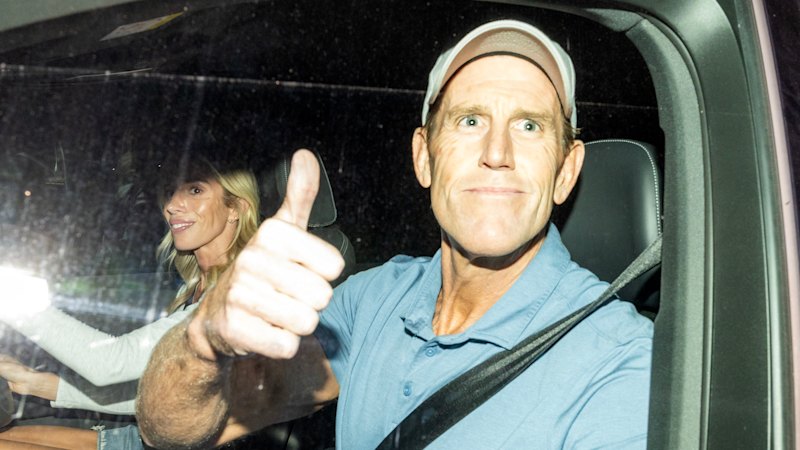
Roberts-Smith was released from Silverwater Correctional Complex in chaotic scenes on Friday night, having spent 10 days in custody.
Corrective Services officers escorted him out through a back exit of the facility, avoiding a waiting media throng at the front gate.
Officers obstructed the street in an attempt to stop this masthead from photographing Roberts-Smith as he left the complex.
Some officers actively blocked photographs being taken on the roadside, having left their vehicle to intervene. “Stop, stop, you can’t take pictures,” they shouted.
Earlier, Roberts-Smith appeared via video link for his bail hearing in Downing Centre Local Court, dressed in prison greens, sitting bolt upright and with his hair neatly combed. His parents, Len and Sue, had flown into Sydney to support their son and sat in the front row of Court 5.2 for the hearing.
Court documents released after the hearing reveal prosecutors will allege that five people killed by, or on the orders of, the decorated soldier had been unarmed and handcuffed, and evidence was then staged to portray their deaths as legal.
There were “common themes” underlying the five charges of war crime – murder, each allegedly committed, directed or facilitated by Roberts-Smith in Afghanistan, the statement of facts alleges. Three of the four soldiers granted indemnity by the Commonwealth are relevant to the current prosecutions.
The witnesses have given prosecutors written evidence of their personal involvement in executing one or more of the alleged Afghan victims. The soldiers allege they carried out the killings “at the direction or with the complicity” of Roberts-Smith.
The 47-year-old did not react as Judge Greg Grogin granted him bail on “exceptional circumstances” in front of a courtroom packed with dozens of journalists.
“I take it by tonight you will probably be home,” Grogin said.
“Thank you, your honour,” Roberts-Smith replied.
The facts as alleged by the Crown prosecution state that each victim was unarmed and present in a place where it would be suspected insurgents were located. However, in each case, there was no active combat with enemy forces, and Australian troops had control of the battle space.
The alleged victims were handcuffed, detained, and questioned before their alleged execution. Forensic analysis found marks and injuries on the wrists of several of the alleged victims, the alleged facts state.
Evidence was planted or falsely associated with each deceased “to enhance reporting that each of the killings were within the lawful rules of engagement”.
In one instance, Roberts-Smith “threw a grenade” towards those who had been detained, causing it to detonate, to support a “later false claim” that the deaths occurred during legitimate warfare. A handheld radio device was allegedly planted next to the body of another.
In another instance, Roberts-Smith is alleged to have directed a junior to kill an Afghan, telling him to “shoot that c—”, according to the alleged facts.
In granting bail, Grogin found the expected lengthy delays of the coming trial, coupled with issues conferring with his legal team and accessing sensitive documents from prison, meant Roberts-Smith should be released.
“There is no way anyone today can predict what the outcome of the trial would be,” he said.
He agreed that any potential risk of absconding or interfering with witnesses could be managed with strict bail conditions, issuing a warning to Roberts-Smith that he would find himself back in custody should he breach them.
“His arrest would no doubt come very swiftly and he would no doubt find himself again donned in green,” Grogin said.
Along with his parents, who fronted the $250,000 surety for his release, Roberts-Smith was supported by a smattering of supporters inside the courtroom.
Walking out of court following the bail decision, his mother Sue Roberts-Smith told media she supported her son. “I love him,” she said.
Veteran and supporter Trevor Stewart, who attended the proceedings, criticised the cost of bringing the criminal charges.
“He was following orders,” Stewart said outside court, arguing the investigators looking into the allegations weren’t present.
Stewart said he was surprised there weren’t more supporters present, noting the issue had “divided” the veteran community.
A ‘different picture’
Roberts-Smith’s defence team argued he should be granted bail due to the complexity and potential delays in the proceedings, including the need to assess national security documents.
“The prosecution of these allegations will take many, many years and have many twists and turns,” his barrister Slade Howell said.
The defence also said the information to emerge from the criminal trial would be vastly different to what was heard in the long-running defamation trial launched against this masthead.
“By the time all the evidence is disclosed or procured, we say a very different picture may emerge as to the strength of the case,” Howell said.
Roberts-Smith’s lawyers said their client was highly likely to comply with bail conditions, having known for “several years” that he was under criminal investigation and having always returned home after travelling abroad.
Howell suggested Roberts-Smith and his legal team be restricted from knowing details about witnesses and when they were providing statements, noting that more than one witness was “firmly in the prosecution camp” and had been given indemnity.
“If the applicant was foolish enough to attempt to contact, that would be quickly reported and the applicant arrested,” Howell said.
Barrister Simon Buchen, SC, appearing for the Commonwealth Director of Public Prosecutions, said the prosecution relied upon the “gravely serious” nature of the charges, the maximum penalty of life imprisonment, and the strength of the Crown case to argue against bail.
“Forensic evidence, including marks on the wrists of detainees showing evidence of their detention prior to their execution, a large amount of documentation sourced from the Australian Defence Force, and evidence of conduct following the alleged five murders,” the prosecution said.
Grogin said the risks could be managed by the bail conditions, including restricting his travel out of Queensland unless for legal or medical appointments. Roberts-Smith has been restricted from contacting witnesses or those involved with the coming proceedings. He must surrender his passport and can only use one phone and one laptop, the details of which must be provided to police.
Grogin said Roberts-Smith had previously been placed under telephone intercepts, visual surveillance and monitoring that was likely to continue.
Roberts-Smith will next face court on June 5.
Outside Silverwater Correctional Complex, a lone Roberts-Smith supporter waved a placard at passing traffic. “Free Ben Roberts Smith”, the sign read.
The high-profile arrest
The decorated former special forces soldier was arrested on April 7 at Sydney Airport after his plane had touched down from Brisbane, before being transferred to Silverwater Correctional Complex. He had been travelling with his twin teenage daughters and girlfriend Sarah Matulin.
He was charged following a five-year investigation by the Office of the Special Investigator and the Australian Federal Police, examining allegations that Roberts-Smith had executed, or ordered the execution of, five Afghan prisoners and civilians between 2009 and 2012.
It’s expected two dozen SAS soldiers will be subpoenaed to give evidence for the prosecution in the Supreme Court of NSW.
Their testimony will be about what they knew of allegations that Roberts-Smith had executed, or ordered the execution, of five Afghan prisoners and civilians.
Others are also understood to be under active investigation for their own alleged involvement in the deaths crimes.
The court case is expected to proceed over the next two years or more.
 Amber Schultz is a crime and justice reporter with The Sydney Morning Herald.Connect via X or email.
 Jack Gramenz is a breaking news reporter at The Sydney Morning Herald.Connect via email.
From our partners
Read the full article here