





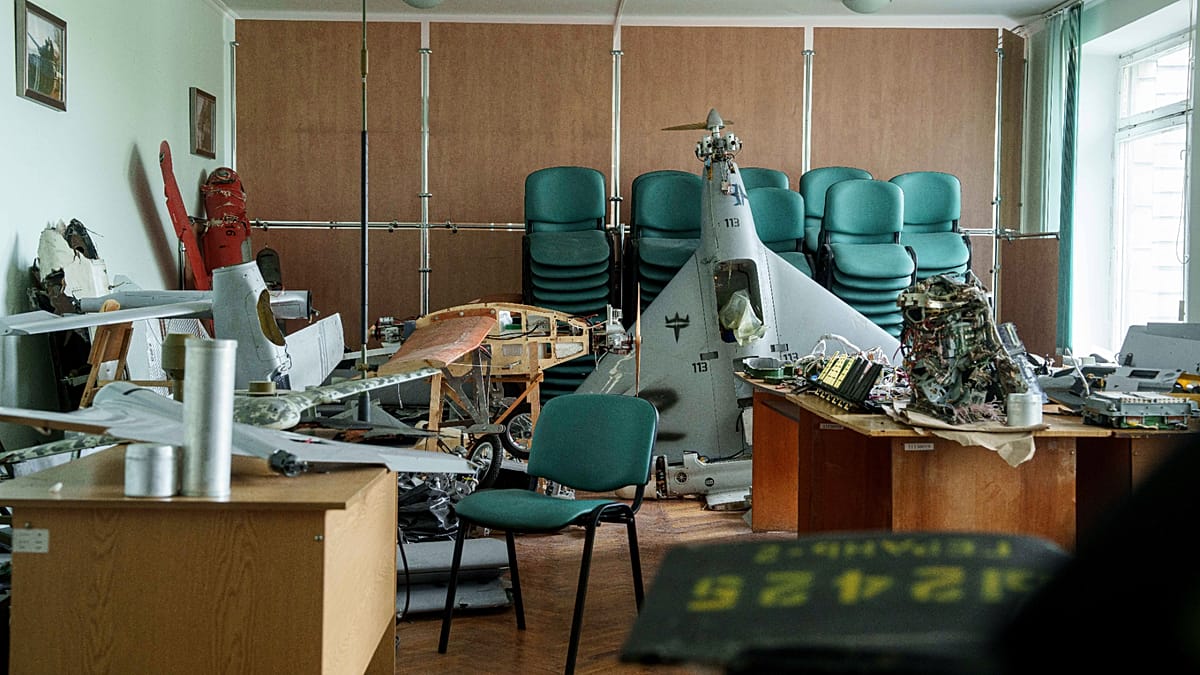
Hundreds of thousands of German-made components are used in Russian drones attacking Ukraine, according to Ukraine’s military intelligence service.
The HUR published a list of components without which Russian drones would not function, many of which originated in Germany.
The War and Sanctions portal lists 137 components from Germany – 59 of them installed in drones. The remainder are found in missiles, radar systems, military vehicles and helicopters.
German transistors in Geran drones
Transistors are the most commonly used components. The HUR published a detailed list of such transistors from Germany, including their manufacturers. One German company name appears repeatedly on the War & Sanctions website: Infineon Technologies.
“Infineon Technologies condemns Russia’s war of aggression against Ukraine. We are deeply concerned when our products are misused for purposes for which they are not intended,” Infineon Technologies told Euronews.
One example is the Geran-5 drone, in which German transistors were found, according to Ukrainian intelligence. The International Institute of Strategic Studies said it is an upgraded, jet-powered variant of the Geran series.
Debris found in Ukraine apparently points to a revised aerodynamic design that more closely resembles a cruise missile.
The drone is said to reach speeds of up to 600 km/h, have a range of around 950 kilometres and carry a payload of about 90 kilograms. The Geran-5 is fitted with a more powerful engine and an aerodynamically optimised design. Compared with the Geran-3, the drone is faster and has a greater range.
Fuel pumps are another component installed in Russian drones. War & Sanctions lists seven parts from the German company Bosch, built into numerous drones, including the Geran-3 and Shahed-136.
“Bosch no longer has any operational business relations with Russia. Nor does the company supply any products or components to Russia. All our units and staff worldwide have been instructed not to conduct any business with Russia or Belarus,” Bosch told Euronews.
Record drone attacks in March
Russia launched 6,462 Shahed-type drones at Ukraine in March 2026, averaging 208 per day – a new record, according to the Institute for Science and International Security.
This surpassed both February 2026 (181 per day) and the previous record in July 2025 (203 per day).
Between 6 pm on 23 March and 6 pm on 24 March, Russia launched 948 Shahed-type drones and 35 missiles – the highest daily drone deployment against Ukraine since the start of the war.
For comparison, in March 2025 drone launches averaged 140 per day. That represented a sharp increase compared with the period from August 2024 to 31 January 2025, when the average was 60 drones per day.
The Shahed-136 is a kamikaze drone developed in Iran and designed to strike ground targets. It has a distinctive delta-wing design and is usually fired in groups from launch racks.
The drone flies relatively slowly and at low altitude and is generally guided by satellite-based navigation. It carries a warhead of around 30 to 50 kilograms and, depending on the mission profile, can reach ranges from several hundred to more than a thousand kilometres.
Because of its relatively simple and inexpensive design, it is considered particularly suitable for saturation attacks. Russia uses the Shahed-136 in its war against Ukraine under the designation Geran-2.
Components in military vehicles
In addition to transistors and pumps, Russia is also using inductors, generators, capacitors, transformers and batteries.
These components are used in the Kamaz-63968, a Russian heavily armoured multipurpose military vehicle developed to transport personnel under combat conditions.
The vehicle has an armoured hull with a V-shaped underbody to protect against mines and improvised explosive devices, as well as modular armour against small-arms fire.
Depending on the configuration, it can carry up to 16 soldiers and can be equipped with modern communications systems and optional remote-controlled weapon stations.
Components from Bosch have also been found in the ZSA-T Linza, a Russian armoured medical evacuation vehicle designed specifically for use in combat zones to recover and transport wounded personnel under armour.
The vehicle offers ballistic protection and a floor designed to withstand mines and improvised explosive devices. Depending on the version, it can carry several wounded people lying down or seated and comes with basic medical equipment for first aid during transport.
Other components can be traced to German manufacturers, including TDK Electronics, Würth Elektronik and Pierburg, a subsidiary of Rheinmetall.
How components reach Russia
Producing Shahed drones in Russia is relatively inexpensive, which is why they are manufactured there on a mass scale, according to The Kyiv Independent.
One European intelligence source told The Kyiv Independent that the Geran-2 drone poses a potential threat to the European Union because of its range of around 2,000 kilometres.
During large-scale Russian air raids on Ukraine, Russian Shahed combat drones have violated the airspace of neighbouring Poland, Romania and Moldova.
In 2025 a Russian Shahed drone failed to explode in Ukraine. It was recovered and dismantled by Ukrainian military intelligence, The Kyiv Independent reported. The Geran-2 had been manufactured at the Russian Kupol plant in Izhevsk.
Among the wreckage, investigators found an encoder produced by the Austrian company ams-OSRAM.
Ukraine’s military intelligence service dated the manufacture of the sensor to 2024, two years after the Kremlin launched its full-scale war against Ukraine and after the EU had imposed export restrictions.
According to a statement from ams-OSRAM cited by The Kyiv Independent, the sensor was shipped in July 2024 to a company in Hong Kong. From there it was forwarded to a firm in China, which the manufacturer regarded as the end user.
Despite a contractual clause prohibiting the product’s use for military purposes, the sensor still ended up in a Russian military drone.
Either the Chinese company sold the sensor to Russia, or it used the Austrian-made sensor as a component in a larger product and then sold that product to Russia, according to The Kyiv Independent.
Third countries named as transit routes
Euronews contacted five German companies, including Infineon Technologies, Rheinmetall, Würth Elektronik, Bosch and TDK Electronics. Three of them replied.
“We are making special efforts and have implemented specific controls to prevent the illegal and abusive use of the products we manufacture. Compliance with applicable laws is of the utmost importance to Infineon, and we have taken extensive measures to ensure compliance with sanctions not only in letter but also in spirit,” Infineon Technologies said**.**
The company said it has not supplied any components to Russia since the start of Moscow’s war of aggression against Ukraine in early 202.
“Immediately after Russia’s attack on Ukraine, Infineon Technologies took comprehensive measures to halt all direct and indirect deliveries to Russia, regardless of the then still existing legal possibility of continuing certain business. As decided in March 2022, the company subsequently wound up its Russian subsidiary,” it said.
Infineon Technologies told Euronews that it blocks delivery systems used for direct or indirect shipments to Russia. “We also sell our products only to customers who are not suspected of doing business with Russia,” the company said.
To prevent misuse, the company relies on a “no-Russia clause”. Every delivery note points out the ban on forwarding goods to Russia and Belarus. If it is established that a business partner is trading with Russia, Infineon Technologies stops supplying that company, it added.
The company said it proactively conducts internal investigations into products and cooperates with the authorities.
However, Infineon Technologies also acknowledged: “What happens to the products thereafter lies outside our direct sphere of influence.” It is extremely difficult to monitor a product’s resale throughout its entire life cycle, the company said.
“We manufacture around 30 billion chips a year. Worldwide, only about 60 states are applying the sanctions, which makes a coordinated and effective international response more difficult,” the company told Euronews.
Some items may be counterfeits, companies say
Bosch commented on the pumps listed by the HUR on its website. “We are generally aware of reports such as the ones you mention,” the company said.
The company said it had examined the information and images. Referring to one case involving a fuel pump, Bosch stated: “Our analysis in the case of one fuel pump showed that this was not a Bosch product.”
Yet the War & Sanctions portal explicitly mentions Bosch pumps and publishes corresponding images.
“In general, fuel pumps of the type in question are sold as mass-produced items in large quantities for use in private vehicles,” the company said. “There are also often counterfeit versions of these products in circulation,” Bosch told Euronews.
“On the basis of our analysis, we assume that this was also the case here and that the item was a fake. In other cases, the material available to us suggests that the products concerned – in this instance electronic components – could possibly be standard off-the-shelf Bosch products that are sold in large volumes for a wide range of applications, for example smartphones,” Bosch told Euronews.
Bosch said it has halted all direct and indirect deliveries of Bosch products to Russia and all services for customers in Russia.
The company said it uses various tools to minimise the risk of circumvention. For example, in dealings with new and existing customers, Bosch pays close attention to potentially critical factors such as unexpected order volumes.
“The end use of our supplies is often unknown because of complex, multi-stage supply chains. It is extremely difficult to monitor subsequent sales following direct distribution over the entire life cycle of a product. It is crucial that all parts of a supply chain comply with existing regulations,” the statement said.
Parallel imports typically occur without the manufacturer’s knowledge and originate from countries that have not imposed sanctions on Russia, the company added. “We have no reliable information on the scale of possible parallel imports, nor is it possible to assess this on the Russian market,” Bosch told Euronews.
Rheinmetall learns of its parts’ fate from authorities
Rheinmetall also responded to Euronews’ enquiry, stating that it fully respects the sanctions on Moscow and is working closely with German authorities on investigating how some of its products made their way to Russia.
“Rheinmetall takes the utmost care to ensure that all domestic and foreign companies within the group comply with all relevant sanctions, including those imposed on Russia,” Rheinmetall said.
In January 2024, the German customs authorities informed Rheinmetall that civilian electric fuel pumps with a production date of July 2020, manufactured for the automotive spare parts market, had reached Russia, the company told Euronews.
“This was not a delivery by Rheinmetall, and we have no knowledge of the export to Russia or of the exporter. We learned of the use in connection with drones from the authorities,” Rheinmetall said.
Rheinmetall had supported them to the best of their ability in clarifying the facts of the matter, the statement said.
“For our automotive customers, we have implemented recommended procedures to prevent circumvention of the sanctions wherever possible. In order not to jeopardise their effectiveness, we refrain from disclosing further details,” Rheinmetall said.
This supports the assumption that German components are being resold to Russia via third countries, where they are removed from finished products and then installed in drones.
Sanctions expert Dr Viktor Winkler told Deutsche Welle that deliveries are increasingly being organised directly through fraudulent shell companies within Germany. These firms buy goods from manufacturers and export them illegally to Russia in breach of sanctions.
Overall, he considers such shipments of military components from Germany to Russia to be legally serious, but isolated cases – especially when compared with other forms of sanctions evasion that are on a far larger scale, such as trade in luxury or consumer goods.
B4Ukraine calls for sanctions reform
Despite extensive EU sanctions against Moscow, technological components that can be used in the arms industry are still making their way from the 27-member bloc to Russia.
According to the War & Sanctions website, most foreign-made components in Russian military equipment come from the United States and China.
The analysis shows that these components reach Russia via a network of intermediaries and trading companies.
The study also suggests that the EU’s current sanctions regime often targets individual companies, while broader trading networks – including illicit firms and distributors – remain beyond the reach of sanctions. This enables export controls to be circumvented and allows the continued supply of technologies that bolster Russia’s military-industrial complex.
The organisation B4Ukraine criticised structural weaknesses in EU sanctions and export control law in a report. These include high evidentiary thresholds for proving knowledge of end use and comparatively limited due diligence obligations for companies.
As a result, European firms may in some cases lack sufficient knowledge of the actual military end use of the goods they export – something two of the companies surveyed confirmed to Euronews.
In individual cases examined, export-controlled machinery was declared as non-controlled via intermediaries in third countries such as Turkey and then forwarded to Russia, in some instances even to companies linked to the original EU exporter, B4Ukraine reports.
B4Ukraine is calling for reforms of EU export control law to make sanctions against Russia easier to enforce and to improve the criminal prosecution of violations.
It proposes lowering the knowledge threshold that triggers an export licence requirement. In future, checks should be mandatory not only when an exporter is certain that goods will be used for military purposes, but when there is suspicion or reasonable cause for concern.
Second, the organisation is calling for mandatory due diligence obligations for exporters. Companies should be required to carry out standardised checks for sensitive goods, obtain specific documentation from customers and heed defined warning signs. If these cannot be dispelled, a duty to notify the authorities or seek authorisation should automatically be triggered – a procedure Bosch has already described to Euronews.
Third, the scope of these obligations should be extended to strategically important industries such as mechanical engineering and components for military production. This would ensure that suspicious deliveries in these sectors are subject to systematically tighter scrutiny.
Overall, the proposal aims to align EU rules with stricter international standards and close loopholes, as European technology exports continue to be viewed as a potential security risk to Russia’s defence industry.
The analysis shows that despite extensive EU sanctions, Western – including German – high-tech components are still ending up in Russian weapons systems. Research indicates that many of these parts originate from complex, hard-to-monitor supply chains and are channelled via intermediaries, third countries or, in some cases, dedicated circumvention structures. Dual-use goods that can be employed for both civilian and military purposes are particularly affected.
At the same time, it is clear that the existing system of sanctions and export controls is reaching its limits in practice. Investigations often result in no criminal consequences, while high legal thresholds and limited due-diligence obligations fail to hold companies sufficiently accountable.
Experts and organisations such as B4Ukraine therefore see structural weaknesses in EU law that facilitate deliberate circumvention.
Against this backdrop, reforms are being demanded that would include lower suspicion thresholds, mandatory checking and documentation requirements and tighter oversight of particularly sensitive industrial sectors. The aim is to increase the effectiveness of sanctions and to better prevent the unwanted military use of European technologies in future.
Read the full article here