





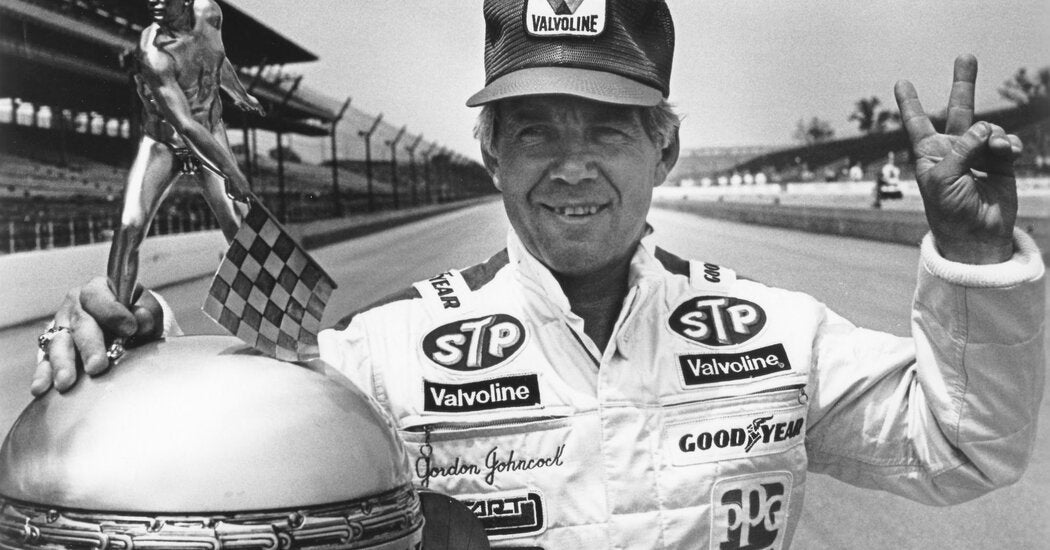
Gordon Johncock, who twice won the Indianapolis 500, the first time in what came to be known as the race everyone wanted to forget, and the second time in one of the most thrilling finishes in the Brickyard’s history, died on Monday at his home in South Branch, Mich. He was 90.
His wife, Suzanne Johncock, confirmed the death.
Johncock was among the premier drivers in the Indy 500, competing in 24 races and finishing eight times in the top five. He won the United States Auto Club title in 1976, edging Johnny Rutherford for most points in 13 open-wheel events.
Johncock’s Indy 500 victories came in 1973 and 1982, each time for Patrick Racing in cars sponsored by Andy Granatelli’s STP oil treatment company.
The ’73 race was shadowed two weeks before its traditional Memorial Day start when Art Pollard, a teammate of Johncock’s, was killed in a crash during time trials.
Soon after the race began, Salt Walther was badly burned and suffered multiple injuries when he crashed into a wire fence. A dozen or so spectators were also hurt. After racing resumed, rain began to fall and a halt was called. It rained again the next day, putting off the race once more.
On the third day, cloudy weather delayed the start for more than five hours. Some 54 minutes into the race, David Earl Savage Jr., who was known as Swede and was another teammate of Johncock’s, crashed into an inner wall. His car exploded, leaving him with severe burns as flames spread along the track.
In pit row, Armando Teran, a member of the STP/Patrick Racing crew, died after he was struck by an emergency vehicle racing to the scene of the accident.
Savage was pulled from the wreckage and hospitalized, and racing resumed about an hour and fifteen minutes after the crash. When rain fell once again, the race was declared over after 133 of the scheduled 200 laps (332.5 of the scheduled 500 miles). Johncock, in an Eagle-Offenhauser, was awarded first place, since he led the most laps, with 64.
After a low-key victory lane celebration, Johncock visited Savage, 26, in the hospital. Savage died a little more than a month later. Walther returned to the Indy 500 in 1974 but was in pain from his injuries for many years.
“That was a bad year — everything went wrong,” Johncock once told the speedway’s website. “My teammate got killed. The race was delayed so many times, and it was a short race.”
Johncock’s second victory in the Indy 500, in 1982, was also preceded by a death at the track. Gordon Smiley was killed during a practice lap two weeks before the race.
That race featured a spectacular duel in the final laps, with Johncock and Rick Mears vying side by side. Johncock, on the inside, driving a Wildcat/Cosworth, finished a few feet ahead of Mears, winning by 16-hundredths of a second, the slimmest margin in the race’s history at the time.
Johncock’s margin now ranks fifth. The closest finish came this year, when Felix Rosenqvist bested David Malukas by 0.0233 seconds.
Johncock announced his retirement shortly before he was scheduled to race in the 1985 Indy 500. But he returned to the Brickyard four more times before retiring for good after the 1992 race.
Gordon Walter Johncock was born on Aug. 5, 1936, in Hastings, Mich., where his parents had a farm. He quit school while a teenager, began competing at small tracks and by the early 1960s was racing in sprint cars. His first Indy race came in 1965.
Johncock was inducted into the International Motorsports Hall of Fame in 1999 and the Motorsports Hall of Fame of America in 2002.
For all his success in auto racing, Johncock had a particular soft spot for another sport. “I can’t say there’s anything I like more than hunting,” he told Sports Illustrated in 1977.
“When I was a kid I used to go rabbit hunting with my dad in Michigan,” he said. “We’d go out early on a winter morning and drive around in the snow. I’d be standing in the pickup’s bed, and when I’d see a rabbit I’d pound my fist on the cab, and dad would stop so I could get a shot.”
He added, “I wish I was still a kid shooting rabbits in the snow.”
In addition to his wife, Johncock’s survivors include his children Peggy, Wally, Patsy, Pam and Gordon, and two stepchildren, Valerie and Traci.
Johncock distanced himself from the motorsports scene in his later years. He and his wife owned and operated a sawmill near their home in South Branch, in northeastern Michigan.
“I’ve never been a person who wanted to be out in public and make appearances — I don’t like that stuff,” he told The Indianapolis Star in 2016.
And the deaths of two drivers and a crewman from his STP team in 1973 had left a scar on his psyche.
“I think it was because of things like that that I really never got that close to another driver,” Johncock once told The Milwaukee Journal Sentinel. “I would do my racing, get in an airplane and go home.”
Francesca Regalado contributed reporting.
Read the full article here