





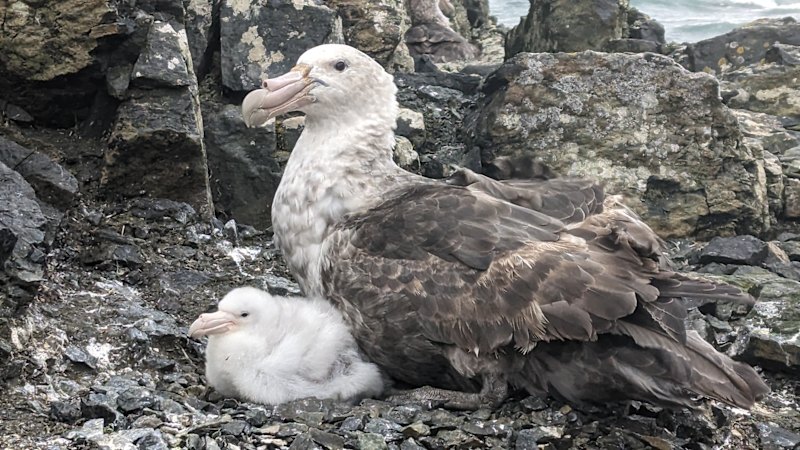
The 500 personnel scouring the state’s beaches for seabirds sick with deadly H5 bird flu are racing against nature’s scavengers, the dingoes, gulls or sea eagles that may serve as the crucial link between sick washed-up seabirds and widespread wildlife disaster.
Surveillance efforts have intensified on the Mid North Coast after a giant petrel found on Bennetts Beach in Hawks Nest, north of Newcastle, was announced on Friday as a suspected case of the dreaded H5N1 virus.
The bird washed up on the beach opposite Cabbage Tree Island, which hosts the key breeding colony of Australia’s rarest seabird, Gould’s petrel. Fears for local wildlife are high as more infected migratory birds from the sub-Antarctic are expected to collapse on Australian shores.
“Worst case is spillover into local birds,” University of Sydney spillover expert Professor Michael Ward said. “Once it’s there, it probably would then circulate forever until it fades out. And there’s not a lot you can do.”
Since a type of the virus called Clade 2.3.4.4b emerged in 2021, it has killed hundreds of millions of birds overseas and left seal colonies rotting on beaches. The government considers the risk to native wildlife as potentially catastrophic.
Wedge-tailed eagles, Tasmanian devils and black swans are among the species at risk of mass death. Experts hold extinction fears for the remaining 12,000 Australian sea lions after the virus slashed adult populations of elephant seals in Argentina by 60 per cent and killed almost all pups. Recovery for those colonies, experts said, could take the length of a human lifetime.
Biosecurity experts have likened the sick seabirds arriving at Australian beaches to ember attacks. Either we find them and stamp them out, or they flare into a bushfire with mass casualties.
Members of the public or trained surveillance staff have found and reported each of the seven petrels and skuas with suspected infection so far, helping douse the spotfires. Many wildlife hospitals and vets now have PPE and quarantine protocols ready after years of preparing for the virus.
But it’s likely that other infected birds have reached the mainland undetected.
Authorities say finding sick birds before scavengers do is crucial. The infected petrel in Hawks Nest could have been picked at by sea eagles or the area’s resident dingoes, ferrying the virus into native wildlife populations. But the race to find washed-up casualties first may be a losing game.
“Scavengers are smarter than us. They can smell and see better than us,” said seabird ecologist Dr Yuna Kim, of BirdLife Australia.
A migratory seabird infecting a waterbird in an estuary or coastal wetland is another pathway to disaster, Ward said. Humans or pets touching infected carcasses would also facilitate spread. Authorities have urged people to look out for dead or sick birds, take photos from a distance, and swiftly report sightings.
Greater risk of mass die-offs arrives with spring, when species such as silver gulls congregate in tightly packed colonies to breed. There is crossover in September and October between migratory sub-Antarctic carrier species remaining in Australian waters as native species gather to breed.
A gull could scavenge an infected migratory seabird carcass and spread the virus into its massive breeding colony. Seals may then eat or interact with gulls left dead, carrying the virus back into their own dense colonies to possibly catastrophic consequences.
It is a grim irony that the first suspected NSW detection of the deadly H5N1 bird flu occurred on the beach just across from the critical breeding site of Australia’s rarest seabird, Gould’s petrel. It was named for John Gould, the ornithology legend who described more than 200 Australian species, including laughing kookaburras and lyrebirds.
This vulnerable bird has endured many threats, including being bombed by the Australian army.
The military used Cabbage Tree Island off Bennetts Beach as wartime target practice for amphibious artillery in 1954, until bird experts warned that they were blasting craters into the endangered creature’s sole breeding site.
The island was gazetted as the John Gould Nature Reserve, the state’s first fauna sanctuary. Gould’s petrel clawed back from 250 breeding pairs to more like 1000, though numbers are sporadic due to climate change.
But even as the spectre of bird flu bears down, the tale of this rosella-sized creature is one of nuanced hope. First, the crevice-dwelling birds have not yet flown back from their winter grounds in the central Pacific, south of Hawaii, and are therefore at little risk from the recent incursion of suspected bird flu.
Even if the virus were to hack permanently into wildlife populations as feared, Gould’s petrel expert Nicholas Carlile isn’t worried about a mass die-off. “Around the world, there has been no population of burrowing, crevice-nesting seabird that’s been significantly impacted by H5N1,” he says.
But the species’ story does point to a key angle of defence against bird flu’s onslaught: given the chance through ecosystem care, native species can withstand and recover from grave threats.
The petrel fought back from extinction because of research and ecosystem management in the 1990s, said Carlile, who worked with the Department of Planning and Environment.
Cabbage Tree Island is the only rainforest island in southern Australia, but rabbits invaded in the early 1900s and tore out its undergrowth.
That left the petrel vulnerable to attack by ravens and currawongs, and their numbers plunged. By eradicating the rabbits, the undergrowth grew back, and the petrels recovered. The species was taken off the endangered species list in 2009, and breeding colonies have now spread to other nearby islands.
As bird flu bears down, and with few practical options to manage the virus directly once it gets into wildlife, BirdLife Australia and the Invasive Species Council have called for $200 million in urgent federal funding to accelerate habitat restoration and control of feral species such as foxes, rats, rabbits and cats.
Species with protected and well-managed habitats have the best chance of surviving bird flu’s deadly threat.
“It is concerning, this virus, but the effort really should be in mitigating the existing threats we already know,” Kim said.
The Examine newsletter explains and analyses science with a rigorous focus on the evidence. Sign up to get it each week.


From our partners
Read the full article here