


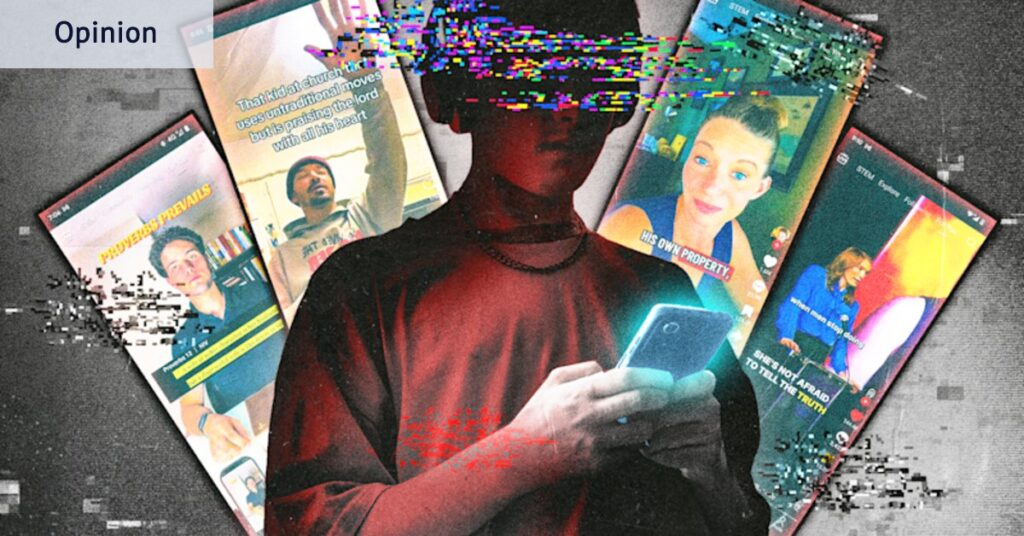
Thirteen minutes of scrolling on social media is all it took for my fake profile of 17-year-old Jaden Michael to be exposed to the manosphere content pipeline.
Toxic online content is increasingly linked to violent sexualised behaviour in young men. Last month, two separate groups of private school boys were charged over the alleged gang rape of girls. A 16-year-old Sydney girl died after a suspected act of strangulation during sex.
The government is considering banning porn which depicts choking alongside a crackdown on social media algorithms serving “rubbish” to children. On Wednesday, Teach Us Consent chief executive Chanel Contos used her National Press Club speech to call for better protection for boys from the manosphere, proposing opt-in algorithms and feeds limited exclusively to subscriber accounts.
Research from Dublin City University found it took just 23 minutes for a new male social media profile to be served misogynistic content. This masthead decided to replicate that 2024 experiment, spending an hour on TikTok, Instagram Reels and YouTube Shorts.
Using a factory-reset phone set-up with a US-based e-SIM (which doesn’t require ID), I set up an account for 17-year-old Jaden Michael. For the first 30 minutes, I was a passive user. After that, I began linking videos and following users who promoted manosphere views.
Here’s how it played out.
TikTok
TikTok was the worst offender, almost immediately promoting gender-war content.
- 13 minutes: I was shown content from Lady J, who criticises feminism and promotes traditional gender roles.
- 18 minutes: I discovered Stay at home Chad, who explains how easy it is to be a stay-at-home parent while criticising mothers who said it was hard.
- 23 minutes: I was shown content from Pearl Davis, who hosts a dating and relationship “debate show”. Pearl questioned a feminist on “what would happen when men stopped doing the dirty and dangerous jobs”. “There’s no gratitude or appreciation. The future is not going to be great for feminism,” she said.
- 24 minutes: Lady J again, stitching a video of a woman reacting negatively to a friend saying she was pregnant with a boy. “Men are a demographic it’s ok to be prejudiced against,” she said.
The cycle continued, with more content from the three influencers. Interestingly, most gender-war content I was shown was presented by women.
- 49 minutes: Here, the religious content began, with a user stitching together videos of women promoting traditional gender roles, featuring proverbs praising “noble” wives.
- 55 minutes: A woman explained that women should treat their husbands “the same way you treat your boss” by dressing nicely with lipstick, smiling, being “agreeable” and “bringing him what he needs before he needs to ask twice”.
TikTok never showed me content depicting a healthy relationship.
Instagram was more reluctant to lead me down the pipeline. Instead of wanting me to rally against women, Instagram’s algorithm wanted me to join a church (perhaps due to the US-linked phone number) and get a girlfriend, but gave me happy relationship content. Couples were giggling, boys were getting their girlfriends flowers, and people were worshipping together.
It wasn’t until the 45-minute mark that Instagram recommended a pick-up artist account praising women who reject male attention as a sign of respect for their partners. Even after following several manosphere figures, Instagram’s feed remained largely filled with mainstream, non-extremist content.
It’s worth noting that last week, Meta, which owns Instagram, added algorithmic restrictions as part of a landmark $24 billion settlement in the US. During the trial, it was accused of fuelling the youth mental health crisis by deliberately designing features that addict children.
YouTube shorts
YouTube, owned by Google, was the worst offender in the 2024 university research. For “Jaden’s” algorithm, however, YouTube was the least offensive (though it served up the most ads – often every second reel – promoting mobile games).
At the 26-minute mark, it showed a reel asking, “which one contains more DNA, [OnlyFans creator] Bonnie Blue or the Omnitrix [a watch that can alter DNA in Cartoon Network’s show Ben 10].”
I then followed three manosphere influencers to see if that would change things. I received content from Joe Rogan, fishing content and Jordan Peterson talking about uncontroversial things like not being dishonest to friends, but nothing more.
Duty of care
I spent just one hour on each platform. Australian teens spent an average of 14.4 hours a week online, according to the e-Safety Commission. TikTok was the fourth-most popular platform with nearly 10 million users – 200,000 of them early teens – in the commission’s 2025 report into how kids were circumventing the social media ban.
It’s concerning, then, in such a short amount of time, “Jaden” was already sent messages telling him that women should be submissive and subservient, promoting division between men and women.
As Contos said on Wednesday, we have a duty of care to protect boys from violent, extremist content.
“We owe it to our boys and young men to not hand-deliver them to an industry that takes their valid concerns, fuels the fire with unfounded grievance and then extracts their strong emotions for profit,” she said.
We also have a duty to protect the girls exposed to such behaviour.
After spending hours scrolling through brain rot, I’m going to step outside and look at a tree, smile at my partner without wearing lipstick and ponder ways to be a “disgraceful” woman.
Get the day’s breaking news, entertainment ideas and a long read to enjoy. Sign up to receive our Evening Edition newsletter.
From our partners
Read the full article here