




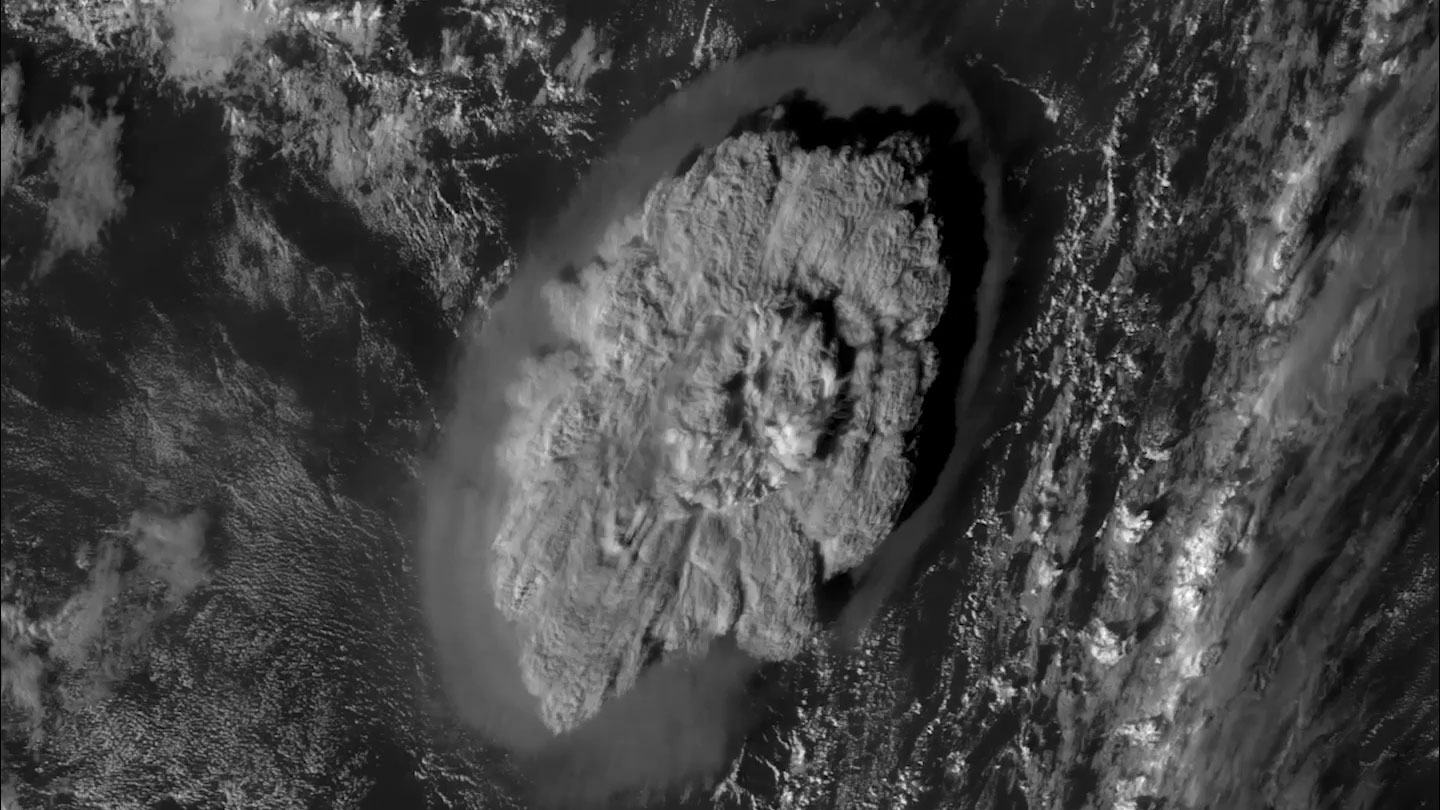
A gigantic underwater volcano became a massive chemistry experiment that could help researchers quantify the success of tactics designed to tackle climate change.
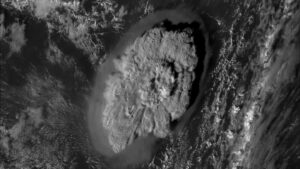
In January 2022, the Hunga Tonga–Hunga Ha’apai volcano in the South Pacific Ocean exploded with the power of several atomic bombs, launching a towering plume of ash, gas and seawater 55 kilometers into the atmosphere. Researchers now report that chemical reactions inside the plume may have partially cleaned up some of the eruption’s own pollution by breaking down methane, a potent greenhouse gas, as revealed by satellite data that tracked methane destruction. The findings, published May 7 in Nature Communications, could help researchers evaluate proposals to accelerate methane removal from the atmosphere, slowing global warming.
Methane is responsible for roughly one-third of present-day global warming. Although methane traps more heat than carbon dioxide, it’s easier to break down, persisting in the atmosphere for only about a decade, compared to the centuries that CO2 lingers. That relatively short lifetime has made methane an attractive target for geoengineering schemes aimed at further accelerating its breakdown.
Having a reliable way to measure success is a prerequisite for attempting any methane removal strategy, says Maarten van Herpen, a physicist with Acacia Impact Innovation, a consulting firm in Heesch, Netherlands. It so happened that the eruption provided van Herpen and colleagues a rare opportunity to test their ability to quantify methane destruction from space. “If we can see it in the volcano, we would also see it in a hypothetical intervention,” van Herpen says.
One way to strip methane molecules apart is with highly reactive chlorine atoms. Earlier work from van Herpen and colleagues suggested that chlorine atoms can form when iron-rich dust blown from the Sahara Desert mixes with salt-rich sea spray — which contains chlorine in a different form — over the Atlantic Ocean. Sunlight drives chemical reactions between the iron and salt, freeing chlorine in a highly reactive atomic form. The team suspected volcanic ash might drive similar reactions, and the 2022 eruption created the perfect setting to test it.
The researchers turned to the European Space Agency’s Tropospheric Monitoring Instrument, a satellite-based tool that monitors air pollution and greenhouse gases globally. Because methane is difficult to measure over the ocean due to the similar wavelengths at which water absorbs light, the team looked for formaldehyde as evidence of reactive chlorine. Formaldehyde is not emitted by volcanoes, but forms as methane degrades. Formaldehyde remained detectable in the volcanic plume for several days, even though it normally breaks down within hours, suggesting that it was being continuously produced by ongoing chemical reactions.
“It is quite surprising that these formaldehyde levels were observed,” says Folkert Boersma, an atmospheric scientist at Wageningen University & Research in the Netherlands who wasn’t involved with the study. “That points to something that I did not know myself.”
The 2022 eruption provided unusually favorable conditions for this chemistry. Chlorine is not usually a major component of volcanic eruptions, but in this case the explosion occurred 150 meters below sea level, lofting more than a hundred million metric tons of salty water into the atmosphere. Researchers estimate that chlorine-driven reactions destroyed roughly 900 tons of methane per day after the eruption. This is a modest amount relative to the explosion’s estimated total methane emission of 300,000 tons.
However, some researchers think that using chlorine to degrade methane would probably create a bigger problem than methane itself. “I don’t think we should go anywhere near injecting chlorine into the stratosphere. We’ve done that before, and it didn’t go well,” says Pete Edwards, an atmospheric chemist at the University of York, in England, referring to chlorofluorocarbons, the chlorinated chemicals that leaked into the atmosphere from sources including refrigerants and aerosol sprays, responsible for severe ozone depletion and the Antarctic ozone hole. Chlorine is far more likely to react with the atmosphere’s more abundant molecules, such as ozone, than with methane, which is relatively scarce. That’s especially true in the cold stratosphere, where chlorine reacts with ozone about 380 times faster than it does with methane, Edwards says. “Chlorine in the stratosphere is a bad thing.”
Boersma says that before moving forward with any such schemes, the priority should be emitting less methane and CO2. “We all know what to do,” he says. “It’s not shooting chlorine into the stratosphere, it’s just making sure that we reduce emissions.”
Read the full article here