






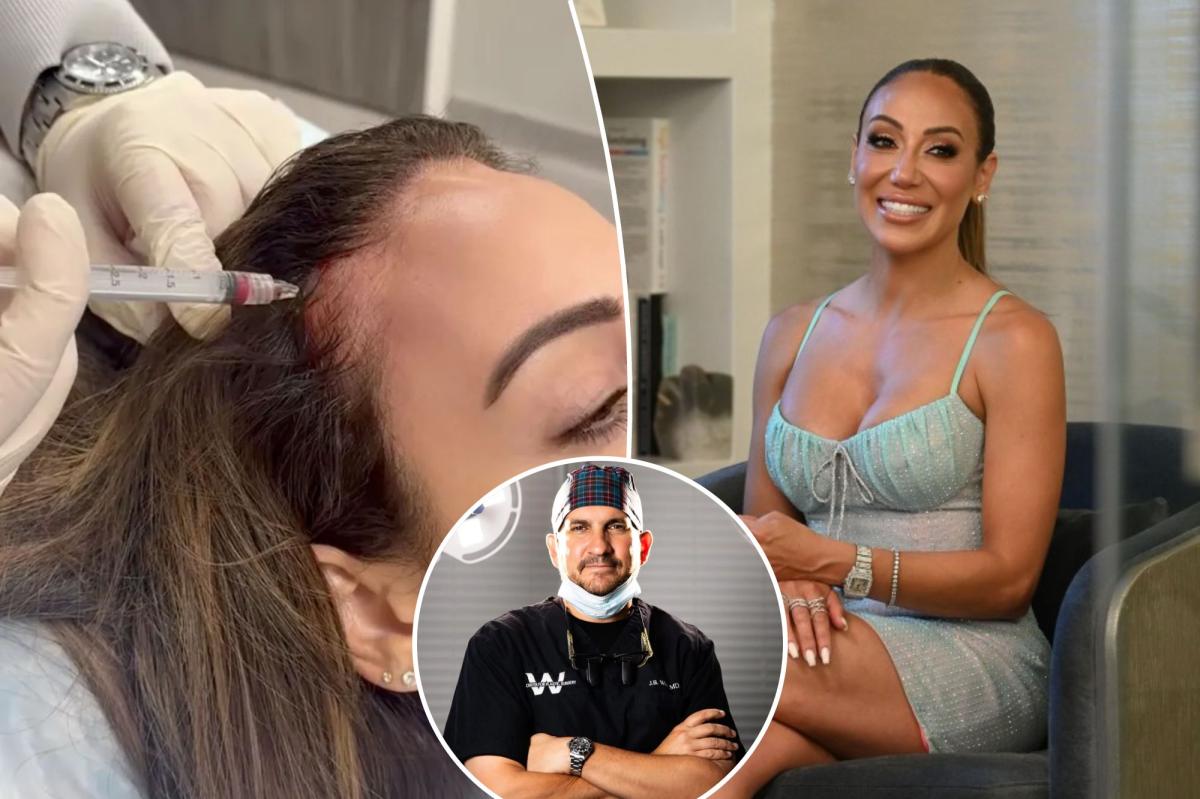
Love a snatched ponytail? Don’t let it snatch your hairline, too.
A self-proclaimed “ponytail girl,” Melissa Gorga took to Instagram to reveal that she’d used regenerative hair loss injectables to keep her hairline looking lush and healthy when pulled back.
“[It’s] starting to thin a little bit, right along my hairline, and it’s gonna help with all of that so I’m excited,” “The Real Housewives of New Jersey” star said from the exam table. “I’m a little nervous. I’m excited for the laughing gas. They numb you and it doesn’t hurt that bad, is what everyone’s saying!”
The mom of three went to see Dr. Jeffrey Wise, a plastic surgeon based in Wayne, New Jersey, to get the treatments done.
Over half of women experience noticeable hair loss in their lifetime, usually at the top of the head near the part — called female pattern hair loss. Wise told the Post that he found mild to moderate thinning around Gorga’s hairline, it wasn’t extreme enough to call for hair transplants.
“We generally reserve hair transplantation for women who have severe thinning, or for correcting areas that are completely devoid of hair,” he explained. But Wise said Melissa “wanted to throw the proverbial kitchen sink at her problem,” so they tried other solutions.
They landed on a combination of platelet-rich plasma (PRP) and exosome therapy to deliver “a substantial dose of stem cells,” which can “wake up” inactive follicles, signaling them to grow and thicken.
Here’s how it works.
What are PRP and exosome therapy?
In PRP, a sample of the patient’s blood is spun in a centrifuge to separate the platelets and plasma from the red blood cells. That platelet-rich plasma is injected into thinning areas.
PRP is often used after injury or surgery because it can help heal diseased or injured tissue, but doctors have found that injecting it into the scalp prolongs the growing phase of hair — especially if the hair loss is recent and early stage.
Wise said PRP — which costs about $1,000 on average, according to RealSelf — helps “reactivate dormant hair follicles, improve hair density and support natural regrowth.”
Exosomes, meanwhile, are a kind of “delivery driver” between cells, transporting proteins, lipids, and RNA. Importantly, they don’t have DNA and aren’t living, so they can’t become harmful or multiply.
They’re “derived from various kinds of cell tissue, from bone marrow and fat cells to amniotic fluid and placental cells,” Wise explained. “They could have up to 15-20 times the number of cellular signals and growth factors as PRP.”
The doc said they’re both outstanding as stand-alone treatments — but combined, they can provide “really beautiful results.” He also has some patients pair them with minoxidil, aka Rogaine.
What’s the treatment like — and when do people see results?
Wise gives patients nitrous oxide, aka laughing gas, and topical numbing ahead of treatment. “Patients often describe the treatments as being mildly uncomfortable, but not painful,” he said.
After injection, patients may get “mild swelling or bruising at the injection sites, which usually resolve within a few days.” He recommends avoiding vigorous activity for a few days to allow the scalp to heal.
Patients should expect to see results gradually, over several weeks after treatment as stimulated hair follicles produce thicker, healthier hair. Results generally peak from six months to about a year, he said.
How women lose hair differently than men
While men are more sensitive to a chemical called DHT in certain areas of a scalp — causing hair loss at the temples and crown — women have a more uniform and lower sensitivity to it. This causes more diffuse hair loss and thinning around the head.
“Female hair loss tends to happen very gradually. The biggest clue might be seeing more hair in the shower drain or on the hair brush,” Wise said.
“Typically, one would start to see a wider part, and notice more of the scalp being visible in bright lighting. Hair would feel thinner, with short wispy hair along the front hairline, and the texture finer and softer, not holding volume as well by mid-day.”
These are signs of female pattern hair loss, which is caused by a mix of genetics, hormones, and aging. But Wise tells The Post that some choices — like hairstyling — can affect hair loss, too.
“Tight hairstyles that involve pulling the hair back, such as braids or tight ponytails, can cause something called traction alopecia,” he explained. “Women who have consistently worn these kinds of hairstyles over the years, with tension on the hair roots, are now becoming more aware of hair loss in those areas. As we have more discourse about hair loss in general, more women are reaching out to find solutions for it.”
There’s only one FDA-approved treatment for female pattern hair loss: topical minoxidil, which is available over the counter. Certain laser and light-therapy devices are also FDA-cleared for hair growth. Finasteride is also FDA-approved, but only for men.
Read the full article here