




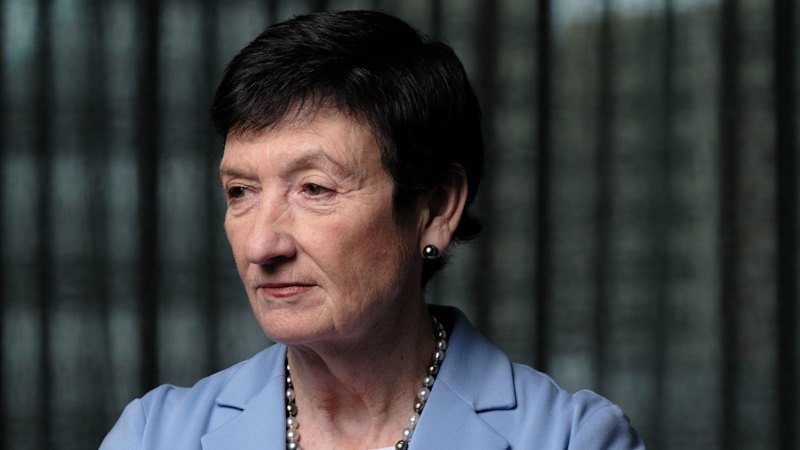
Professor Jennifer Westacott is set to appear before the Royal Commission on Antisemitism and Social Cohesion on Thursday as part of its hearings in Melbourne exploring how universities respond to threats faced by Jewish students and academics.
Below is an excerpt of her submission.
I make this submission in a personal capacity, drawing on my experience as chancellor of Western Sydney University, former chief executive of the Business Council of Australia, and as a guardian of the Dor Foundation. I do not speak on behalf of any institution. I speak as an Australian, and a leader, who has watched, with growing alarm, the unravelling of something we once took for granted: that Jewish Australians could live, study and work in safety and dignity.
I want to be transparent about my personal reasons for speaking out because I think they matter to what this commission needs to understand. My early life was characterised by disadvantage, by moments of family dysfunction, and by sporadic but often severe violence. My father was an antisemite. I remember, as a young child, seeing an image on television of two people in striped prison clothing, hanging by their necks in a street. I must have been visibly distressed, because my father said to me: “Don’t worry, that only happens to the Jews.” I have never been able to shake off the image of their faces. Nor have I been able to shake the question of my own silence as a child and then as a young adult. My fear and my own lack of understanding meant that even as I grew older, I was afraid to challenge his views.
My father’s views were, I now understand, commonplace then, and they remain so in some sections of our society today. The lesson I draw from that is not only personal. Silence, incremental acquiescence, and the comfort of inaction are how hatred gains ground. That is what happened after October 7, 2023, and it is what this commission must help us never repeat.
No one university, no one government department, no single entity, can be held solely responsible. This was a whole-of-nation failure to comprehend, in real time, the seriousness of what was happening and to respond with the urgency and moral clarity it demanded.
With notable exceptions, our leaders did not get on the same page. Universities did not align around a common principle. Business, with some honourable exceptions, was largely silent. Governments at both federal and state levels were slow to act with the decisiveness the moment required.
We allowed, through silence and through a failure of moral clarity, the legitimate grief and anger many Australians felt about events in Gaza to be used as justification, or at least as cover, for antisemitic language, placards, and acts of intimidation directed at Jewish Australians who had nothing to do with the decisions of a foreign government. Holding Jewish Australians responsible for the actions of Israel is not political commentary. It is racism, and it is the oldest and most persistent form of it.
Universities are by their nature places of contest and debate. They should be. Free inquiry, the clash of ideas, and the right to protest are not merely permitted on university campuses; they are essential to the university’s mission. But free speech is a profoundly different concept from hate speech, and what occurred on too many Australian campuses was not free speech. It was hate speech: placards calling for the murder of Jews, chants calling for the annihilation of the Jewish state, behaviour designed to intimidate and to drive fear into a specific group of people. That is not a contest of ideas. That is the deliberate targeting of people because of who they are.
Too many universities hid behind the concept of free speech to avoid taking action, and too many used academic freedom as cover for tolerating what was plainly abhorrent. The result was that Jewish students and staff were left frightened, unsafe and unsupported in institutions that should have been places of safety and learning for everyone. It is also worth noting that the evidence suggests Muslim students were among those who reported feeling unsafe on Australian campuses during this period. An environment in which hatred is normalised is one in which nobody is truly safe, and that is another reason why the failure to act decisively was so damaging and so wrong.
I visited Bondi Beach in the days after the December attack with Jewish friends. It was a place of unspeakable sorrow, a place that had witnessed both cruelty and cowardice, and at the same time, extraordinary bravery from those who ran towards the gunfire. I thought of every Jewish Australian who had spent the previous two years in fear and who deserved better from the country and the institutions that were meant to keep them safe.
I have spoken out on antisemitism because I know what silence costs. I knew it as a child, watching my father’s hatred go unchallenged, and I refused to carry that silence into my professional life. I became a guardian of the Dor Foundation, the Hebrew word for generation, because I believe that generational change is both possible and necessary. That we can build a future in which antisemitism does not merely go into remission, but is actively and permanently dismantled through education, institutional courage and genuine collective leadership.
Jennifer Westacott is the chancellor of Western Sydney University, a guardian of the Dor Foundation, and the former chief executive of the Business Council of Australia.
Start the day with a summary of the day’s most important and interesting stories, analysis and insights. Sign up for our Morning Edition newsletter.
From our partners
Read the full article here