





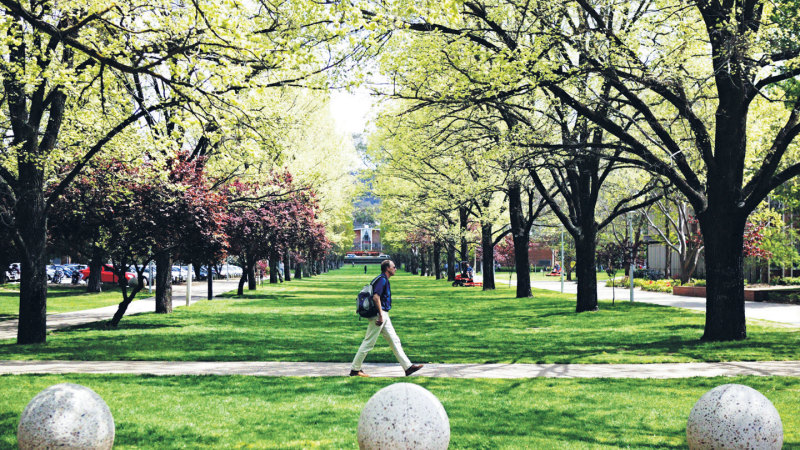
A Jewish student was called a “baby killer” and “genocide supporter” on a prestigious Australian university campus by people taking part in the country’s longest-running university encampment in 2024.
Appearing as part of a two-week block of hearings in Melbourne for the Royal Commission into Antisemitism and Social Cohesion, the student, Liat, was granted partial anonymity and was the first of a number of lived experience witnesses who will not be fully named.
Commissioner Virginia Bell said the hearings were taking place in Melbourne because it was the location of Australia’s largest Jewish population.
Liat on Monday described experiencing a “low-level hum” of antisemitism on campus before October 2023, but said that after the Hamas attack on Israel and Israel’s subsequent war on Gaza, a sense of “pervasive fear” had developed. She told the royal commission she felt the need to hide her identity, to the extent of not using her real name when ordering coffee.
Living as a Jew at the Australian National University (ANU) in Canberra had been “exhausting”, Liat said, and passing the encampment, which was set up in the middle of the campus, was a daily ordeal.
“I felt very physically unsafe when people would laugh and leer at me and say, ‘Look at the baby killer, look at the genocide supporter’,” she said.
Liat said she helped organise a counter-protest of Jewish students on campus, during which a man approached, despite a heavy security presence, and performed a Nazi salute.
After October 2023, the student, who told the commission she was a Zionist, said she lost the vast majority of her non-Jewish friends.
She said one friend told her: “You’re of Israeli heritage, you can’t possibly be my friend.”
In the magazine welcoming students produced by the ANU student association, a line included said: “Zionism is a far-right political project, and the state of Israel is run by war criminals and proponents of genocide”. Liat told the royal commission the statement “portrays Jews as uniquely and distinctly bloodthirsty and murderous” and was an antisemitic trope.
She said she also felt unwelcome when, in a meeting of the student association, fellow students voted to remove a reference that condemned Hamas as a terror organisation.
Bell said on Monday lived experience witnesses would not be cross-examined on their evidence.
Introducing the hearing, Zelie Heger, SC, the counsel assisting the commissioner, said Australian universities carried a “profound duty of care to ensure that everyone feels safe, respected and included”.
Heger acknowledged institutions faced challenges in balancing different rights and freedoms and that, “it’s not always easy to discern when legitimate expressions of opinion cross the line into antisemitism or other forms of racism”.
“Nevertheless, the difficulty of striking that balance cannot be used as an excuse for inaction,” she said.
The hearing comes after the Albanese government’s announcement on Sunday that it would compel all universities to apply clear definitions of racism, including antisemitism, Islamophobia and anti-Aboriginal racism.
Home Affairs Minister Tony Burke said the government would not mandate any current working definition, such as the controversial International Holocaust Remembrance Alliance, and universities would be able to design their own or adopt credible definitions.
Universities will also be required to file annual reports to the regulator, the Tertiary Education Quality Standards Agency.
Universities Australia, the sector’s peak body, last year drafted a new definition of antisemitism and it was endorsed by 39 of its members. The government said campuses would not have to be compliant until January 1, 2027.
Burke said he had used the definition in visa cancellations “to test where there might be an allegation that there’s antisemitism involved”.
Education Minister Jason Clare said the tertiary regulator needed “more teeth, more powers” and should be able to issue fines when institutions fail to act.
“The regulator, at the moment, if it wants to fine a university, needs to go to court,” Clare said. “I figure that that’s not the right approach, and so we’ll introduce legislation to give the regulator more powers over the coming months.”
Speaking after giving her evidence, Liat agreed with the government’s decision to require universities to define antisemitism.
“I don’t think any of these people want to be antisemitic, and if you have a tool – whether that’s a definition or a policy – that tells you how not to be hateful towards a group of people, I see no reason why you wouldn’t want to use that,” she said.
Start the day with a summary of the day’s most important and interesting stories, analysis and insights. Sign up for our Morning Edition newsletter.
 Michael Bachelard is a senior writer and former deputy editor and investigations editor of The Age. He has worked in Canberra, Melbourne and Jakarta, has written two books and won multiple awards for journalism, including the Gold Walkley.Connect via X or email.
From our partners
Read the full article here