



With the United States’ attention locked on Iran, another supreme leader thousands of miles away is leveraging his nuclear-backed geopolitical position to great success.
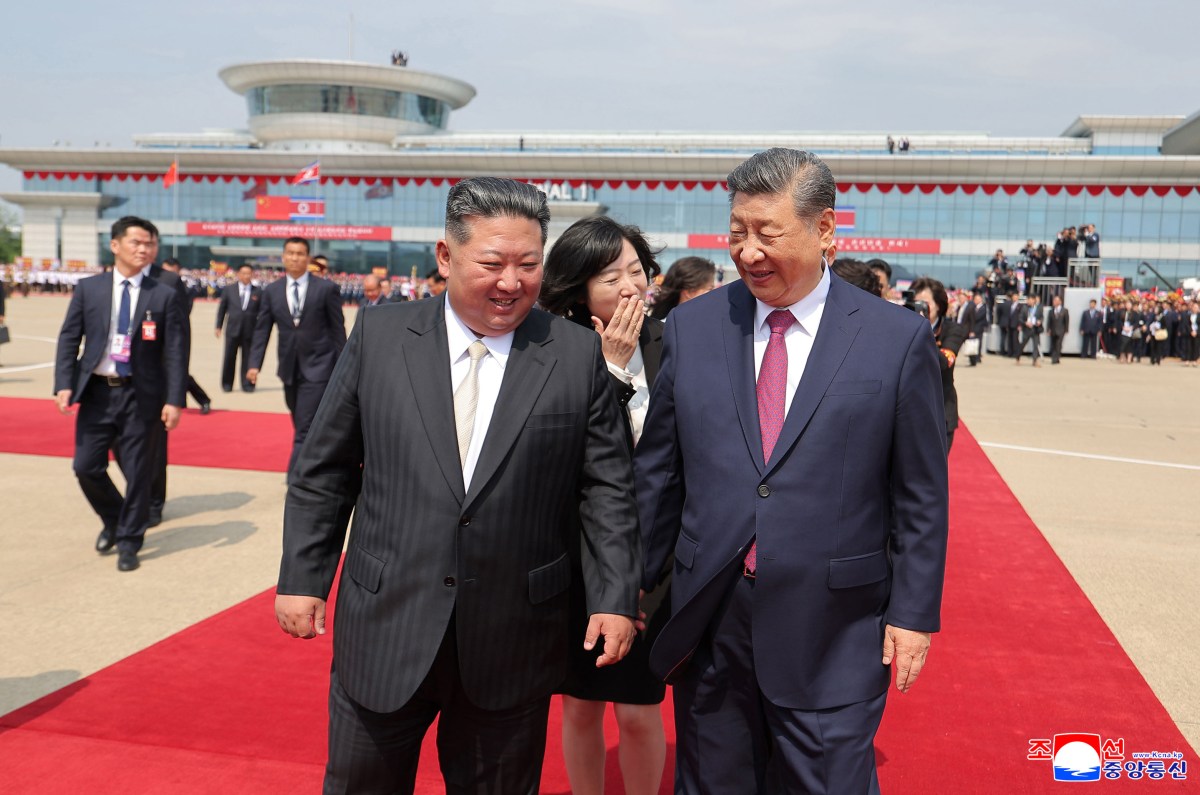
North Korean Supreme Leader Kim Jong Un’s summit earlier this week with Chinese President Xi Jinping in Pyongyang marked not only an affirmation of the two nations’ 65-year mutual defense treaty but an opportunity for the ruler to showcase his status on the world stage.
Just weeks earlier, Xi had received U.S. President Donald Trump and Russian President Vladimir Putin in separate summits in China. Xi’s meeting with Kim, his second since hosting the North Korean leader last September, illustrated the degree to which Beijing views Pyongyang as a relevant player at the highest levels.
“For Kim Jong Un, Xi’s visit demonstrates that North Korea’s geopolitical value has increased substantially,” Uk Yang, researcher at the Asan Institute for Policy Studies and member of the South Korean military’s Joint Chiefs of Staff advisory board, told Newsweek.
“Rather than being merely a dependent partner of either China or Russia, Pyongyang has positioned itself as an increasingly important actor whose strategic relevance has grown alongside the intensification of regional and global competition among major powers,” Yang said.
The Beijing-Moscow-Pyongyang Axis
North Korea already occupies a unique geopolitical standing. The 1961 treaty commemorated this week makes it China’s only official security ally, while a June 2024 pact with Putin marked an elevation of the longstanding Moscow-Pyongyang into another mutual defense framework, one Kim immediately acted on by sending troops to aid Russia in its war with Ukraine.
China has offered a relatively muted response to the tightening Russia-North Korea relationship. At the same time, he has sought to reinforce his ties with both countries, particularly as the U.S. doubles down on military partnerships with its two regional allies, Japan and South Korea.
U.S. officials met with South Korean counterparts on Wednesday to discuss enhancing deterrence measures through their Nuclear Consultative Group. Days earlier, representatives of Washington and Tokyo held talks through a similar initiative known as the Extended Deterrence Dialogue.
“The deepening security cooperation among the United States, South Korea, and Japan provides additional incentives for closer coordination among North Korea, China, and Russia,” Yang said. “All three countries possess nuclear weapons, and each shares an interest in limiting U.S. strategic influence in their respective regions. While it would be premature to describe this as a formal alliance structure, there is a growing convergence of interests among the three countries on key security issues.”
“For Beijing and Moscow, North Korea serves as a useful strategic partner that can create additional challenges for the United States and its allies in Northeast Asia,” Yang added. “For Pyongyang, closer ties with China and Russia help reduce diplomatic isolation, strengthen deterrence, and expand its room for maneuver in dealing with Washington, Seoul, and Tokyo.”
Patrick Cronin, Asia-Pacific security chair at Hudson Institute, identified core aims of both Kim and Xi in their latest encounter.
“Xi strengthens China’s position as gatekeeper for mainland Asia, including the Korean Peninsula; nothing important should happen without checking with Beijing,” Cronin told Newsweek. “Kim wants to burnish his identity as a nuclear-weapon state, en route to gaining a permanent seat at the high table of nuclear powers.”
The Road to Trump
Cronin also observed that “Kim positioned himself to meet with Trump,” who remains the only sitting U.S. president to meet a North Korean ruler.
During his first term, Trump met with Kim three times, part of an attempted peace process that would entail North Korea’s denuclearization in exchange for sanctions relief. When talks unraveled in 2019, hostile rhetoric reemerged, though Kim and Trump have notably avoided direct criticisms of one another.
During a speech to the Supreme People’s Assembly last September, weeks after returning from China, Kim declared his openness to reigniting contact with Washington, on the condition that it abandon “its absurd pursuit of other’s denuclearization” and sought “genuine peaceful coexistence with us.”
“Personally, I still have a good memory of the current U.S. President Trump,” Kim said at the time, according to a readout published by the official Korean Central News Agency.
Trump, for his part, has openly declared his intention to seek another meeting with Kim. He’s also frequently spoken of his “very good relationship” with the North Korean leader, most recently during a press encounter aboard Air Force One on his way to Beijing last month.
Cronin argued that “Trump is eying a summit with Kim,” and may become more active on this front after this year’s midterm elections, potentially on the sidelines of the APEC Economic Leaders’ Meeting set to take place in Shenzhen in the latter half of November.
The goal for Kim would be to capitalize on his personal rapport with Trump to influence U.S. policy in a similar fashion to Xi’s appeal on Taiwan, the self-ruling island claimed by China and supported politically and military by the U.S.
“Kim’s opportunity is to reframe the nuclear issue the way Xi has tried to reframe the Taiwan issue,” Cronin said. “After Beijing, President Trump appeared more willing to adopt the Chinese narrative, blaming Lai Ching-te for cross-Strait tensions, holding an arms sale in abeyance, and stressing Washington’s disinterest in fighting a war in Asia.”
Gilbert Rozman, professor at Princeton University who specializes on Northeast Asia, described Trump as “eager” to meet with Kim, noting that any such summit “would be conditioned on recognition (even if implicit) of North Korea as a ‘nuclear power.'”
Also seeking company with Kim is South Korean President Lee Jae Myung. A revival of inter-Korean dialogue would fulfill “the longstanding desire of Korean progressives, but Kim’s conditions will be hard to satisfy,” Grozman told Newsweek, noting how Kim’s recent meeting with Xi only bolstered North Korea’s diplomatic leverage.
“The Xi-Kim summit opens the door to the breakthrough Kim Jong-un has coveted,” Grozman said. “After tightly sealing North Korea’s borders, he foresees diplomacy on his terms.”
The Iran War Factor
The extent to which another push for peace would prove more successful than the last remains uncertain, however.
Youngjun Kim, professor at the Korea National Defense University who has advised U.S. and South Korean officials on policy, described Trump as a “two-year temporary card to Kim,” meaning “if Kim meets with Trump, it will be just one time show which will strengthen Kim’s reputation.”
A more permanent card is North Korea’s growing and increasingly modernized nuclear arsenal. Pyongyang’s commitment to its nuclear capability has only been further entrenched amid the U.S.-Israeli war against Iran, which has not crossed the nuclear threshold despite advanced uranium enrichment.
Rather than pin hopes on security guarantees from Washington or Seoul, with whom Kim has officially revoked the longstanding policy of reunification, North Korea appears more set than ever on shoring up ties with traditional allies China and Russia.
“Kim has seen Iran and naturally decided that North Korea will never give up its nukes,” Youngjun Kim, who also serves on South Korea’s presidential Peaceful Unification Advisory Board, told Newsweek.
“And Kim destroyed the traditional one-nation unification policy and now chooses a hostile two-Korea policy and will strengthen more stable and predictable partnership with China and Russia,” he added, “and China and Russia will support North Korea’s nukes and survival as well as no sanctions.”
Yang also felt the Iran conflict would only reinforce Kim’s calculus at a time when his “geopolitical strategy today is fundamentally centered on regime survival, nuclear deterrence, and maximizing North Korea’s strategic autonomy in an increasingly competitive international environment.”
“The recent conflict involving Iran is likely to reinforce Pyongyang’s long-held belief that nuclear weapons are the ultimate guarantee of regime security,” Yang said. “North Korean leaders have consistently argued that states without a credible nuclear deterrent remain vulnerable to external military pressure. Recent events are therefore likely to strengthen North Korea’s determination to maintain and further develop its nuclear capabilities.”
“At the same time, Kim appears to have largely abandoned the traditional goal of peaceful reunification and instead seeks to establish North Korea as a permanent nuclear-armed state with international relevance,” he added. “His strategy is to leverage North Korea’s strategic value to both China and Russia while preserving sufficient independence to avoid becoming overly dependent on either partner.”
Read the full article here