





Ljubljana and Zagreb are two seriously underrated capitals.
Both overshadowed by other destinations in their respective countries – Lake Bled for Slovenia, and basically anywhere along the coast for Croatia – these cities are more than overdue their time in the spotlight.
While people have slowly been waking up to the joys of Ljubljana, with its car-free city centre and fantastic creative scene, Zagreb next door hasn’t quite hit the mainstream just yet.
Hopefully we can change that.
(Plus, if after reading all this you still can’t decide between the two you can always “trip-maxx” and visit them both – you can travel between them by bus or train in just two-and-a-half hours).
Ljubljana
One of the things travellers comment on most when talking about Ljubljana is just how walkable it is.
Its centre has been closed to cars and other vehicles since 2007, and it makes the best parts of a European city break – walking around aimlessly and stopping in shops, cafés, and restaurants that catch your eye – infinitely better.
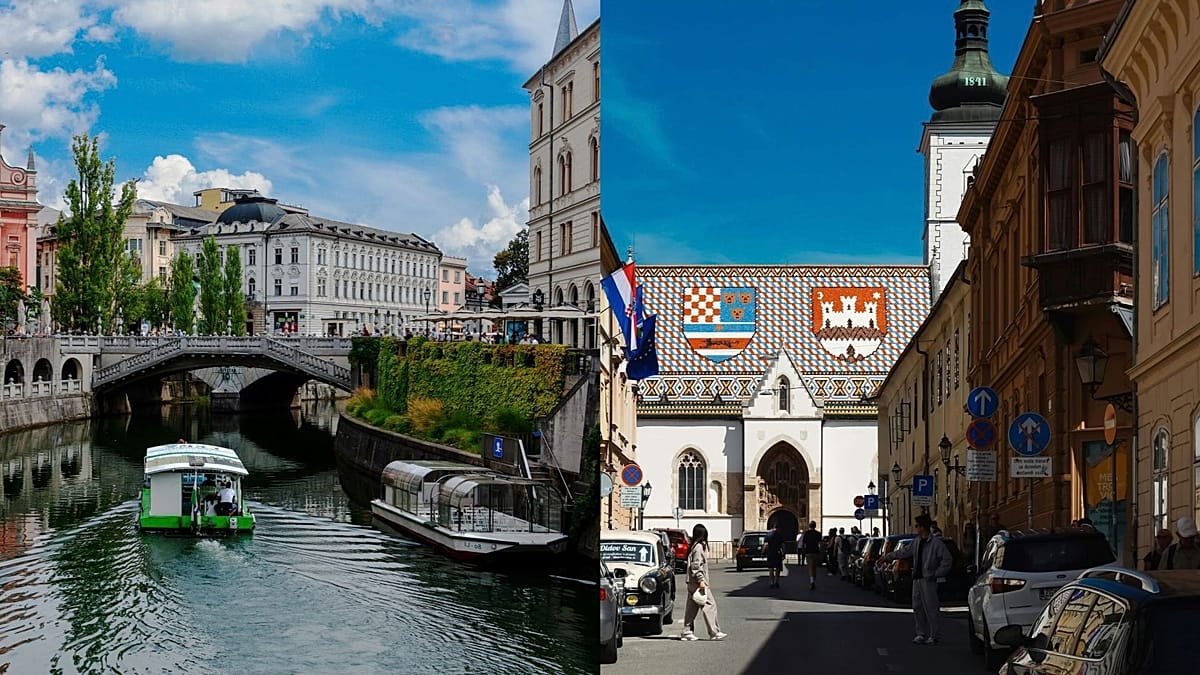
A good place to begin your wandering will be the Triple Bridge over the Ljubljanica River – not just because it’s incredibly central, but the bridges are UNESCO-listed as part of the works of Jože Plečnik in Ljubljana heritage site.
The Slovenian architect played a key role in the development of the city between the two World Wars, and you can see his works along the river embankments and at sites such as the National and University Library or the outdoor theatre Križanke.
For a closer look, you can visit Plečnik House, which offers a deep dive into his best-known buildings (both realised and not), and has his original furniture and tools amongst its collection.
If rambling has your stomach rumbling, head to Trubarjeva Street, which is dotted with independent shops, cafés and restaurants.
While I’ve obviously just spoken about the joys of meandering without a goal in sight, I do have to give a shoutout to Abi Falafel, which serves the best falafel I’ve ever eaten and think about constantly. High praise, given I live in Qatar which has plenty of great options to choose from.
Should you be in town on a Friday between March and October, you could also explore the Open Kitchen food market near the Central Market.
The city’s most iconic sight is, of course, Ljubljana Castle, which sits on a hill above the capital.
Originally built in the 11th century, much of the current structure is from the 15th and 16th century, and visitors can reach it via funicular railway.
Inside, you can learn about the fortress’ history, climb up the viewing tower, or buy a bottle of wine made with grapes on the slopes of the castle’s hill.
Ljubljana is also known for its alternative scene, the most famous of which is Metelkova Mesto, a cultural centre started from a squat in a former military barracks started in the 90s. Today, there are various art spaces here, and you can also attend club nights, the details of which are posted on the Metelkova website.
Zagreb
Croatia’s capital is also plenty walkable, with many of the main tourist attractions concentrated in the Upper Town, although you can also make use of the extensive tram network.
To reach the Upper Town, you’ll pass through the Stone Gate, which dates back to the 13th century.
While you’ll no doubt have been through plenty of medieval gates while visiting other historic cities in Europe, Zagreb is notable for its shrine to Mary, which survived a fire unscathed in the 18th century and now serves as the city’s patron saint.
Zagreb’s most notable – and most colourful – site has to be St. Mark’s Church. First founded in the 13th century, the historic building’s roof tiles show the Zagreb city emblem as well as the coat of arms of Croatia, Slavonia and Dalmatia, the kingdom within the Austro-Hungarian Empire.
Time your visit to then pass by Lotrščak Tower for noon, when the Grič cannon has been fired daily since 1877.
An alternative to your bog standard history or archaeological museums, Zagreb’s Museum of Broken Relationships is a must-visit.
Featuring objects donated by the public from around the globe, you’ll find things inside like the “toaster of vindication”, taken cross country post break-up (“How are you going to toast anything now?”). Both depressing and hilarious, it’s proven so popular in recent years that a second location has since opened in Thailand.
Another popular attraction in the Upper Town is Zagreb Cathedral, but it should be noted that restoration works are still underway following the 2020 Zagreb earthquake.
While the Upper Town is all about medieval history, Zagreb’s Lower Town was built in styles popular in the Austro-Hungarian empire in the 19th and 20th centuries.
There’s plenty of greenery: The area is home to the Green Horseshoe, a U-shaped system of parks in the city’s squares, as well as the Zagreb Botanical Garden.
You’ll also find galleries and museums like the Archeological Museum, Ethnographic Museum and the Museum of Arts and Crafts, while those looking for restaurants, cafés and bars can head to the streets around Ban Jelačić Square.
Read the full article here