




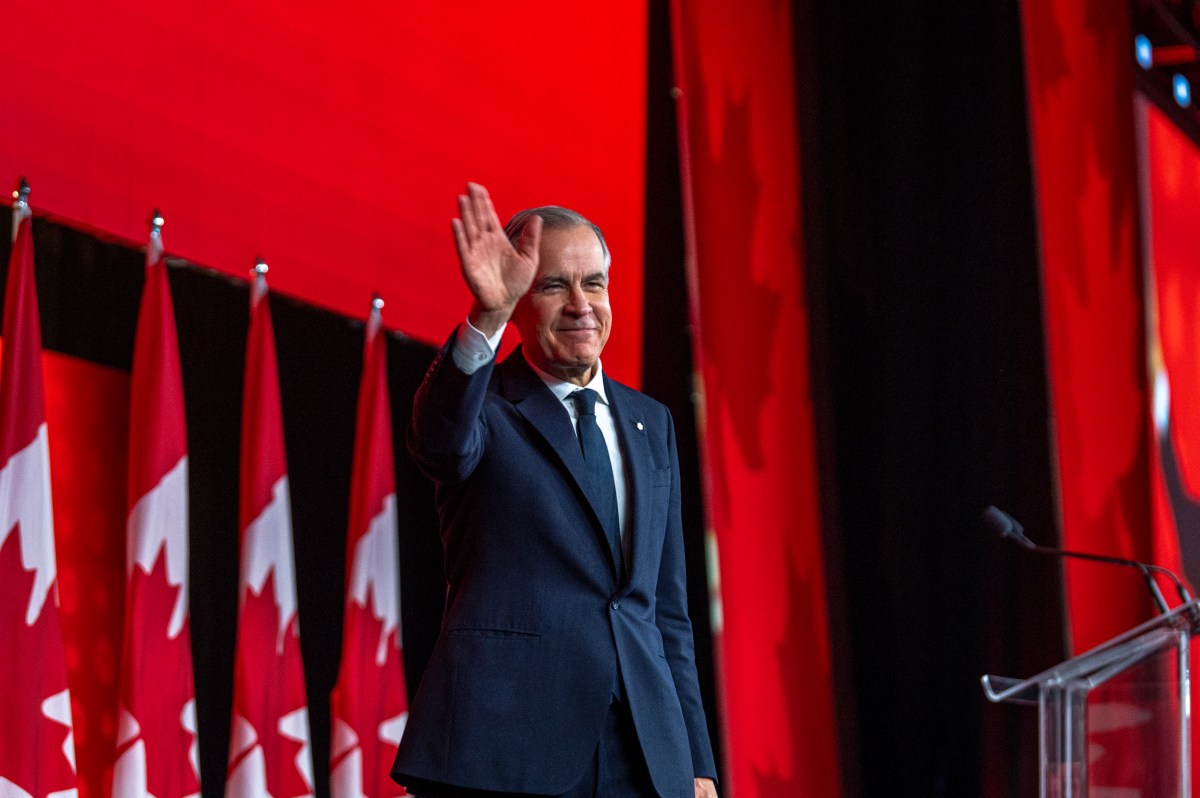
Canada’s Prime Minister Mark Carney secured a majority government following projected victories in two byelections held Monday that pushed his Liberal Party to 173 seats — above the 172-seat threshold — in the 343-seat House of Commons in Ottawa.
Voters cast their ballots in the Toronto-area districts of Scarborough Southwest and University-Rosedale, both longstanding Liberal strongholds. A third byelection was held in the Montreal-area district of Terrebonne, where results are still pending. CBC News projected Liberal wins in both Toronto ridings.
Winning just one of them would have delivered a majority for the Liberals, allowing Carney’s party to pass legislation without opposition support and cement his hold on power until the next scheduled federal election in October 2029.
Carney Boosted by the Trump Effect
Carney had taken office in 2025, after a campaign buoyed in part by public anger over Donald Trump’s repeated threats to annex Canada, placing the former head of the Bank of England at the center of a diplomatic and economic fight with the U.S. president.
“Mark Carney with his steady hand, is perceived by many Canadians as someone who can weather the storm, and of course, the storm is largely about the policies and statements coming from the White House,” Daniel Béland, director of the McGill Institute for the Study of Canada in Montreal, told Newsweek on Monday.
Carney’s speech at the World Economic Forum in Davos in January calling for middle powers in the world to unite was seen as a barely veiled denunciation of Trump following months of the U.S. president calling Canada the 51st state and later imposing tariffs on Canadian goods.
Béland said this sense of crisis created an opportunity for Carney to frame himself as the technocrat-in-chief who could take on Trump. This was in contrast to Pierre Poilievre, the conservative leader, whose style is more populist and framed by Liberals as being too close to Trump for comfort.
The Liberals were behind in the polls under the previous prime minister, Justin Trudeau, but Carney turned the party around since he became leader “in a very specific context that is directly related to the return of Donald Trump to the White House,” Béland added.
Five defections from opposition parties including four from the Conservative party had put Liberals in the driving seat ahead of the byelections sparked by MP departures and contested ballot counting.
Former Liberal cabinet minister Bill Blair left his seat to become Canada’s high commissioner to the U.K. and former cabinet minister Chrystia Freeland resigned to become an economic development adviser to Ukrainian President Volodymyr Zelensky.
In Terrebonne, a heavily francophone electoral district north of Montreal, Liberal candidate Tatiana Auguste had a rematch against Bloc Québécois candidate Nathalie Sinclair-Desgagné.
This followed the overturning of last April’s federal election result in which Auguste was declared the winner by a single vote. Sinclair-Desgagné challenged the result after one of her supporters said her special ballot was never counted and won her case at the Supreme Court of Canada.
The Canadian prime minister may not be on the ballot there but his face is prominent on posters in Terrebonne. “The Liberals are using the popularity of Mark Carney, which is quite strong in Quebec, to help them,” said Béland.
Following Monday’s success, the Liberals’ majority could grow further amid reports that as many as nine MPs are tempted to cross the floor in the coming months, said Béland. “That’s very difficult for Poilievre because that calls into question his leadership if you have quite a few of your MPs who leave your caucus to join the ruling party.”
Read the full article here