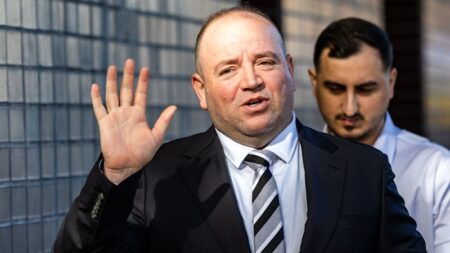





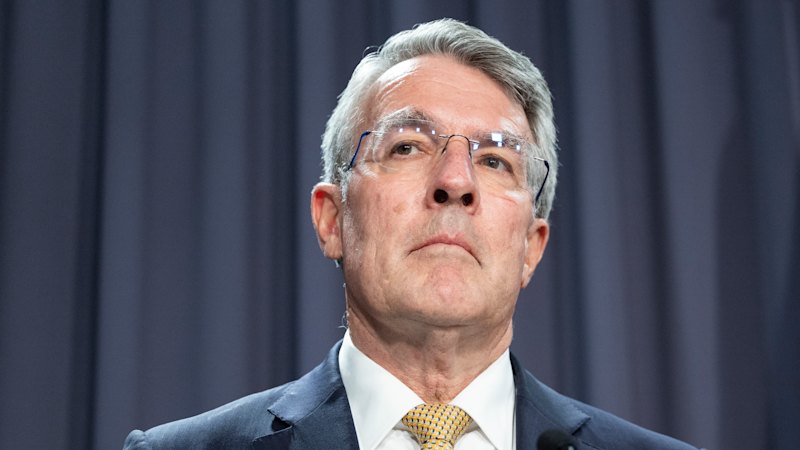
Former attorney-general Mark Dreyfus said Australia should consider banning protests outside synagogues and Jewish schools by introducing laws similar to those that apply to abortion clinics.
Appearing before the Royal Commission on Antisemitism and Social Cohesion on Monday as part of its hearings into security measures, the federal MP said the Jewish community in Australia has been under “constant threat” since October 7, 2023.
Dreyfus said Jewish schools have now “hardened” the exterior of their buildings because of threats against them, and told the commission it should consider recommending new laws “analogous to the restrictions on protest activity around abortion clinics” as part of its eventual report.
“No other religious group in Australia, in going to worship, has to walk past guards. The Jewish community does, in response to a real and assessed risk. No one would wish for this, but it has been necessary, and sadly continues to be necessary,” Dreyfus said.
Speaking of his own personal encounters with antisemitism, the member for Isaacs told Commissioner Virginia Bell that in 2024 he was approached by a man in the street who said: “You are a genocidal Zionist, you should be ashamed of yourself.”
“I had never experienced that form of abuse,” Dreyfus said. “No one had ever hurled abuse at me because I am Jewish.”
About a month later, his electorate office in Melbourne’s south-eastern suburbs was vandalised, with signs painted saying, “Who does Attorney-General Dreyfus serve?”
“It invokes all of those old antisemitic tropes about dual loyalties and treachery to Australia, all of which are false. It’s a deeply wounding attack.”
Dreyfus also said he had been called a “kapo” – a reference to Jews who had cooperated with concentration camp guards during the Holocaust – on social media by Jewish Australians. He said he believed it was because he had been constrained in what he could say publicly by cabinet solidarity.
“I found those attacks from some Jewish Australians particularly difficult and painful,” Dreyfus said.

Having served as the federal first law officer between 2022 and 2025, Dreyfus also told the commission that Australia should again consider legal changes to beef up hate speech laws, establishing a national gun registry, and imposing new restrictions on social media – including a right for Australians to sue social media companies for abuse that appears on their platforms, without having to risk paying the costs.
“Australia can show the way here on legislating rules … and establish an enforceable duty on the social media platforms,” Dreyfus said.
Pointing out the huge wealth of social media companies compared with the relatively small budget of the eSafety commissioner, Dreyfus said that a “private right of action might assist in enforcement of this digital duty”.
“It’s something that pushes the cost onto social media platforms at an early stage, and says you’re going to pay the whole cost of this … it can’t just be left to the safety commissioner,” he said.
Rather than individuals suing for damages, the law could require the social media companies to take down offending comments, Dreyfus said.
Counsel assisting the commission Richard Lancaster, SC, opened the commission’s fifth hearing block on Monday, saying synagogues had been forced to cancel events and services, and observed a “shrinking of Jewish communal life” because of ongoing security issues that included “individuals who waited near the synagogue gate, shouting abuse of those who attended”.
He also quoted a school principal who said students were sitting exams with the equivalent of “20 per cent of their brain switched off” because they were so preoccupied with security measures.
That was “the bandwidth that has to be directed to dealing with the impacts of antisemitism and the consequential physical measures”, Lancaster said.
“That principal and others are right to say that no Australian community should face these conditions.”
Lancaster said this hearing block would contain four categories of evidence – the experience of Jewish Australians under these conditions, the government funding for security, the role of police, and the role of Jewish communal security groups.
Start the day with a summary of the day’s most important and interesting stories, analysis and insights. Sign up for our Morning Edition newsletter.


From our partners
Read the full article here