




Italian Prime Minister Giorgia Meloni has announced that the government is preparing a bill that would ban burqas and niqabs in schools and introduce a limit on the number of foreign pupils in each class.
Several European countries, including France and Belgium, already ban face coverings in public places. Austria has also introduced restrictions in schools. Elsewhere, including Spain and Poland, freedom of conscience and religion is protected by the constitution.
Meloni said a package of measures will soon go before the Italian cabinet, including a ban on burqas and niqabs in schools, a requirement for parents of pupils facing “serious difficulties integrating” into the national school system to learn Italian, and a limit on places for foreign pupils.
Italy heads to the polls next year, with competition intensifying to the right of Meloni’s party following the entry of retired general Roberto Vannacci, who has called for even tougher measures. Migration is a highly political and divisive issue in Italy.
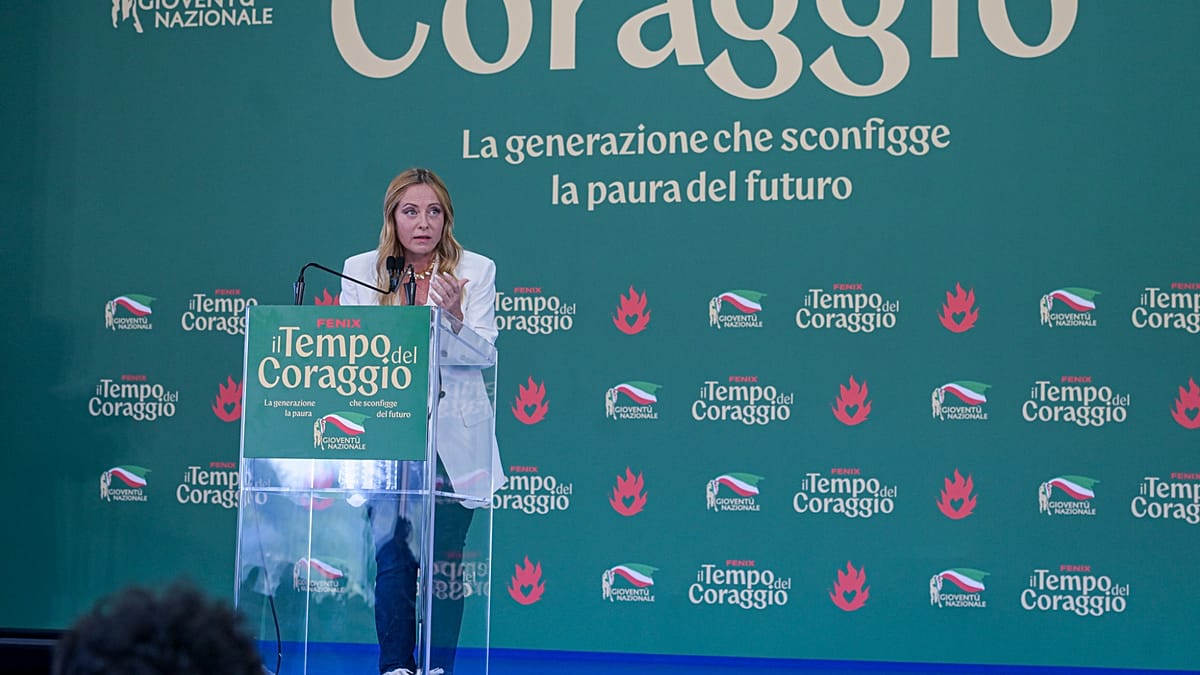
“It is unacceptable that in an Italian classroom the children who end up feeling pushed into a corner are Italian children because they have become the minority. That cannot be allowed,” she said during a rally organised by Gioventù Nazionale, the youth wing of her Brothers of Italy party.
“Calling all this integration is yet another lie, a convenient lie for those who live off ideology, for those who preach to us from their living rooms and then send their own children to schools where this problem does not exist.”
Previous initiatives and legislative proposals
Meloni’s announcement comes after several related initiatives in recent months.
In early August, Education and Merit Minister Giuseppe Valditara proposed action on the full-face veil through an amendment to the security bill.
At the end of July, Futuro Nazionale — the party founded by far-right MEP Roberto Vannacci, who has backed Meloni’s proposal — tabled a resolution against the full-face veil in the Chamber of Deputies’ Culture Committee. It was approved with centre-right votes after being redrafted at the government’s request.
In March, the League introduced a bill in the Senate to amend Article 5 of the 1975 Reale law, which was introduced by then-Justice Minister Oronzo Reale during the Years of Lead to ban face coverings in public places.
The proposed amendment would create a new offence of forcing someone to conceal their face, punishable by one to two years in prison and fines of between €10,000 and €30,000. It would also bar those convicted from obtaining Italian citizenship.
Full-face veils in Europe
Meloni referred specifically to a ban on burqas and niqabs. A burqa traditionally covers the entire body and includes a mesh over the eyes, while a niqab covers the face, leaving only the eyes visible. A hijab, by contrast, covers the hair and neck but leaves the face uncovered.
Several European countries have introduced restrictions on face coverings in public spaces.
France imposed a nationwide ban on concealing the face in public places in April 2011, a measure later upheld by the European Court of Human Rights.
Belgium approved a nationwide ban in July 2011, with fines and prison sentences for violations. Bulgaria has prohibited full-face veils in state, administrative and educational institutions since September 2016.
Austria passed an anti-mask law in October 2017 requiring faces to remain visible in public spaces. From September 2026, girls up to the age of 14 will also be prohibited from wearing at school any veil that “covers the head according to Islamic traditions”.
Denmark introduced a nationwide ban in August 2018, with financial penalties increasing for repeat offences. The Netherlands introduced a partial ban in August 2019 covering schools, hospitals, government offices and public transport.
Switzerland introduced a federal ban on face coverings in public spaces following a national referendum, with the implementing legislation coming into force in 2023. Portugal completed its legislative process in August 2026 with a law banning face coverings in public spaces and imposing financial penalties.
Germany has no nationwide ban, but federal legislation prohibits public employees, judges, members of the armed forces and motorists from covering their faces while driving. Several Länder also restrict full-face veils in schools and universities for students and teachers.
Foreign pupils in the classroom
If Italy introduces a statutory maximum for foreign pupils in each class, it would become the first European country to adopt such a rule, according to the proposal.
Italy already has a 30% limit on non-Italian pupils, set out in a 2010 ministerial circular issued by then-Education Minister Mariastella Gelmini. The limit has often gone unenforced because of local demographic conditions and a lack of flexibility, particularly in urban outskirts.
Other European countries use different approaches.
Denmark has some of the most restrictive policies. The government has allowed upper secondary schools to introduce caps of up to 50% for pupils of “non-Western origin” or from disadvantaged neighbourhoods. Schools can also organise classes based on parents’ income, with the aim of encouraging social and ethnic mixing — a model the Italian government is watching with interest.
In France, quotas based on origin would be unconstitutional because the state does not collect statistics based on ethnic or religious identity. Instead, authorities use “zoning” to redesign school catchment areas, linking working-class and wealthier neighbourhoods. In areas with high concentrations of migrants, the state also reduces the number of pupils per class.
Criticism of Meloni’s proposal
Meloni’s announcement has received support from members of the governing coalition but has also drawn criticism from the opposition and legal experts.
Speaking to ANSA, Salvatore Curreri, a professor of constitutional law at the University of Enna, pointed to Article 34 of the Constitution, which states that “school is open to everyone”, including foreign children.
“If the measure were so restrictive as to uproot minors and their families to other areas, far from where they live, it could prove excessive precisely because it conflicts with the overriding functional aim of integration, with the risk of infringing a right recognised by the constitution,” Curreri said.
Angelo Bonelli, an MP for the Green and Left Alliance (AVS) and co-spokesperson for Green Europe, also criticised the proposal.
“Yet again, instead of dealing with schools, she is chasing the neo-fascist right of AfD and Vannacci, who has proposed separate classes for students with disabilities,” he said. “The truth is that the prime minister is not at all interested in how schools work. Our teachers’ salaries are among the lowest in Europe.”
Read the full article here