





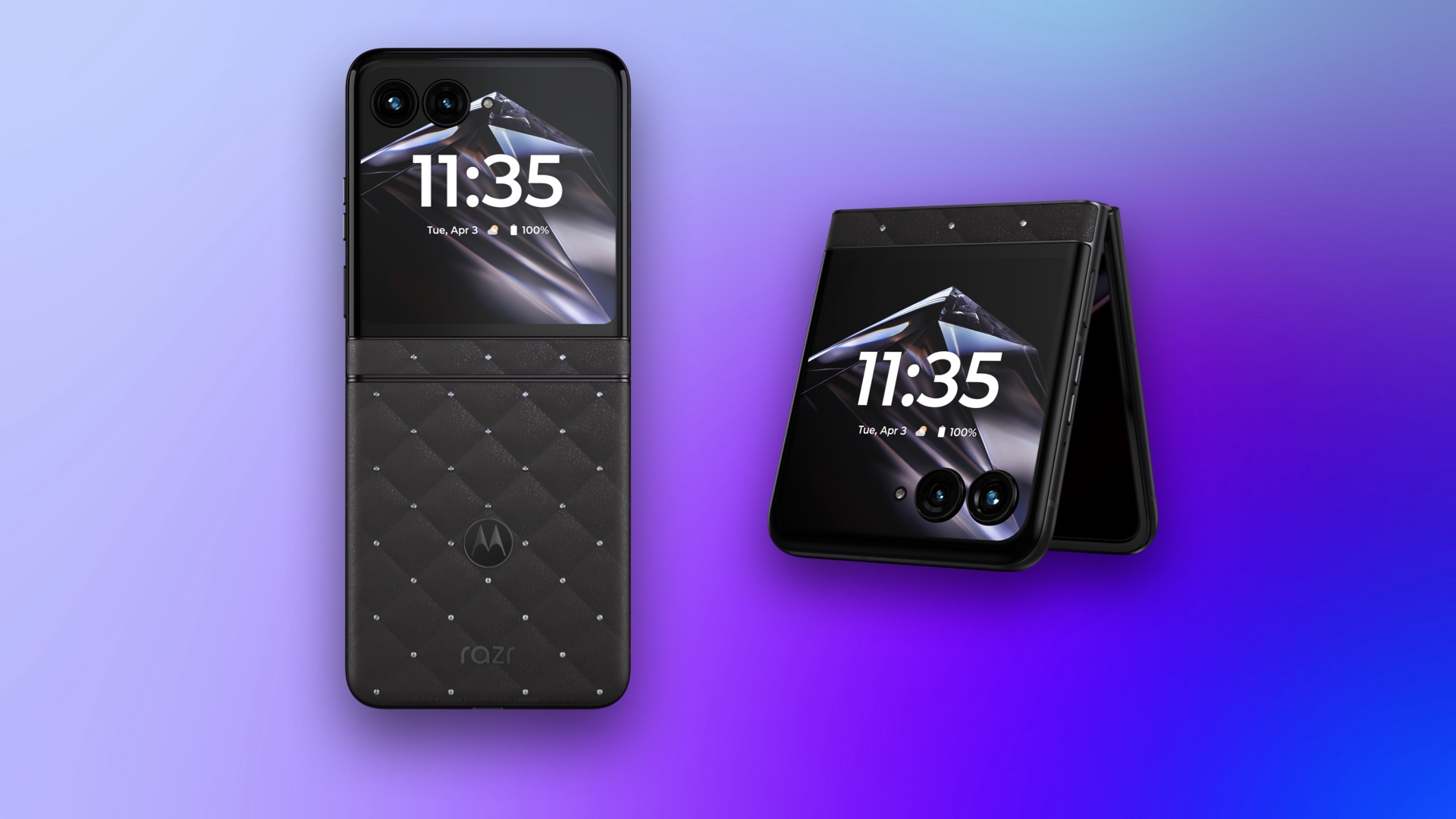
I’ve long admired Motorola’s commitment to making fun phones, and especially fun foldable phones. It’s in the company’s DNA, which is why it’s not a surprise — but still a delight — to see it zhuzh up the already fun and flirty Motorola Razr 2026 (or Razr 70, as it’s known in Europe) with Swarovski crystals and a Pantone meteorite (that’s black, to you and me) color variant.
The phone, which Motorola unveiled at IFA in Berlin, has a quilted back studded with 35 hand-positioned crystals and an additional 32-facet crystal on the hinge for that extra razzle-dazzle. We scored the original version an 8/10 in our review, praising its great cover screen and fast charging capability. This base model retails for $800, but the limited edition Swarovski version is listed for a price of 1,000 euros ($1,159).
Two further phones round out Motorola’s handset offering at IFA: the Motorola Edge 70 Plus and Edge 70 Plus Neo. They’re part of the same line of phones as the Edge 70, announced last November, which stood out for being ultra thin at 5.99mm and having a 4,800-mAh battery.
The Edge 70 Plus and Neo aren’t quite as thin, measuring 8.49mm each, but they have even bigger batteries — a whopping 6,500-mAh and 7,000-mAh, respectively. These phones should easily last you all day and then some.
As well as a slight difference in battery size, the two models are set apart by their cameras. Both have a 2-megapixel macro camera and 32-megapixel front camera, but the Edge 70 Plus has a 200-megapixel main camera, whereas the Edge 70 Plus Neo packs a 50-megapixel Sony LYTIA 710 sensor.
The Neo might boast fewer megapixels, but that Sony sensor marks it out as superior, promising greater dynamic range with less image noise, especially in low-light situations. Keep in mind that more megapixels doesn’t mean a better image — if you’re looking for the phone with the better camera, the Neo is the one for you.
Both phones feature a 6.78-inch Extreme AMOLED screen and should offer strong performance for mid-range devices thanks to a Snapdragon 7s Gen 3 processor. They’ll be available in a range of Pantone shades, including mountain view (green), gray lilac (mauve), milky blue (blue) and sage (a different shade of green).
Moto Watch Ultra
Motorola also unveiled the Moto Watch Ultra at IFA, which is an LTE version of the Moto Watch — a device we reviewed earlier this year. This new watch packs a bigger screen — a 1.5-inch OLED display, compared to the earlier watch’s 1.43 inches, but it’s also a hair thinner at 46mm rather than 47mm.


In our review we praised the watch for its display, its solid battery performance and the partnership with Polar, which continues to lend its science-backed expertise on sleep and activity tracking to Motorola for the Watch Ultra.
We were less impressed with the watch’s running tracking, which overcounted steps. Let’s hope Motorola has fixed this in the Watch Ultra, which also offers a running coach. In Europe, the Watch Ultra’s price is listed as 429 euros ($497) — significantly more than the Moto Watch, which retails for $150.
Motorola’s IFA portfolio is rounded out by the Moto Snap Wireless Charger, which provides up to 25-watt fast wireless charging to Qi-compatible products, and up to 30 watts for supported Motorola devices, thanks to the company’s own charging protocol.
Editors’ note: Katie Collins’ travel costs for the IFA conference were covered in part by Xiaomi. The judgments and opinions of CNET are our own.


See full bio
Read the full article here