





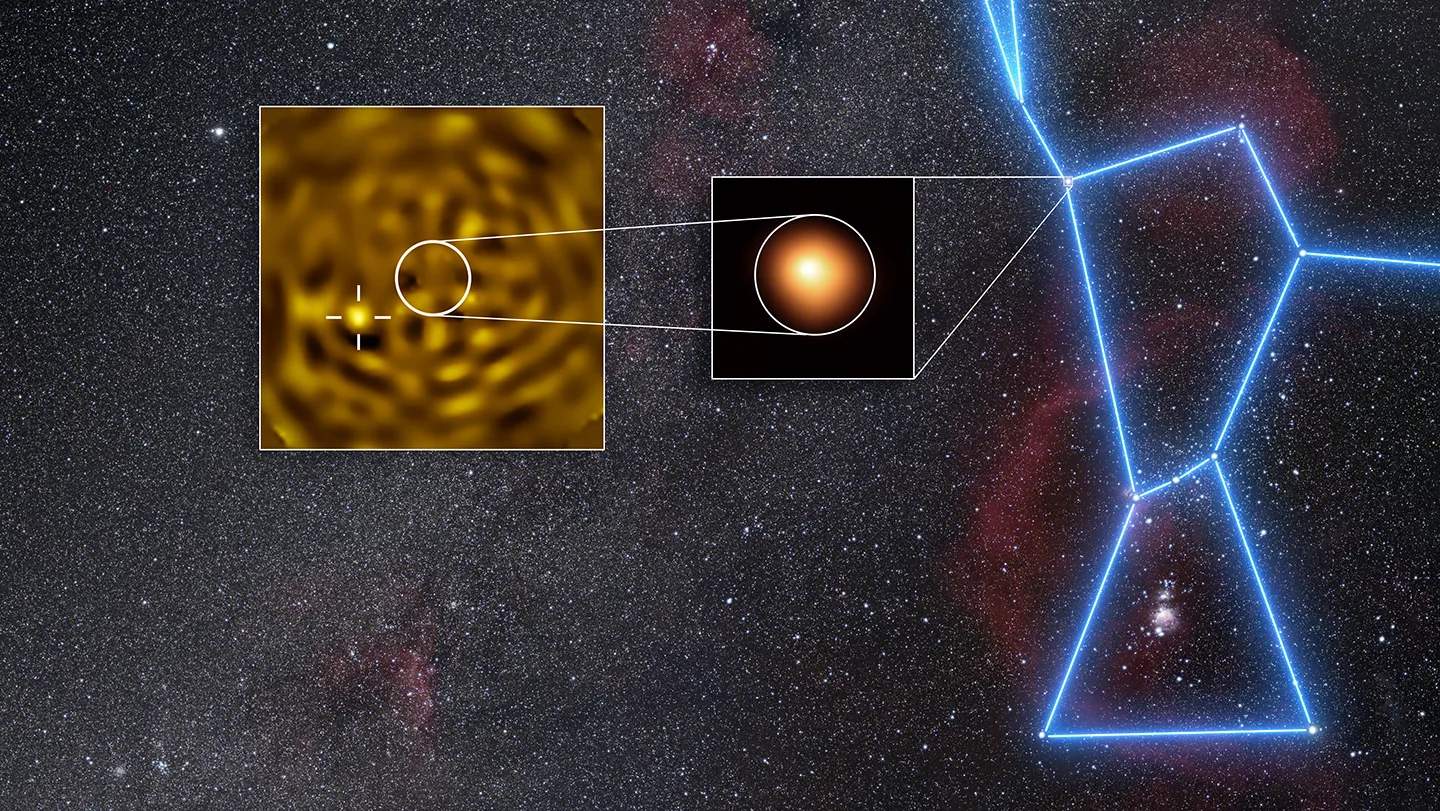
Betelgeuse’s companion star is finally ready for its close-up. Astronomers have taken a clear portrait of an ordinary star orbiting the famed supergiant.
Borrowing imaging techniques from exoplanet hunters, the team captured the dim light of the smaller star amid the light of the huge one. The resulting images are the most definitive detection of Betelgeuse’s buddy yet, the team reports in a paper to appear in Astronomy & Astrophysics.
The red supergiant marks one shoulder of the constellation Orion, making it one of the most recognizable stars in the night sky. “It’s really an iconic star,” says astronomer Andrea Dupree of the Harvard-Smithsonian Center for Astrophysics in Cambridge, Mass.
There have been hints and claims that Betelgeuse has a buddy for more than a century. Betelgeuse’s brightness varies on a complex schedule. Variations every few hundred days are attributed to pulsations inside the star itself. But a longer variation, lasting six years, was more mysterious.
In 2024, astronomers linked that six-year brightness cycle to a smaller star orbiting Betelgeuse. If real, that star would reach its farthest point from Betelgeuse as seen from Earth in December 2024. Another group’s attempt to get the star on film was inconclusive.

Dupree and her colleagues used the SPHERE instrument on the Very Large Telescope in Chile to observe Betelgeuse on two days in December 2024. Dupree was visiting her colleague Miguel Montargès, an astronomer at the Paris Observatory, when he finished processing the images.
“He ran in and said, ‘Oh my god, look! Look what I just found!’” she recalls. The companion star already has a formal name: Siwarha, meaning “her bracelet,” as a reference to Betelgeuse’s Arabic name meaning “hand of the giant.”
Assuming the stars formed at the same time, the companion is 2.6 to 3.1 times the mass of the sun. That’s more massive than originally expected, Dupree says.
Montargès wants to observe Betelgeuse again in late 2027, when Siwarha is expected to appear on the other side of Betelgeuse. That will be convincing, Dupree says. But she’s already fairly convinced.
“Miguel, he’s very conservative. He keeps calling it a candidate,” she says. “But some of us are more uninhibited. We say it’s really there.”
Read the full article here