





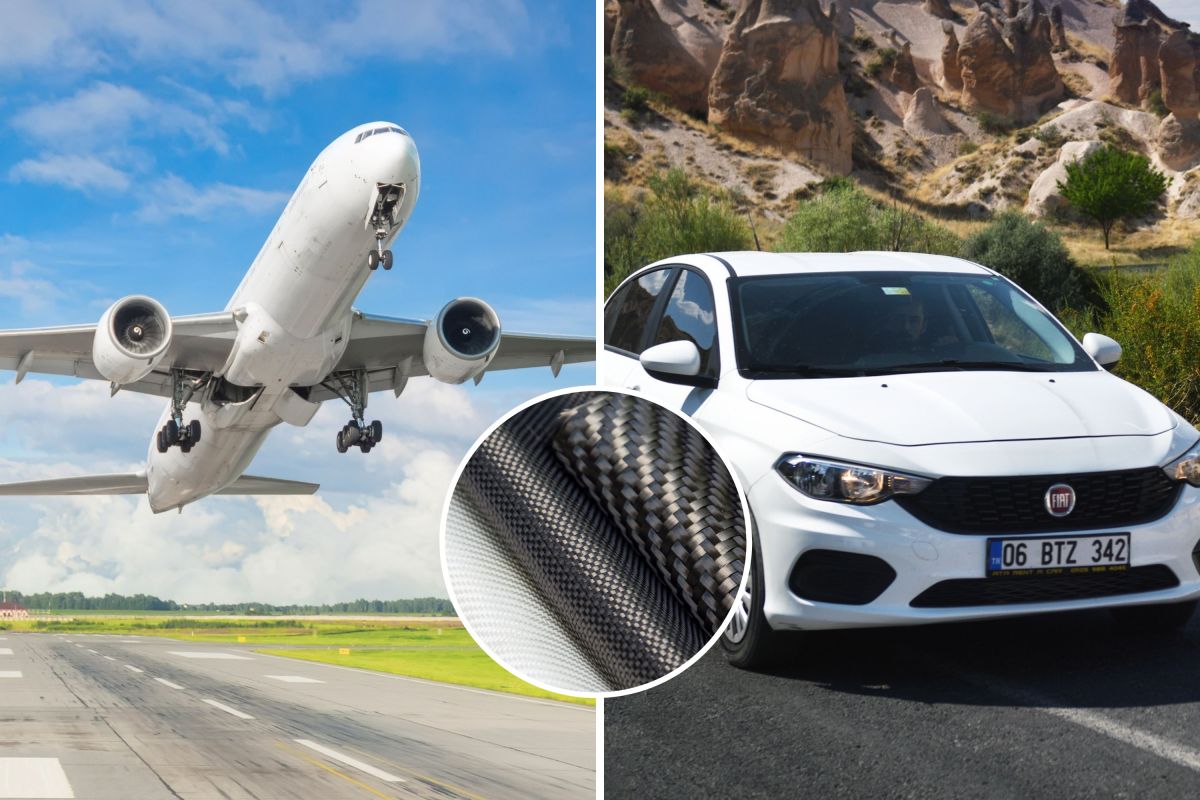
Scientists in the United States have invented a new “self-healing” material that may dramatically expand the life span of parts used for planes, cars and other structures by hundreds of years.
Engineers from North Carolina State University and the University of Houston have built a fiber composite that can repair a common form of internal damage known as delamination more than 1,000 times, which could stretch the lifetime of such composites from decades to centuries.
The breakthrough was unpacked in a study published in Proceedings of the National Academy of Sciences.
Fiber-reinforced polymer (FRP) composites, which offer high strength without the weight, are often used to manufacture planes, cars, wind turbines, and even spacecraft.
However, one downside of FRPs has been interlaminar delamination, which sees the layers inside the composite begin to separate following the formation of cracks. Structural integrity quickly diminishes once this separation begins, and these products end up undergoing a series of inspections, repairs, and part replacements.
Jason Patrick, a civil and environmental engineering professor at North Carolina State University and co-author of the study, told ECONews: “Delamination has been a challenge for FRP composites since the 1930s.” He added that conventional FRP composites typically last around 15 to 40 years.
The findings of the latest study show that “this self-healing strategy for interlaminar fracture” made possible by the newly built material “is repeatable on a scale far exceeding typical composite design lifetimes, thus shedding delamination from structural concern.”
The newly created material looks like a standard FRP composite but comes with two new key features. One of these is a thermoplastic healing agent that was 3D-printed onto the fiber reinforcement, forming a patterned interlayer between the composite’s laminates. This interlayer, which is made from poly (ethylene-co-methacrylic acid), known as EMAA, makes the laminate around two to four times more resistant to delamination from the start, effectively preventing cracks from forming.
The second upgrade to the standard FRP composite has been a set of thin, carbon-based heater layers embedded in the composite. This means that, when an electrical current runs through these layers, they warm up and melt the EMAA interlayer, allowing it to flow into cracks and microfractures and re-bond the damaged interface. So, the composite is designed to reweld itself with material that already exists within the structure.
Jack Turicek, a lead author of the study, said the composite starts out “significantly tougher” than typical ones and resisted cracking better than existing laminated composites for at least 500 cycles. The study found that toughness declines with repeated healing, but “very slowly,” and researchers estimate parts could remain functional for around 125 years with quarterly healing or up to 500 years with annual healing, according to ECONews.
Modern clean-energy and low-emission technologies tend to significantly rely on lightweight composites that are not only challenging to repair but also difficult to recycle. Therefore, they are often replaced rather than fixed.
The newly built fiber composite could be a game-changer for curbing industrial waste if critical parts for structures like aircraft, cars, and wind turbines can be repeatedly repaired using the new material, leading to fewer components being manufactured and scrapped.
Do you have a tip on a science story that Newsweek should be covering? Let us know via life@newsweek.com, and your story could be featured on Newsweek.
Read the full article here